So much of the precepts of men that mingle with scripture are the result of imprecise language. This regrettable human limitation was pointedly lamented by Joseph Smith:
“Oh Lord God deliver us in thy due time from the little narrow prison almost as it were total darkness of paper pen and ink and a crooked, broken, scattered, and imperfect language.”1
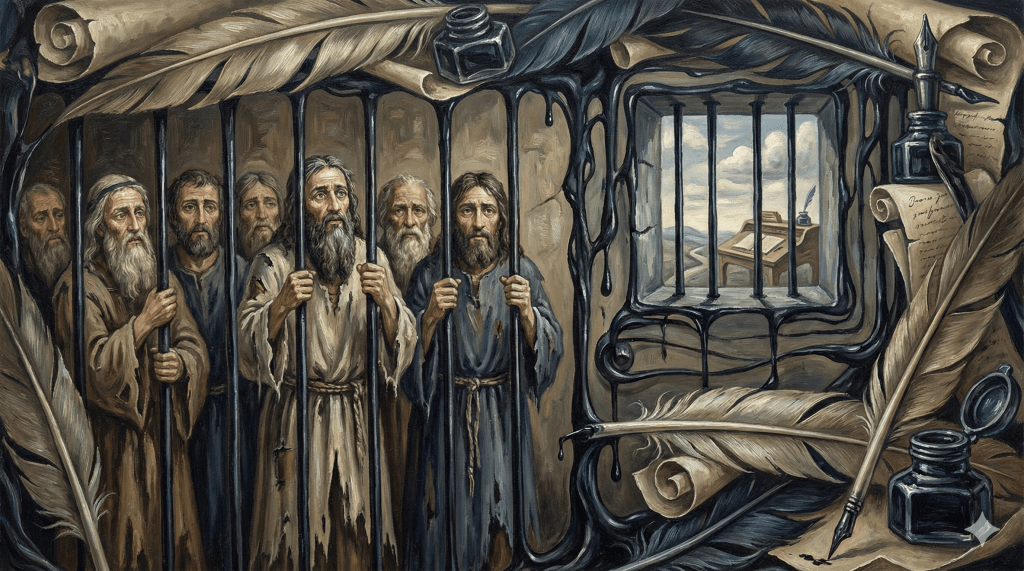
One of the precepts that has crept in unawares due to this ‘narrow prison’ of ‘imperfect language’ is the concept that the priesthood is something added to a person—as if, with the “magic touch” of the laying on of hands, men given the priesthood are literally given something. Terms like “priesthood holder” attest to this misunderstanding and only began to show up in church vernacular in the 1960s. Prior to that time it was not uncommon to refer to “holding the priesthood,” but this phrasing was also used to describe secular or civil office (“so and so has held office in the senate for a number of years”).
Definitionally, it is still true today that the transitive verb “to hold” has multiple meanings. In one sense, it means “to have as a privilege or position of responsibility”—the meaning intended by pre‑1960 references to men “holding” the priesthood; it meant holding a position within it. In other senses, it means “to have or maintain in the grasp” or “to enclose and keep in a container or within bounds,”2 which latter meanings have slowly taken root, with the post‑1960s “priesthood holder” carrying a sense of a person having something within their person. The common use of the ‘crooked, broken, scattered, and imperfect’ verb “to hold” has slowly caused a collective shift in the understanding of what priesthood is!
Pursuant to this definitional collapse has been a general neglect of the etymology of the word “priesthood” itself. Definitionally, it would strictly prohibit anyone from thinking that someone can “hold” something called priesthood. Consider the following summary:
- Greek (πρεσβύτερος, presbyteros) → literally elder; used in early Christian communities for spiritual leaders.
- Latin (presbyter) → adopted in church Latin for “minister or elder.”
- Old English (preost) → Anglicized form from Latin presbyter.
- Middle English (priest) → became the standard word for Christian clergy.
- Old English suffix -hād (-hood) → added to form preosthād (“the office or order of priests”).
- Modern English (priesthood) → by c.1200, “the office, dignity, or body of priests.”
Where originally the priesthood was understood to be a ‘body of priests’—a sacred spiritual corporation or fraternity whose byproduct is power—priesthood has now become synonymous with the power itself. The impact of this shift may seem trivial at first, but by stepping past the notion of an organized body as the preliminary and total definition of priesthood, core concepts—such as what priesthood keys are, how power is derived from priesthood, and the regulating necessity of immutable ordinances—are easily abandoned in favor of a totalitarian attitude of “priesthood is power regardless of form.” And thus the biggest threat to priesthood power—changes in outward form—is given sanction by the body intended to protect itself from those very threats, all because of a slight shift of word use.
There’s a lot to unpack here, and it’s daunting to think that such massive losses of knowledge all stem from believing that men are holding priesthood as opposed to holding a position within the priesthood. So, let’s begin the process of reclaiming the truth through remedial instruction by learning and exploring the definition of the priesthood’s full name according to the scriptures:
The Order of the Son of God
Since the etymology of the word priesthood shows that it literally means an ‘order of priests,’ it behooves us to understand what an “order” is.
Order
- Proto-Indo-European (h₃er- → h₃r̥dʰos) → “to arrange, to put in a row” → “a row, line, arrangement”
- Latin (ōrdō, ōrdinis) → “row, rank, series, class, arrangement; social or clerical rank”
- Late Latin / Medieval Latin (ōrdō ecclesiasticus) → “ecclesiastical rank, the class of the ordained clergy” → “a body bound by religious rule”
- Old French (ordre) → “rank, class, command, rule; monastic or religious order”
- Middle English (ordre → order) → “rule, command, community bound by vows or rule”
- Modern English (order) → “systematic arrangement; a body of clergy or monks under a religious rule”
(Interestingly, the word “ordain” also comes from the Latin ōrdō, thus “to ordain” means to place within the order.)
The connection to a community “bound by rules” (or bound by “orders”) is inherent to the definition of an order as a body of people. Thus an order of priests is not merely a random assemblage of priests with varying customs or traditions, but it is a group of priests organized under definite rules and regulations, or in other words, laws and ordinances. Yes, “ordinances” are decrees to uphold—you guessed it—order:
Ordinance
- Proto-Indo-European (h₃er- → h₃r̥dʰos) → “to arrange, to put in a row” → “a row, line, arrangement”
- Latin (ōrdō, ōrdinis) → “row, rank, series, class, arrangement; social or clerical rank”
- Late Latin / Medieval Latin (ōrdināre) → “to put in order, to arrange, to appoint.”
- Derived noun (ōrdinantia) → “an arrangement, decree, or regulation.”
- Old French (ordenance) → “order, command, directive.”
- Middle English (ordinance) → “a rule, arrangement, or authoritative order.”
So, at its root, ordinance always means something that establishes or preserves order—whether civic or ecclesiastical. In relation to an order then, ordinances help the group to be ‘bound by rules’ that dictate their actions.
Throughout history there have been many orders instituted among men—all branching from the first order established by Adam. This first or original order descended in regular succession through multiple generations, even beyond the flood of Noah, and into the ministry of Melchizedek and beyond. This Holy Order of priests, or “Holy Priesthood,” was, according to a revelation given to Joseph Smith in 1835, originally known as “the Order of the Son of God”:
“There are, in the church, two priesthoods, namely, the Melchizedek and Aaronic, including the Levitical Priesthood. Why the first is called the Melchizedek Priesthood is because Melchizedek was such a great high priest. Before his day it was called the Holy Priesthood, after the Order of the Son of God. But out of respect or reverence to the name of the Supreme Being, to avoid the too frequent repetition of his name, they, the church, in ancient days, called that priesthood after Melchizedek, or the Melchizedek Priesthood. All other authorities or offices in the church are appendages to this priesthood” (D&C 107:1 – 5).
The details of Adam’s antediluvian initiatic order3a are not known through direct descriptions in every particular, but clues and revelations have enabled it to be clearly reconstructed. For example, Abraham informs us that the Egyptians initially attempted to “imitate that order established…in the reign of Adam” (Abr. 1:26). This mimicked order included sacred architecture, rituals, segregated and incrementally holier spaces (i.e., temples), deific recognition of plural marriage (per the Osirian Order, as discussed in another blog post), initiatic mystery rites, and ascending ranks or levels of priests (though the Egyptian translation is “prophet” instead of “priest”). That these Egyptian elements were original to Adam appears substantiated by their preservation under the Law of Moses.
Sometimes orders claim to have been founded in ancient times, such as during the reign of King Solomon under the Law of Moses (as some of the Masonic Order claim); sometimes orders definitionally overlap as business entities or even religions under sociological criteria. A simple comparison draws the point out:
| Corporate Entity | Esoteric Order |
|---|---|
| Charter / Articles of Incorporation | Founding Constitution or Ancient Charges |
| Board of Directors | Grand Lodge / Supreme Council / Governing Body |
| Officers (CEO, Treasurer, etc.) | Worshipful Master, Grand Master, etc. |
| Shareholders | Members / Brethren |
| ID badges with job titles | Ritual vestments / regalia |
| Bylaws and policies | Ritual laws, obligations, and degrees |
| Delegated authority via resolutions | Degrees confer symbolic and administrative powers |
| Purpose: conduct lawful business | Purpose: conduct moral or spiritual work |
| Promotion to higher positions | Ascension to higher degrees |
| Whole corporation is a legal “person” | Symbolic “Body” or Brotherhood |
The parallels are minutely instructive. Take the following example:
A man begins work at a bank (a corporation) and is barely acquainted with its bylaws and policies. Having little confidence from the Board of Directors, and as an agent of the bank, he is granted limited withdrawal rights (no more than $500 at a time). He is given a basic ID badge.
Over time, he proves his trustworthiness through thorough and disciplined adherence to the bylaws and policies. He is promoted for his diligence and knowledge, and his agency is increased to $10,000 at a time. His ID is reprinted with his new title, giving him access to new areas of the bank.
Eventually he is raised even higher—having passed many tests of knowledge and demonstrating commitment to the charter of the organization—and is made an officer in the corporate body, with sufficient agency to withdraw $1,000,000. This includes a new ID with higher access privileges.

This illustrates how law, trust, and graduated authority define a body—not a substance—and how power flows through office and charter. The parallels to an esoteric order are essentially comparable:
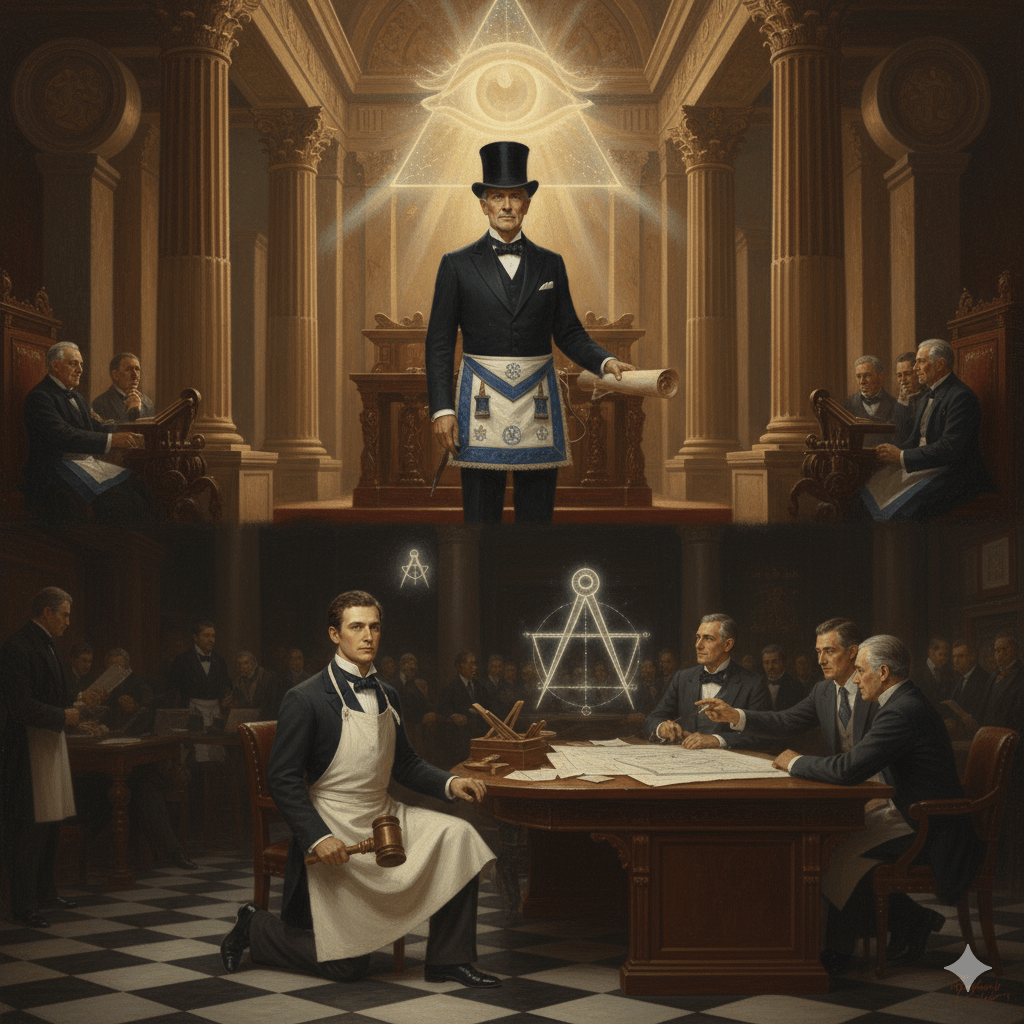
A man is initiated as a new member of a masonic lodge (an esoteric order) and is barely acquainted with the ritual laws, obligations, and degrees involved. Having little confidence from the Grand Lodge, and as a brother in the craft, he is entrusted with only the simplest working tools (and limited knowledge of the mysteries). He is given basic regalia, a white lambskin apron, unadorned.
Over time, he proves his worth through steady attendance, faithful observance of obligations, and strict adherence to the ancient usages of the Order. He is passed to a higher degree for his diligence and understanding; his trust within the Lodge is enlarged, permitting participation in more significant labors and entrusting him with greater symbolic light. He is given an apron with two blue rosettes and blue edging.
Eventually, he is raised even higher—having endured trials of knowledge and conduct, and having demonstrated fidelity to the Constitutions of the Order—and he is made a Master Mason within the Lodge, a true laborer in the temple of Solomon, possessing authority to instruct, guide, and represent the Craft. His apron is upgraded and he is given a top hat.
Here, rites, obligations, and degrees transmit identity and define the scope of esoteric work to be done; once again, advancement is patterned and not infused by some substance. Now consider the Holy Order (for the purposes of keeping orders straight, we will hereafter refer to the true priesthood order as the Holy Order):
| Corporate Entity | Holy Order |
|---|---|
| Charter / Articles of Incorporation | Revelation from Heaven (first to Adam) |
| Board of Directors | The Elohim |
| Officers (CEO, Treasurer, etc.) | High Priests |
| Shareholders | Offices (Apostle, Seventy, Elder, Teacher, Deacon, etc.) |
| ID badges with job titles | Priestly robes and garments |
| Bylaws and policies | Progressive laws and scriptures |
| Delegated authority via resolutions | Ordinances confer knowledge and power |
| Purpose: conduct lawful business | Purpose: administer the work of the Father |
| Promotion to higher positions | Conferral to greater portions |
| Whole corporation is a legal “person” | The Priesthood |
Now to extend the analogy one step further:
A man is ordained by a legal administrator of the Holy Priesthood (after the Order of the Son of God) and is barely acquainted with the progressive laws and scriptures involved. Having little confidence from the Elohim, but as a faithful disciple of Christ, he is entrusted with a position within the lesser portion of the priesthood after the order of Aaron (let’s say, he’s a deacon). He is given priestly robes to be worn on a certain shoulder.
Over time, he proves his worth through steady attendance, faithful observance of obligations, and strict adherence to the revelations he studies. He is ordained to the Melchizedek Priesthood for his diligence and understanding but only operates according to a patriarchal power inherited from his lineage; he is given agency to perform ordinances, permitted to participate in more significant labors, and entrusted with greater light and truth. He is instructed to change his robe to the other shoulder and admitted to the presence of his Lord.
Eventually, he is raised even higher, having endured the trials of knowledge and conduct presented in the endowment, and having demonstrated fidelity to the revelations from heaven; God himself ordains him to the full Melchizedek priesthood, or Holy Order. He abides as a priest continually in the temple of God, possessing sufficient authority to instruct, guide, and represent the Lord in weighty matters pertaining to His work. He is given the power of an endless life and is given a crown.
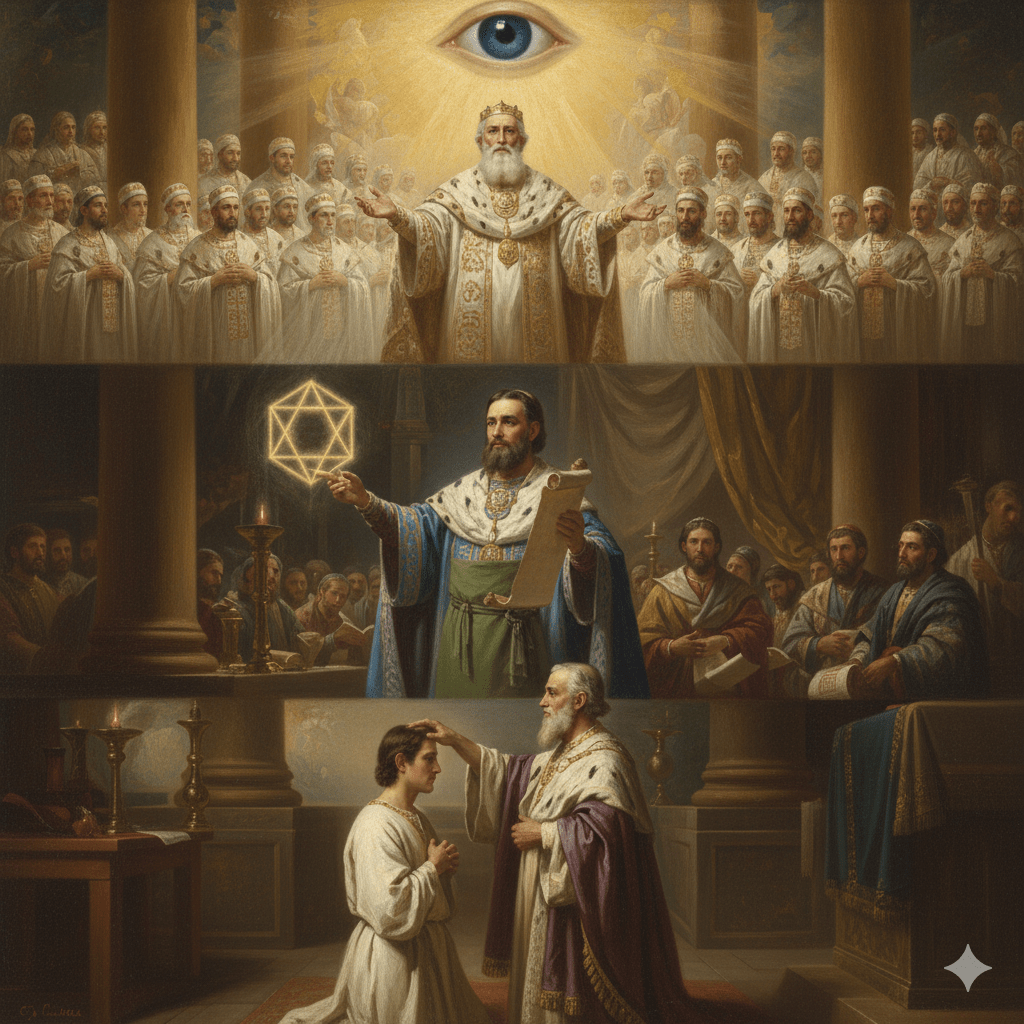
Thus in the Holy Order, rites and covenants—again, not a mystical substance—confer rights and privileges. Now, the above analogy may not make much sense to a regular member of the church unless there is some familiarity with the larger vision for the endowment ordinance. Brigham Young was tasked by Joseph Smith to “organize” the endowment ordinances as Joseph did not have much time before his death to present it in its most ideal setting.4 Regarding his vision for the fully completed temple ordinances, Brigham Young often remarked that the portion of it pertaining to the Aaronic order should be separated from those of the Melchizedek, meaning that priests after the Aaronic Order could participate only so far before requiring ordination to the higher or Melchizedek Order to participate in the rest, having proved themselves faithful to the lesser portion of the ordinances before assuming the higher portion. As he said:
“When we give the brethren their endowments, we are obliged to confer upon them the Melchizedek Priesthood; but I expect to see the day when we shall be so situated that we can say to a company of brethren you can go and receive the ordinances pertaining to the Aaronic order of Priesthood, and then you can go into the world and preach the Gospel, or do something that will prove whether you will honor that Priesthood before you receive more. Now we pass them through the ordinances of both Priesthoods in one day, but this is not as it should be and would if we had a Temple wherein to administer these ordinances. But this is all right at present; we should not be satisfied in any other way, and consequently we do according to the circumstances we are placed in” (Brigham Young, JOD 10:309).
The foregoing shows that the temple ordinances, including the endowment, are intended to be a system of progression by degrees, meaning that an initiate begins at the lowest degree and progresses higher and higher through advancement. This system of rites is expressly that of an initiatic order,3b or a community ‘bound by rules.’
Restoration of Priesthood: By Degrees, Not All at Once
Another witness that the priesthood is not a substance nor itself a power comes in the historical treatment of its restoration during the ministry of Joseph Smith. As professor Mike MacKay argued in his treatment on the misunderstood events of “the chamber of old father Whitmer” (D&C 128:21), the restoration of priesthood to the earth by diverse angels was not a two-time thing (once with John the Baptist and once with Peter, James, and John); instead, it was administered by degrees by representatives of those various degrees over a longer span of time.5
This explains why the temple ordinances were not understood or delivered in full until well into the Nauvoo period of church history; it explains why the endowment of power in Kirtland appeared in Nauvoo to be but the initiatory of the fuller ordinance (as additional keys pertaining to the order were given, the former ordinances became merely initiations themselves into the latter ones); it explains why Parley P. Pratt noted that the first time the Melchizedek Priesthood “had been revealed and conferred upon the Elders in this dispensation” was in Kirtland despite Joseph Smith and Oliver Cowdery having been made apostles at the hands of Peter, James, and John years earlier;6 and it explains why Joseph could not be taken until the order of plural marriage, itself another degree of the Holy Order, was established never to be removed from the earth (in fulfillment of Malachi 4:5 – 6; more on that below).
The Patriarchal or Evangelical Priesthood
Inasmuch as the fullness of the Holy Order was restored by progressive degrees over the course of Joseph Smith’s lifetime, it is here worth noting that very few men in this dispensation have ever attained to the Holy Order in its fullest degree. When someone is ordained by the hands of men to the “Melchizedek Priesthood,” he is only given a right to the full ordination, and he operates only in an appointed state by virtue of a portion or degree of that full Holy Order, which portion we may term the Patriarchal Order, awaiting the day the ordination to the full Holy Order is sealed by “the calling of [God’s] own voice” (Gen. 14:29, JST; cf. D&C 84:40). As Joseph Smith taught:
“All Priesthood is Melchizedek, but there are different portions or degrees of it. That portion which brought Moses to speak with God face to face was taken away; but that which brought the ministry of angels remained. All the prophets had the Melchizedek Priesthood and were ordained by God himself.” (TPJS, 180 – 181).
In the above statement, Joseph Smith refers to Moses’ ability to be brought into the presence of God as pertaining to a ‘portion’ of the Melchizedek Order. Though being brought into the presence of God is described as a primary feature of the Melchizedek Order in scripture (more on that below), could it be possible that a portion or degree of it (the Patriarchal Order) would be capable of that same great blessing? Yes; this is positively seen in the life of Abraham. To understand his account though, a key feature of the Patriarchal Order must be introduced: righteous lineage. His history notes that he had received his appointment or ordination to the Holy Order through his fathers when his fathers were still righteous:
“I sought for the blessings of the fathers, and the right whereunto I should be ordained to administer the same; having been myself a follower of righteousness,… I became a rightful heir, a High Priest, holding the right belonging to the fathers. It was conferred upon me from the fathers; it came down from the fathers, from the beginning of time, yea, even from the beginning, or before the foundation of the earth, down to the present time, even the right of the firstborn, or the first man, who is Adam, or first father, through the fathers unto me. I sought for mine appointment unto the Priesthood according to the appointment of God unto the fathers concerning the seed. My fathers, having turned from their righteousness, and from the holy commandments which the Lord their God had given unto them, unto the worshiping of the gods of the heathen, utterly refused to hearken to my voice….
“I left the land of Ur, of the Chaldees, to go into the land of Canaan…. And the Lord appeared unto me, and said unto me:… As many as receive this Gospel shall be called after thy name, and shall be accounted thy seed, and shall rise up and bless thee, as their father; and I will bless them that bless thee, and curse them that curse thee; and in thee (that is, in thy Priesthood) and in thy seed (that is, thy Priesthood), for I give unto thee a promise that this right shall continue in thee, and in thy seed after thee (that is to say, the literal seed, or the seed of the body) shall all the families of the earth be blessed, even with the blessings of the Gospel, which are the blessings of salvation, even of life eternal.
“Now, after the Lord had withdrawn from speaking to me, and withdrawn his face from me, I said in my heart: Thy servant has sought thee earnestly; now I have found thee…. So I, Abraham, departed as the Lord had said unto me, and Lot with me; and I, Abraham, was sixty and two years old when I departed out of Haran” (Abr. 1:3 – 4; 2:4, 6, 10 – 12, 14).
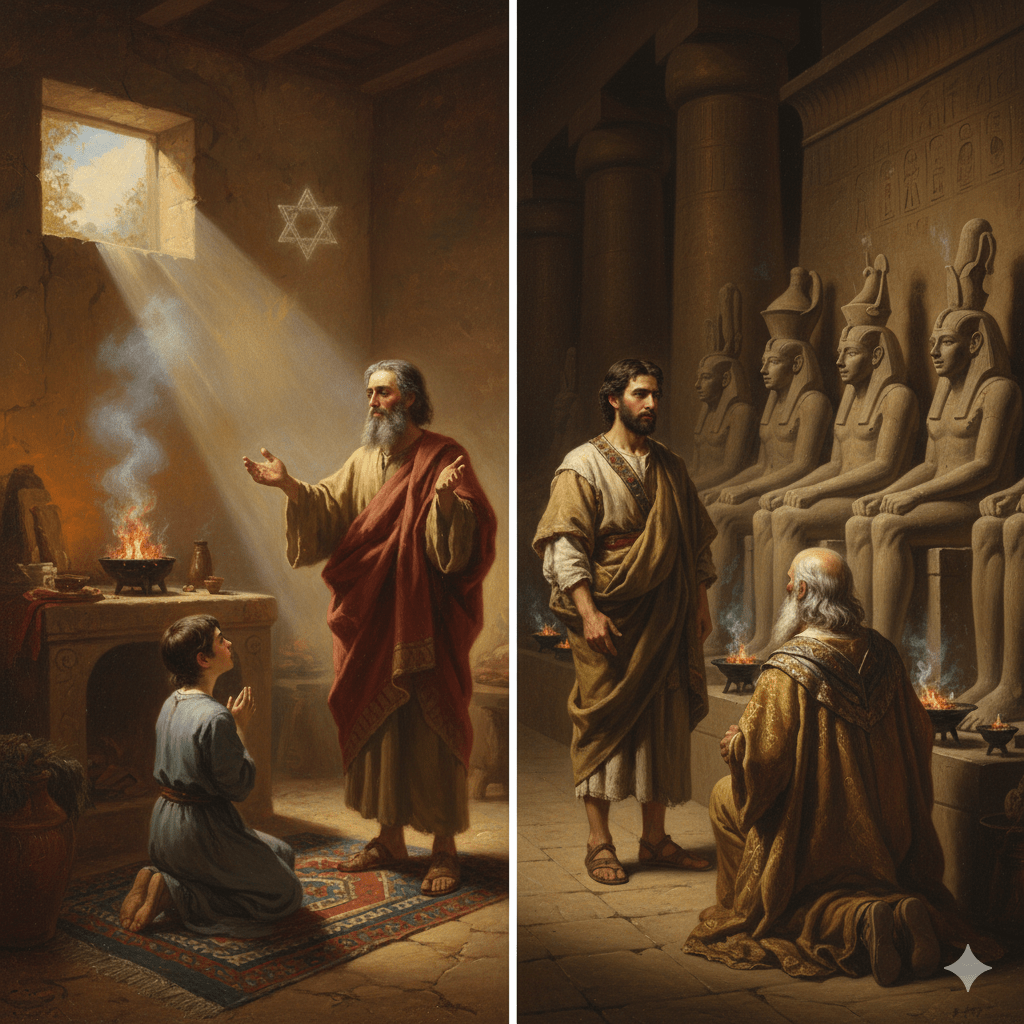
This priesthood that was to continue in and through Abraham bodily was not the Melchizedek Order, but a right to it—if he, and any of his descendants, should prove faithful. This right constitutes an order that comes by father and mother and deals particularly with administering salvation through preaching the Gospel of Jesus Christ to one’s posterity. This is why Joseph Smith called the Patriarchal Order the “Evangelical Priesthood” and said that “an evangelist is a patriarch”; for the meaning of the Greek word εὐαγγελιστής (euaggelistés “evangelist”) is “one who proclaims the Gospel” (TPJS, 40, 151).
The implication of the lineal requirement of this portion of the Holy Order is significant. The scriptures describe how that the Melchizedek Priesthood comes “neither by father nor mother” and so lineage is often not considered relevant (Gen. 14:28, JST); however, such verses are describing the completed ordination to the full Holy Order, which is done by God personally, to those who already possessed a right to that ordination, which right does come by lineal descent. Therefore, unless an initiate to the Holy Order possesses the ‘right of the Firstborn’ (Adam) by blood, he cannot enter the church of the Firstborn by ordination (D&C 76:54; cf. Heb. 12:23, D&C 78:21, 93:21); unless he first masters power in the priesthood from his fathers, he cannot handle power in the priesthood direct from the first Father.
The Joseph Smith translation of Hebrews shows that Abraham did not obtain a place and ordination to the full Holy Order until he met Melchizedek himself many years after he settled in Canaan (Abraham did not participate in the slaughter of the kings until he was around 80 years old):
“Melchisedec, king of Salem, priest of the most high God,… met Abraham returning from the slaughter of the kings, and blessed him; to whom also Abraham gave a tenth part of all;… for this Melchisedec was ordained a priest after the order of the Son of God, which order was without father, without mother, without descent, having neither beginning of days nor end of life; and all those who are ordained unto this priesthood are made like unto the Son of God, abiding a priest continually.
“Now consider how great this man was, unto whom even the patriarch Abraham gave the tenth of the spoils…. And without all contradiction the less is blessed of the better” (Heb. 7:1 – 4, 7, JST).
Joseph Smith commented on this arrangement, Melchizedek bearing a greater degree of priesthood than Abraham, noting that the patriarchal appointment or right by which Abraham had been acting was the greatest degree of power in the Holy Order that had been operating in the church as late as 1843:
“[Hebrews 7th chapter]…. There are three grand principles or orders of Priesthood portrayed in this chapter…. Abrahams Patriarchal power…is the greatest yet experienced in this church; that of Melchizedek…had still greater power, even [the] power of an endless life—of which was our Lord Jesus Christ—which also Abraham obtained by the offering of his son Isaac. [It] was not the power of a prophet nor apostle nor patriarch only, but [that] of [a] king and priest to God, to open the windows of Heaven and pour out the peace and law of endless life to man.”7
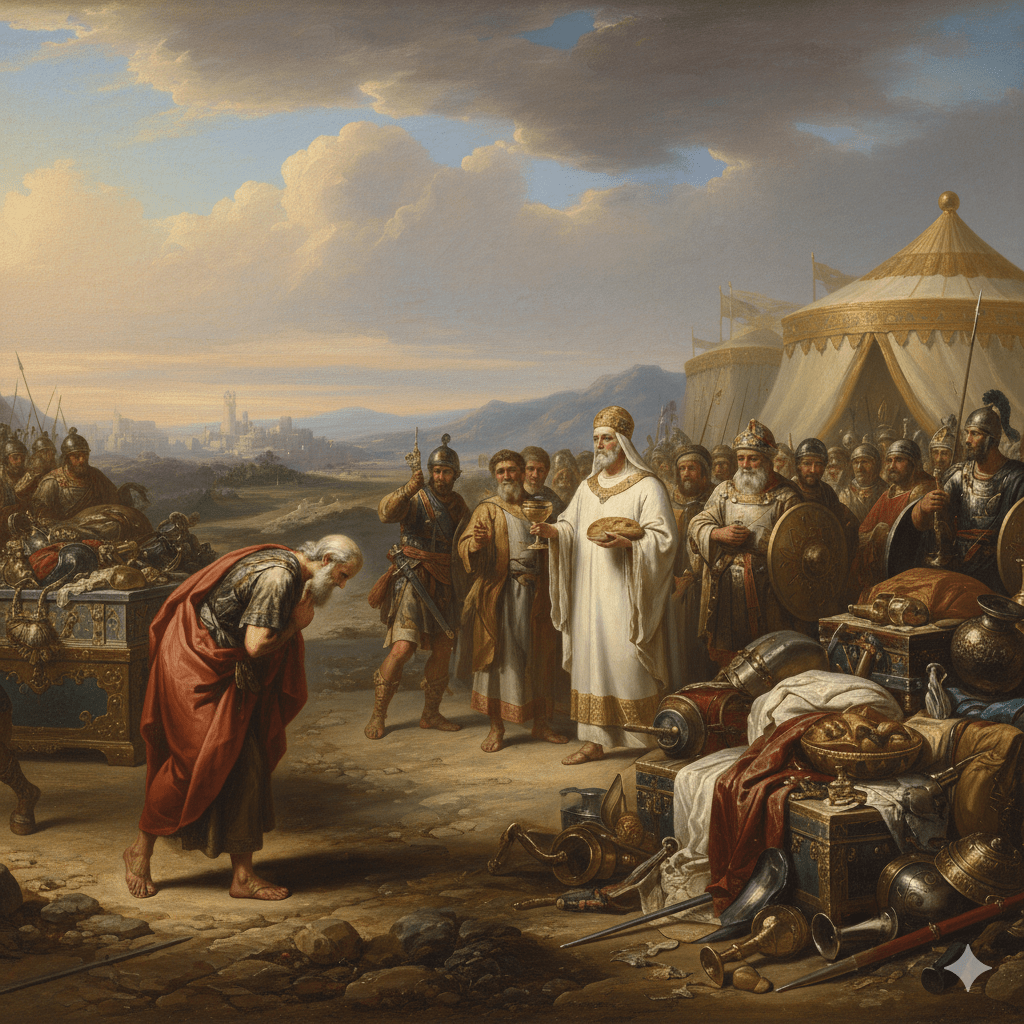
In summary, the Patriarchal Order, or Evangelical Priesthood, is really just the right or an appointment to the Holy Order inherited through blood relation back to those who had not dishonored their own appointments, going back to ‘first father,’ or Adam (as noted above by Abraham). It is greater than the Aaronic or Levitical order inasmuch as that order is a lesser or truncated fragment of the Holy Order, which fragment was “never able to administer a blessing but only to bind heavy burdens.”8 Those with the Evangelical Priesthood can bless others, even the nations of the earth through their descendants, and can “talk and walk with God.”9 As Joseph Smith once dictated in a blessing to his father:
“Blessed of the Lord is my father, for he shall stand in the midst of his posterity and shall be comforted by their blessings when he is old and bowed down with years, and shall be called a prince over them, and shall be numbered among those who hold the right of Patriarchal Priesthood, even the keys of that ministry: for he shall assemble together his posterity like unto Adam; and the assembly which [Adam] called shall be an example for my father…. So shall it be with my father: he shall be called a prince over his posterity, holding the keys of the patriarchal Priesthood over the kingdom of God on earth, even the Church of the Latter-day Saints, and he shall sit in the general assembly of Patriarchs, even in council with the Ancient of Days when he shall sit and all the Patriarchs with him and shall enjoy his right and authority under the direction of the Ancient of Days.” (TPJS, 38 – 39).
Light Given; Light Received or Rejected
Interestingly, God revealed to the early saints that their right to the Holy Order was expressly due to the lineage of their fathers—none of whom were ordained to any degree of the Holy Order in life:
“Therefore, thus saith the Lord unto you, with whom the priesthood hath continued through the lineage of your fathers—for ye are lawful heirs, according to the flesh, and have been hid from the world with Christ in God—therefore your life and the priesthood have remained, and must needs remain through you and your lineage” (D&C 86:8 – 10).
How could this right pass through the fathers of the early saints if their fathers never obeyed the ordinances of the Holy Order? Because continuance to the right was based on father and mother so far as they did not reject greater light from God and thus damn themselves and their posterity. Turning against the light given is how the truncated levitical or Aaronic priesthood was created in the first place:
“When God offers a blessing or knowledge to a man, and he refuses to receive it, he will be damned. The Israelites prayed that God would speak to Moses and not to them; in consequence of which he cursed them with a carnal law” (TPJS, 322; cf. D&C 84:23 – 26).
In that case, it was merciful that Israel had rejected the Holy Order without first obtaining a place in it; the effect of apostatizing from it once having a place in it is far worse. Rather than passing down a truncated portion of the Holy Order, those who reject the light after having received it cut themselves and their descendants off from the right to an appointment in the true order, or in other words, they create a false Patriarchal Order:
“The power, glory and blessings of the Priesthood could not continue with those who received ordination [except] their righteousness [also] continued; for Cain also being authorized to offer sacrifice, but not offering it in righteousness, was cursed. It signifies, then, that the ordinances must be kept in the very way God has appointed; otherwise their Priesthood will prove a cursing instead of a blessing” (TPJS, 168).
The cart is often put before the horse in regard to interpreting Cain’s curse. Whereas it is commonly assumed that his curse began with the murder of his brother, Abel, here Joseph Smith clarifies that Cain’s improper handling of the priesthood through wickedness led to his being cursed, the murder of his brother only following his leap into apostasy. Consequently, his descendants from that point forward could only “fain claim” a right to the Holy Order by father and mother (Abr. 1:27), enacting a false Patriarchal Order that could never produce a full ordination to anything by God. Historically, this apostate religion dissipated by degrees over time, though the lineal implications have remained.
By Degrees, or Grace to Grace
The concept of a restoration of the Holy Order by degrees is not only reflected in the life of Abraham, but also in the life of Jesus Christ himself. According to an account written by John the Beloved, Jesus “received not of the fulness at first, but continued from grace to grace, until he received a fulness” (D&C 93:13). No deep dive is needed to establish that Jesus was of that lineage of Abraham whereby he also had an appointment or right to the Holy Order via Patriarchal Priesthood. But it may be surprising to learn that he may not have obtained the Melchizedek Order, or ordination to the fulness of the Holy Order, until long into his ministry of teaching and healing. As Joseph Smith noted:
“On the mount, transfigured before Peter and John, [Jesus was] there receiving the fulness of priesthood or the law of God, setting up no stake but coming right up to the mark in all things. Hear him after he returned from the mount—did ever language of such magnitude fall from the lips of any man? Hearken [to] him: ‘All power is given unto me both in heaven and the earth‘ (Matt. 28:18).”10
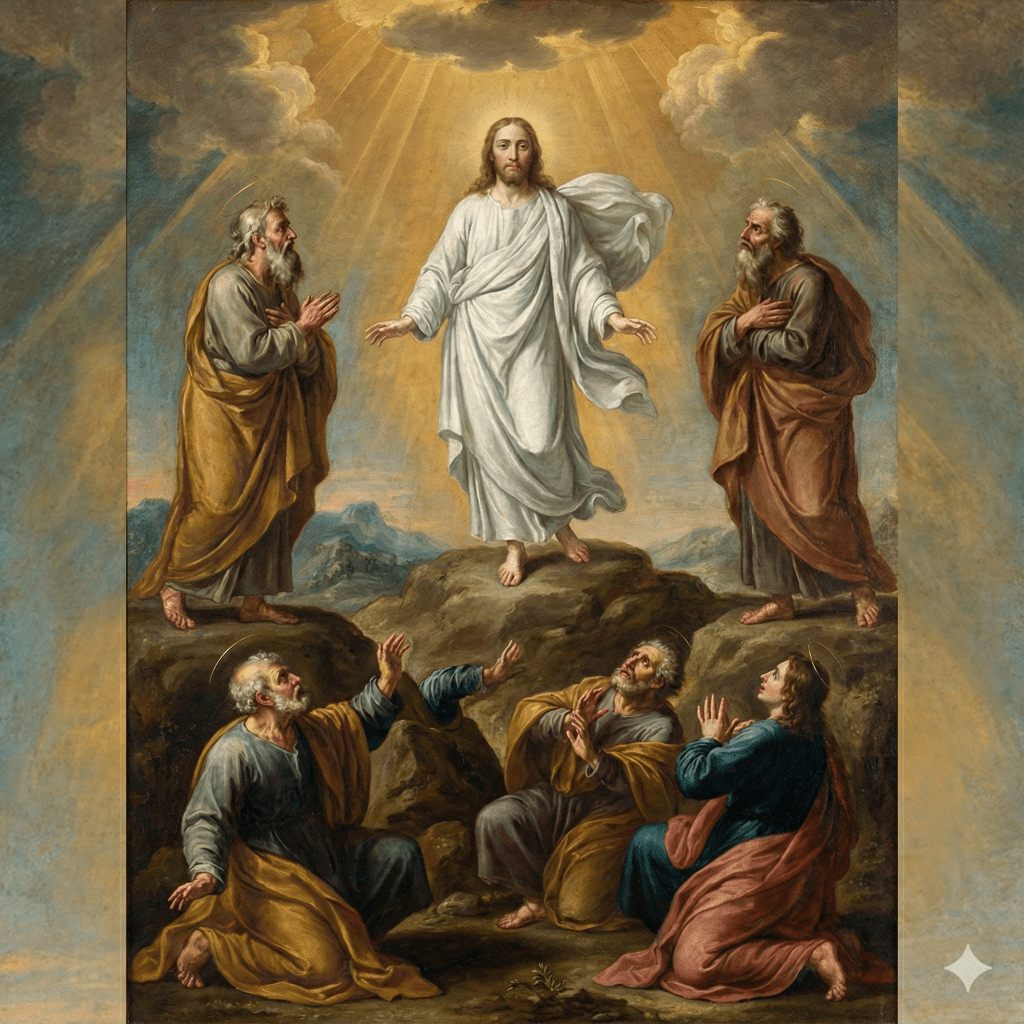
If Joseph Smith has here accurately tied Jesus’ comments in Matthew 28 to a recounting of the events that took place on the Mount of Transfiguration, it is no wonder the church in 1843 had only experienced the power of the qualifying Patriarchal Order and not of the full ordination to the Melchizedek Order by God himself. This may even explain the three degrees of spirits that prevail in the unfolding of God’s work in given dispensations, as Joseph Smith noted:
“The spirit of Elias is first, Elijah second, and Messiah last. Elias is a forerunner to prepare the way, and the spirit and power of Elijah is to come after, holding the keys of power, building the Temple to the capstone, placing the seals of the Melchizedek Priesthood upon the house of Israel, and making all things ready; then Messiah comes to His Temple, which is last of all” (TPJS, 340).
In other words, prophets and saints in every dispensation have been tasked with creating a Zion that their Lord could dwell amidst, bringing earth up to heaven and heaven down to earth. This has been done by the three ‘grand principles or orders’ of the priesthood in its degrees, each associated with a particular mission, spirit or power: the spirit and power of Elias works within the Aaronic Order to prepare the foundation of a living temple, that of Elijah works within the Patriarchal Order to seal together the pieces of that living temple, and finally that of Messiah rests within it and empowers it within the Melchizedek Order. This is the meaning and purpose of Zion, a city established according to the full Holy Order, and it is perhaps therefore simultaneously the reason it has been seen so few times on the earth: Adam had a golden age, Enoch’s city was taken up into heaven, Melchizedek and “his people…obtained heaven” (Gen. 14:34, JST), and Jesus too would have done the same if Israel had hearkened to him:
“The reason why Jesus said unto the Jews, ‘How oft would I have gathered thy children together, even as a hen gathereth her chickens under her wings, and ye would not!’—[was] that they might attend to the ordinances…of the priesthood, and receive revelations from heaven, and be perfected in the things of the kingdom of God—but they would not” (TPJS, 310).
Even if very few in this dispensation have been ordained to the full Holy Order (the bar being much higher than previously imagined), that order nonetheless was restored to the earth in degrees during the lifetime of Joseph Smith. And the keys of even just the Patriarchal degree are sufficient to bring one to ‘talk and walk with God.’ As Joseph Smith noted at the funeral of his friend, Judge Adams:
“I anointed him to the patriarchal power—to receive the keys of knowledge and power, by revelation to himself. He has had revelations concerning his departure, and has gone to a more important work. When men are prepared, they are better off to go hence. Brother Adams has gone to open up a more effectual door for the dead. The spirits of the just are exalted to a greater and more glorious work; hence they are blessed in their departure to the world of spirits. Enveloped in flaming fire, they are not far from us, and know and understand our thoughts, feelings, and motions, and are often pained therewith” (TPJS, 326).
Crucially, Adams had already received the initial Nauvoo temple ordinances (May 4, 1842) and plural marriage before his death (Aug. 11, 1843)—both prior to the earliest “second anointings” (Sept. 27, 1843). That timing suggests Joseph’s phrase “anointed…to the patriarchal power” refers to that first tranche of temple rites, indicating that what many assume to belong strictly to the fulness of the Melchizedek Order is, in practice, functioning within its partial Patriarchal Order. Nonetheless, those rites confer operative keys—“instructive patterns” (as we will read below)—that authorize and enable ‘knowledge and power, by revelation.’
This is precisely the promise of D&C 128:11: “the great and grand secret…consists in obtaining the powers of the Holy Priesthood. For him to whom these keys are given there is no difficulty in obtaining a knowledge of facts in relation to the salvation of the children of men.” In other words, the Nauvoo temple ordinances up through the endowment (rites of the Patriarchal degree) are sufficient to deliver keys that unlock revelatory knowledge of a salvific degree, even prior to the fulness; the timing of Judge Adams’ death exemplifies that graduated, operative power. This may even be exemplified by the timing of Abraham’s early initiation to the Patriarchal Order, the contemporary Egyptian rites containing much of the endowment rites in their mimicked order.
The point is, if the saints desire to go from grace to grace, even to the fulness of the Melchizedek Order and the spirit of Messiah to attend them, they must first make a full use of the degree of the Holy Order given them in the Patriarchal Order within stone temples that the living temple might be readied to receive those greater degrees.
Keys are Instructive Patterns
In a recent blog post, a concept was shared that priesthood keys—in most cases—should be interpreted as instructive patterns. Though it is true that the word “keys” is sometimes used synonymously with “authority,” for the purpose of this essay we will focus on the verses that clearly imply the meaning of a pattern (though, as pointed out in said blog post, even those referring to ‘authority’ are also invoking a part of a greater pattern). For example, regarding the Aaronic Priesthood:
“The power and authority of the lesser, or Aaronic Priesthood, is to hold the keys of the ministering of angels, and to administer in outward ordinances, the letter of the gospel, the baptism of repentance for the remission of sins, agreeable to the covenants and commandments” (D&C 107:20).
Aaronic Order
As we’ve defined above, priesthood is an order, and in this case the lesser, truncated portion of it is called the Aaronic Order. The above verse shows that this order is described as itself holding keys. How does something as intangible as an order “hold” something unless that thing is itself also intangible? If we substitute ‘instructive patterns’ for keys then we get the following: the power and authority of the Aaronic Order is to hold certain instructive patterns. Instructive patterns to what? The ministering of angels. That this comes through its administration of the ‘outward ordinances’ (including the letter of the gospel [practical and literal instruction] and baptism), is stated in the rest of the verse.
It calls to mind the admonition to the early martyr Vibia Perpetua by her brother who associated her true power to be administered to in visions and dreams with her recent ordinance of baptism, when he said, “you are now in high honor, even such that you might ask for a vision; and it should be shown you.”11 Her ability, in other words, to be ministered to by angels in a vision or dream was directly associated with having received the ‘outward ordinances’ (baptism) administered by the Aaronic Order.
All ordinances, or rites of an order, are in themselves the instructive patterns that convey the directives needed for the initiate to master higher knowledge and assume desired traits that enable them to ascend to higher levels or degrees within that system of instruction. In the case of baptism and confirmation, the instruction is that inasmuch as “we are buried with [Christ] by baptism into death: that like as Christ was raised up from the dead by the glory of the Father, even so we also should walk in newness of life” (Rom. 6:4), the subsequent laying on of hands (via higher authority) providing the symbolic injunction that in seeking ‘ye shall find’ (i.e., via revelation through angelic ministration, discussed below).
The sacrament ordinance is another illustration of the instructional pattern of the outward ordinances of the Aaronic Order. That ordinance invokes the symbolism of taking emblems into one’s body as a token of continual remembrance and observation of the ‘letter of the gospel.’ The promise is that as this is internalized, or literally done in daily life by the partaker, angelic ministration will be their right. Now, the actual words are, ‘they may always have his spirit to be with them,’ but the meaning of this promise entails all the spiritual gifts that come from the spirit:
“Seek ye earnestly the best gifts, always remembering for what they are given; for verily I say unto you, they are given for the benefit of those who love me and keep all my commandments, and him that seeketh so to do; that all may be benefited that seek or that ask of me…. there are many gifts, and to every man is given a gift by the Spirit of God.” (D&C 46:8 – 9, 11).
And Nephi plainly teaches that whenever we receive ministrations from the spirit of God, we are in fact hearing the voices of angels (incidentally, when we read “angel” we should, in this case, understand that these are priests or priestesses of the Holy Order on the other side of the veil):
“Do ye not remember that I said unto you that after ye had received the Holy Ghost ye could speak with the tongue of angels? And now, how could ye speak with the tongue of angels save it were by the Holy Ghost? Angels speak by the power of the Holy Ghost; wherefore, they speak the words of Christ. Wherefore, I said unto you, feast upon the words of Christ; for behold, the words of Christ will tell you all things what ye should do. Wherefore, now after I have spoken these words, if ye cannot understand them it will be because ye ask not, neither do ye knock; wherefore, ye are not brought into the light, but must perish in the dark. For behold, again I say unto you that if ye will enter in by the way, and receive the Holy Ghost, it will show unto you all things what ye should do. Behold, this is the doctrine of Christ, and there will be no more doctrine given until after he shall manifest himself unto you in the flesh. And when he shall manifest himself unto you in the flesh, the things which he shall say unto you shall ye observe to do” (2 Ne. 32:2 – 6).
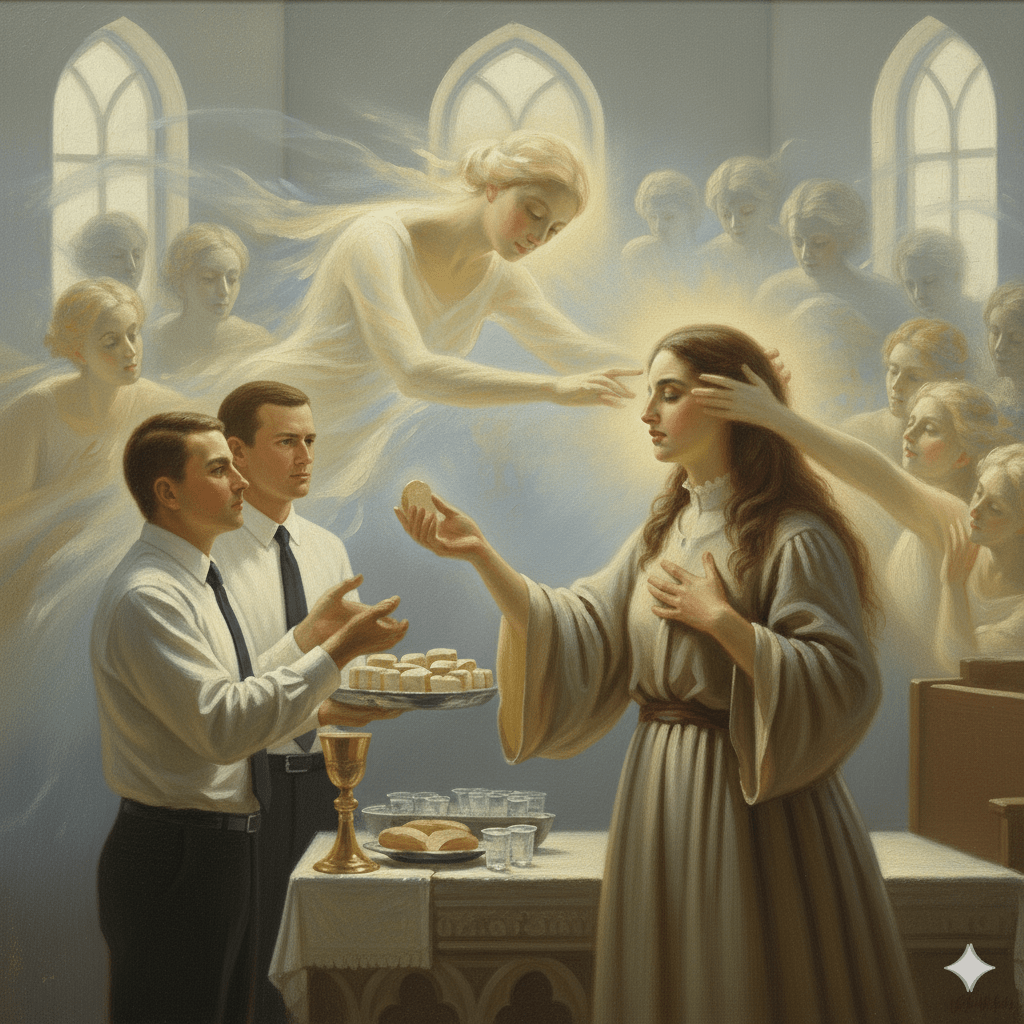
Nephi at the end draws a contrast between ministrations of the first comforter (the power of the Holy Ghost, by which angels speak) and the second comforter (Christ himself), a difference that prepares us to understand the ‘keys’ or instructional patterns of the higher or Melchizedek Order. But, in summary about the ordinances of the Aaronic Order, we can now see how that the order, through its ordinances, “holds” the instructional pattern for receiving angelic ministration when we understand that all spiritual gifts come through angels working via a power we call “the Holy Ghost” (not to be confused with the person of God the Third).
Melchizedek Order
It will be recalled that the Patriarchal Order, or Evangelical Priesthood, comes sufficiently near to the Melchizedek Order that the promises and blessings described below apparently pertain to it as well. For the sake of simplicity, the following descriptions of the Melchizedek Order should be applied to those who operate under a Patriarchal power alone. Compared to the ‘outward ordinances’ of the Aaronic Order, the scriptures are even more plain regarding the instructional nature of the ordinances or rites of the Melchizedek Order (also called the priesthood in its greatest degree, or the greater priesthood):
“This greater priesthood administereth the gospel and holdeth the key of the mysteries of the kingdom, even the key of the knowledge of God. Therefore, in the ordinances thereof, the power of godliness is manifest. And without the ordinances thereof, and the authority of the priesthood, the power of godliness is not manifest unto men in the flesh; for without this no man can see the face of God, even the Father, and live” (D&C 84: 19 – 22).
Why is ‘the power of godliness’ manifest ‘in the ordinances thereof’? Because those rites are the instructional patterns needed for the initiate to master a higher knowledge and certain attributes preparatory to their obtaining an even higher degree of progression in the Holy Order: entering into the presence of the Lord Jesus Christ. Regarding the ordinances of the Melchizedek Order, Alma says the exact same thing: “These ordinances were given after this manner…, it being [the Son of God’s] order…, that they might enter into the rest of the Lord” (Alma 13:16). In other words, whereas the instructional patterns of the lower degree or Aaronic Order brings one to the communion of angels, the instructional patterns of the higher degree or Melchizedek Order brings one to the communion of the Savior Jesus Christ.
“The power and authority of the higher, or Melchizedek Priesthood, is to hold the keys of all the spiritual blessings of the church—to have the privilege of receiving the mysteries of the kingdom of heaven, to have the heavens opened unto them, to commune with the general assembly and church of the Firstborn, and to enjoy the communion and presence of God the Father, and Jesus the mediator of the new covenant” (D&C 107:18 – 19).
Note the described privileges of a fully initiated and elevated high priest after the Melchizedek Order:
- Receiving the mysteries of the kingdom of heaven
- Have the heavens opened unto them
- Commune with the general assembly of the church of the Firstborn (higher than angels)
- Enjoy the communion and presence of Jesus
- Enjoy the communion and presence of God (the Father)
These last blessings, of entering into the presence and rest of the Lord, is the same thing as being sealed unto salvation, or to have one’s calling and election sure, or to obtain the ‘more sure word of prophecy.’ Joseph Smith explained that these terms are synonymous and obtained through the power of the Holy Order:
“Now for the secret and grand key. Though they might hear the voice of God and know that Jesus was the Son of God, this would be no evidence that their election and calling was made sure, that they had part with Christ, and were joint heirs with Him. They then would want that more sure word of prophecy, that they were sealed in the heavens and had the promise of eternal life in the kingdom of God. Then, having this promise sealed unto them, it was an anchor to the soul, sure and steadfast. Though the thunders might roll and lightnings flash, and earthquakes bellow, and war gather thick around, yet this hope and knowledge would support the soul in every hour of trial, trouble and tribulation. Then knowledge through our Lord and Savior Jesus Christ is the grand key that unlocks the glories and mysteries of the kingdom of heaven” (TPJS, 298).
In case that was not clear enough, the concept has even been codified in the scriptures as found in the Doctrine and Covenants: “The more sure word of prophecy means a man’s knowing that he is sealed up unto eternal life, by revelation and the spirit of prophecy, through the power of the Holy Priesthood” (D&C 131:5, emphasis added). All in all, revelation is the privilege of the fully initiated and transformed.
As with interactions with angels afforded by the instructional patterns of the Aaronic Order, it may be instructive to point out that interactions with the Lord Jesus Christ may not always be discerned by outward appearance, or in other words, it may not be visibly noted except by those whose gift it is to see with spiritual eyes. Besides the numerous recorded instances in church history where Joseph Smith (among others) saw the savior while others did not, Heber C. Kimball notably recorded the moment his calling and election was made sure through revelation from the Lord. Note the conspicuous absence of a vision:
“My family having been gone about two months, during which time I heard nothing from them; our brethren being in prison; death and destruction following us everywhere we went; I felt very sorrowful and lonely. The following words came to mind, and the Spirit said unto me, ‘write,’ which I did by taking a piece of paper and writing on my knee as follows: …
“Verily I say unto my servant Heber, thou art my son, in whom I am well pleased; for thou art careful to hearken to my words, and not transgress my law, nor rebel against my servant Joseph Smith, for thou hast a respect to the words of mine anointed, even from the least to the greatest of them; therefore thy name is written in heaven, no more to be blotted out for ever.” 12
Joseph Smith once dreamed of the apostles being visited by the Lord in their trials in the west as they first attempted to settle in Utah and it too contains moving notions of their inability to see Jesus despite his being in their midst:
“He[, Joseph,] saw the Twelve going forth, and they appeared to be in a far distant land. After some time they unexpectedly met together, apparently in great tribulation, their clothes all ragged, and their knees and feet sore. They formed into a circle, and all stood with their eyes fixed upon the ground. The Savior appeared and stood in their midst and wept over them, and wanted to show Himself to them, but they did not discover Him.”13
All of this is to say that the instructive patterns of the Melchizedek Order, transmitted through its ordinances or rites, are designed to make an initiate like his Lord that he may commune directly with his Lord (whether visibly or no). And again, it is written, “We all, with open face beholding as in a glass the glory of the Lord, are changed into the same image from glory to glory, even as by the Spirit of the Lord” (2 Cor. 3:18). Entering into the order of this higher priesthood requires initiates to make and keep sacred covenants related to their personal lives—their knowledge and their attributes—so they may commune personally with the Lord who stands at the head of that order. As Peter described:
“His divine power has given us everything we need for a godly life through our knowledge of him who called us by his own glory and goodness [i.e., ‘the power of godliness is manifest’ through the ordinances of the Melchizedek Priesthood]. Through these he has given us his very great and precious promises, so that through them you may participate in the divine nature, having escaped the corruption in the world caused by evil desires.
“For this very reason, make every effort to add to your faith goodness; and to goodness, knowledge; and to knowledge, self-control; and to self-control, perseverance; and to perseverance, godliness; and to godliness, mutual affection; and to mutual affection, love. For if you possess these qualities in increasing measure, they will keep you from being ineffective and unproductive in your knowledge of our Lord Jesus Christ. But whoever does not have them is nearsighted and blind, forgetting that they have been cleansed from their past sins.
“Therefore, my brothers and sisters, make every effort to confirm your calling and election. For if you do these things, you will never stumble, and you will receive a rich welcome into the eternal kingdom of our Lord and Savior Jesus Christ” (2 Pet. 1:3 – 11, NIV).
In the temple, saints participate in ordinances associated with the Aaronic and Melchizedek Orders that authoritatively instruct individuals on laws that pertain to attributes like those listed by Peter. This is not a coincidence, for Peter is explaining that the path to entering into the presence of the Lord is paved in changing one’s attributes—conforming to God’s divine laws—until one becomes like Christ. Joseph Smith taught that the sealing power of the priesthood is connected to the effectiveness of these changes, which is determined through individual testing:
“Peter exhorts us to make our calling and election sure. This is the sealing power spoken of by Paul in other places… (‘Sealed with that Holy Spirit of promise… sealed up unto the day of redemption’ [Eph. 1:13 – 14]). This principle ought in its proper place to be taught…, for the day must come when no man need say to his neighbor, Know ye the Lord; for all shall know Him (who remain) from the least to the greatest. How is this to be done? It is to be done by this sealing power, and the other Comforter spoken of, which will be manifest by revelation….
“The ‘other Comforter’ spoken of is a subject of great interest, and perhaps understood by few of this generation. After a person has faith in Christ, repents of his sins, and is baptized for the remission of his sins and receives the Holy Ghost, (by the laying on of hands), which is the first Comforter, then let him continue to humble himself before God, hungering and thirsting after righteousness, and living by every word of God, and the Lord will soon say unto him, Son, thou shalt be exalted. When the Lord has thoroughly proved him, and finds that the man is determined to serve Him at all hazards, then the man will find his calling and his election made sure, then it will be his privilege to receive the other Comforter, which the Lord hath promised the Saints….
“Now what is this other Comforter? It is no more nor less than the Lord Jesus Christ Himself; and this is the sum and substance of the whole matter; that when any man obtains this last Comforter, he will have the personage of Jesus Christ to attend him, or appear unto him from time to time, and even He will manifest the Father unto him, and they will take up their abode with him, and the visions of the heavens will be opened unto him, and the Lord will teach him face to face, and he may have a perfect knowledge of the mysteries of the Kingdom of God; and this is the state and place the ancient Saints arrived at when they had such glorious visions—Isaiah, Ezekiel, John upon the Isle of Patmos, St. Paul in the three heavens, and all the Saints who held communion with the general assembly and Church of the Firstborn” (TPJS 149 – 151).
Note again the revelatory blessings of knowledge described by Joseph Smith above and how that they mirror exactly those described as belonging to the keys, or instructional patterns, of the priesthood in its higher degree, or Melchizedek Order:
- Receiving the mysteries of the kingdom of heaven
- Have the heavens opened unto them
- Commune with the general assembly of the church of the Firstborn (higher than angels)
- Enjoy the communion and presence of Jesus
- Enjoy the communion and presence of God (the Father)
All of the necessary procedures related to becoming a true high priest in the Holy Order—including authoritative covenants to required laws—are taught as instructional patterns in ordinances administered in the temple, for “therein are the keys of the holy priesthood ordained, that you may receive honor and glory” (D&C 124:34). This system of progression by degrees, set apart in a holy place, is yet a further witness that the priesthood is not a power in itself but an order through which worthy initiates can learn to obtain power through revelation and communion with their Lord. As Joseph Smith taught, these instructional patterns were thought out long before this world and constitute particular mediums of revealing truth:
“The organization of the spiritual and heavenly worlds, and of spiritual and heavenly beings, was agreeable to the most perfect order and harmony: their limits and bounds were fixed irrevocably, and voluntarily subscribed to in their heavenly estate by themselves, and were by our first parents subscribed to upon the earth. Hence the importance of embracing and subscribing to principles of eternal truth by all men upon the earth that expect eternal life. I assure the Saints that truth, in reference to these matters, can and may be known through the revelations of God in the way of His ordinances” (TPJS, 325).
How Priesthood “Has” Power
The priesthood, especially when erroneously defined as a power by itself, is often considered to be the means by which the sick are healed and the dead raised, etc., but if the priesthood is actually an order and not a power, then what do the scriptures mean when they speak of the priesthood having “power”? (See D&C 107:14, 79; 112:30; 113:8; 128:8, 21; 131:5; 132:7, 19, 44, 45, 59). Clearly, there is such a thing as “power in the priesthood,” but what is it?
Power to Heal?
A month after Joseph Smith instituted the Relief Society in March of 1842, he assembled the sisters to give them special instruction in the upper room of his Red Brick Store (the same place the first endowments would be given a couple months later in May of 1842). These instructions specified that women, having faith, could heal individuals by the laying on of hands:
“Some little foolish things were circulating in the Society, against some sisters not doing right in laying hands on the Sick…. If the people had common sympathies, they would rejoice that the sick could be healed!… ‘And these signs shall follow them that believe; In my name shall they cast out devils; they shall speak with new tongues; they shall take up serpents; and if they drink any deadly thing, it shall not hurt them; they shall lay hands on the sick, and they shall recover’ [Mark 16:17 – 18]. No matter who believeth, these signs—such as healing the sick, casting out devils, etc.—should follow all that believe, whether male or female…. If the sisters should have faith to heal the sick, let all hold their tongues and let every thing roll on…. There could be no devil in it, if God gave his sanction by healing;… there could be no more sin in any female laying hands on and praying for the sick than in wetting the face with water; it is no sin for any body to administer that has faith, or if the sick have faith to be be healed by their administration.”14
These remarks (especially in light of Mark 16:17–18) show that the underlying and fundamental cause of healing through blessings comes not by an invisible power added to a man from priesthood ordination, but through faith. In other words, why can women heal by the laying on of hands just as much as a man may? Because the miraculous powers so often ascribed to a “priesthood holder” is really faith, which comes by righteousness.
The opposite is also true: without faith there can be no power in the priesthood, even despite worthy ordinations. As Joseph Smith once said reprovingly to the elders who had failed to heal the sick in Nauvoo (before he all at once got up and healed most of the town on his own): “Let the Elders either obtain the power of God to heal the sick, or let them cease to administer the form without the power.”15
This principle, ironically, is made nowhere in scripture more clear than in the description of Melchizedek himself, which was restored by Joseph Smith in his retranslation of the Bible:
“Now Melchizedek was a man of faith, who wrought righteousness; and when a child, he feared God, and stopped the mouths of lions, and quenched the violence of fire. And thus, having been approved of God, he was ordained a high priest after the order of the covenant which God made with Enoch…. For God, having sworn unto Enoch and unto his seed with an oath by himself that everyone being ordained after this order and calling should have power, by faith, to break mountains, to divide the seas, to dry up waters, to turn them out of their course, to put at defiance the armies of nations, to divide the earth, to break every band, to stand in the presence of God, to do all things according to his will, according to his command, subdue principalities and powers; and this by the will of the Son of God which was from before the foundation of the world. And men having this faith, coming up unto this order of God, were translated and taken up into heaven. And now, Melchizedek was a priest of this order; therefore, he obtained peace in Salem and was called the prince of peace” (Gen. 14:26 – 27, 30 – 33, JST).
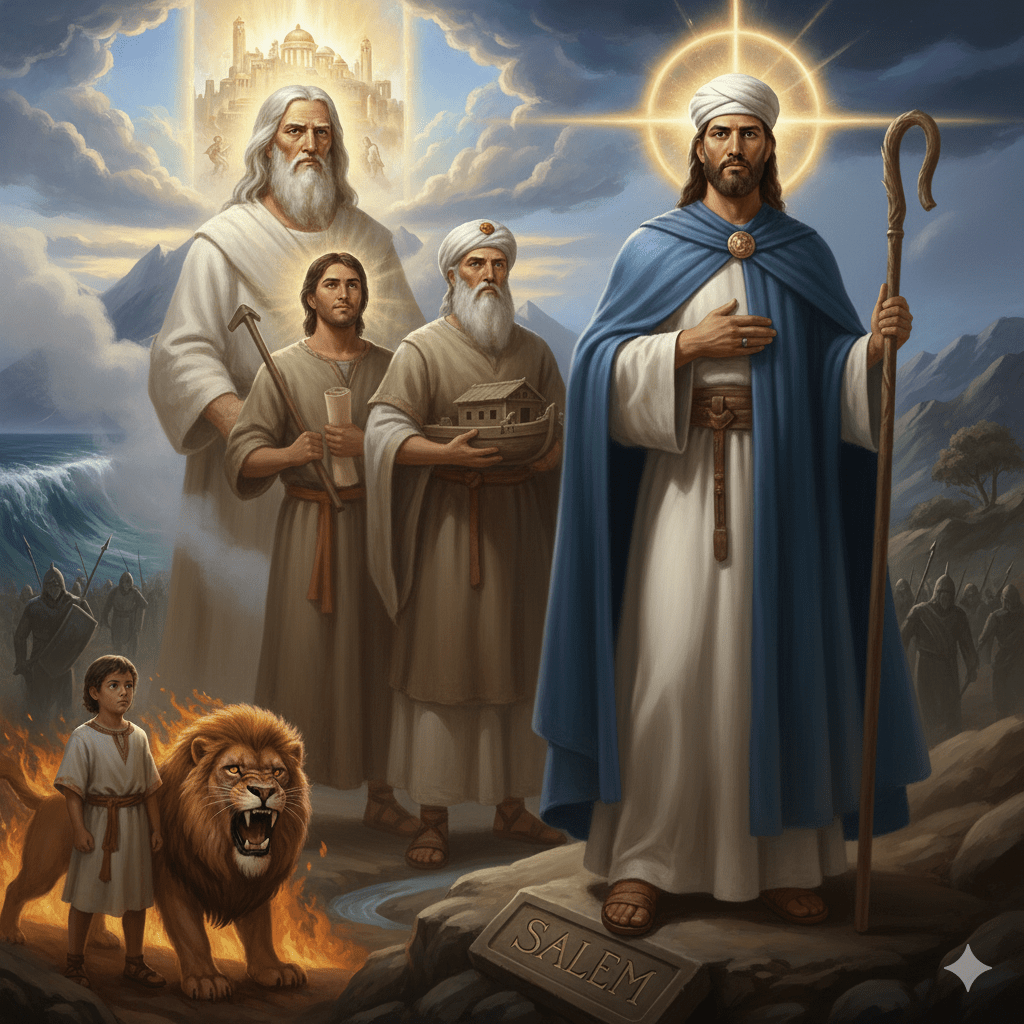
The promise made to Enoch—and thence to Noah and Melchizedek and so on—was that their descendants who faithfully entered the initiatic Holy Order would have power through faith to work miracles. From these verses we discover one of the promises made to the ancient fathers toward which the hearts of their children would turn in the last days:
“Behold, I will reveal unto you the Priesthood, by the hand of Elijah the prophet, before the coming of the great and dreadful day of the Lord. And he shall plant in the hearts of the children the promises made to the fathers, and the hearts of the children shall turn to their fathers” (D&C 2:1 – 2).
(As discussed in my blog post, Horite Priest-Kings, the New and Everlasting Covenant, and the Succession Crisis of 1844, the fact that Elijah restored the degree of plural marriage in 1836 to the then-expanding degrees of the Holy Order shows that ‘the promises made to the fathers’ included that the priesthood in its fullest, highest, and holiest degrees would be enabled to stand upon the earth in the last days. Joseph Smith’s life was preserved to see this principle embedded deeply enough to never be taken from the earth.)
The implication of these ancient priesthood promises may be that for an initiate to enter the Holy Order fully and truly, great faith is a qualifying requirement (beside righteous lineage, as discussed above). Many priests have been ordained, especially in these last days, who have not exhibited the promised powers; this likely indicates they either came through a lineage that rejected light and therefore have no Patriarchal power to aid them or they did not possess the level of faith required to produce power. Consider Paul’s summation of the acts of faith between the time of Moses and his day and how closely that narration of events mirrored the language of the promises made to Enoch:
“By faith they passed through the Red sea as by dry land: which the Egyptians assaying to do were drowned. By faith the walls of Jericho fell down, after they were compassed about seven days. By faith the harlot Rahab perished not with them that believed not, when she had received the spies with peace. And what shall I more say? for the time would fail me to tell of Gedeon, and of Barak, and of Samson, and of Jephthae; of David also, and Samuel, and of the prophets: who through faith subdued kingdoms, wrought righteousness, obtained promises, stopped the mouths of lions, quenched the violence of fire, escaped the edge of the sword, out of weakness were made strong, waxed valiant in fight, turned to flight the armies of the aliens. Women received their dead raised to life again” (Heb. 11:29 – 35).
Note the emphasis on faith. Even the dead being raised back to mortal life is attributed to the faith of the persons involved. Faith is a principle of righteousness and can only be handled by those who live justly according to God’s laws:
“The rights of the priesthood are inseparably connected with the powers of heaven, and that the powers of heaven cannot be controlled nor handled only upon the principles of righteousness. That they may be conferred upon us, it is true; but when we undertake to cover our sins, or to gratify our pride, our vain ambition, or to exercise control or dominion or compulsion upon the souls of the children of men, in any degree of unrighteousness, behold, the heavens withdraw themselves; the Spirit of the Lord is grieved; and when it is withdrawn, Amen to the priesthood or the authority of that man. Behold, ere he is aware, he is left unto himself, to kick against the pricks, to persecute the saints, and to fight against God” (D&C 121:36 – 38).
‘Ere he is aware’ means “without him knowing”—in other words, a man may think he has ‘rights’ or a position within the Holy Order, not knowing that he actually does not; he only assumes he does since the rights were ‘conferred upon’ him. But the powers of heaven only manifest in a priest if he first has faith, which comes from righteousness, the kind of righteousness exhibited by the prophets of the Old Testament who did many mighty works. One remedy for the multitude of ineffective priests would be to assess, before a man is called to the priesthood, his lineage, character, and faith or else his ordination may not result in effective power (or he will have to grow into it to be effective). As Joseph Smith warned:
“On the subject of ordination, a few words are necessary. In many instances there has been too much haste in this thing, and the admonition of Paul has been too slightingly passed over, which says, ‘Lay hands suddenly upon no man.’ Some have been ordained to the ministry, and have never acted in that capacity, or magnified their calling at all. Such may expect to lose their appointment, except they awake and magnify their office. Let the Elders abroad be exceedingly careful upon this subject, and when they ordain a man to the holy ministry, let him be a faithful man, who is able to teach others also; that the cause of Christ suffer not. It is not the multitude of preachers that is to bring about the glorious millennium! but it is those who are ‘called, and chosen, and faithful‘” (TPJS, 42).
It is patently the case that merely going through the motions of the instructive patterns (i.e., the temple ordinances) of the Holy Order will not bring an initiate into the presence of the Lord. The initiate must also act according to the instructions of the patterns that he may ‘handle the principles of righteousness’ and thus control the ‘powers of heaven.’ Nourishing and growing one’s faith is the substance of the oath and covenant of the priesthood for those who have a Patriarchal right to it.
Call for the Elders, Anointing with Oil
Now that we have established that faith via living righteous principles is the substance of power in the priesthood, it will now need to be noted that power from those who possess faith may be transferred to others via objects capacitated to conduct virtue. This is most often seen with cases of miraculous healing and serves most like a set of training wheels to the faith of the person needing healing. After all, Jesus often healed only according to the faith of the recipient (see Matt. 8:13; 9:2, 22, 29; 15:28; Mark 2:5; 5:34; 10:52; Luke 7:9–10, 50; 8:48; 17:19; 18:42; 3 Ne. 9:22; 17:8, 20; 19:35; 26:9), and the encompassing principle was stated by Moroni directly:
“Behold it was by faith that they of old were called after the holy order of God. Wherefore, by faith was the law of Moses given. But in the gift of his Son hath God prepared a more excellent way; and it is by faith that it hath been fulfilled. For if there be no faith among the children of men God can do no miracle among them” (Ether 12:10 – 12).
The legend behind holy relics that had the power to heal people stems from true instances of the conveyance of power, or virtue, to a person in need of healing from someone with greater faith to whom that object belonged or was in some way made holy or consecrated. Many instances exist in scripture:
- Moses’ Rod — Ex. 4:2–4; 7:9–12; 14:16; Num. 20:8–11 → Turned to a serpent, divided the Red Sea, and brought forth water.
- The Brazen Serpent — Num. 21:8–9; cf. John 3:14–15 → Those who looked upon it in faith were healed of deadly bites.
- Aaron’s Rod that Budded — Num. 17:8–10 → Sign of divine authority; miraculously produced blossoms and almonds.
- The Ark of the Covenant — Ex. 25:10–22; Josh. 3:14–17; 6:6–20 → Represented God’s presence; parted the Jordan; led Israel’s victory at Jericho.
- The Manna and the Pot of Manna — Ex. 16:32–34 → Preserved as a divine token of provision.
- Elijah’s Mantle — 2 Kgs. 2:8, 13–14 → Divided the Jordan; passed to Elisha as a medium of prophetic power.
- Elisha’s Staff — 2 Kgs. 4:29–35 → Used in raising the Shunammite’s son.
- Elisha’s Cruse of Salt — 2 Kgs. 2:19–22 → Used to heal the waters of Jericho.
- Elisha’s Meal in the Pot — 2 Kgs. 4:38–41 → Used to neutralize poison in the stew.
- Elisha’s Stick in the Water — 2 Kgs. 6:6 → Caused an iron axe head to float.
- The Hem of Christ’s Garment — Matt. 9:20–22; 14:36; Mark 5:27–34 → Healing flowed to those who touched it in faith.
- Clay and Spittle on the Blind Man’s Eyes — John 9:6–7 → Christ used mud and washing as a means of miraculous healing.
- The Pool of Bethesda — John 5:2–9 → Waters believed to heal when “troubled” by an angel.
- Peter’s Shadow — Acts 5:15 → The sick were healed as his shadow passed over them.
- Paul’s Handkerchiefs and Aprons — Acts 19:11–12 → Objects that had touched him brought healing and deliverance.
- The Bread and Wine of the Last Supper — Matt. 26:26–28 → Instituted as emblems of Christ’s body and blood.
Clearly the Lord can use just about anything to transfer virtue to another assuming at least three variables are sufficiently in place:
- The giver of virtue has greater faith than the recipient,
- The object or medium is capacitated (made holy) via association with the giver, and
- The recipient has sufficient faith to draw the conveyed virtue.
(Note that requirement (1) only applies in the case of healings through physical vessels of virtue; it may well be the case in many instances of other healings that the faith of the sick may be greater than that of the person(s) laying their hands on the sick. But when a vessel is capacitated to transfer virtue, it is the incidental holiness that has “rubbed off” from the healer, as a person of immense faith, that makes the object capable of transferring virtue.)
By the above formula, it’s clear that many impediments may occur in various situations: the giver may not have faith sufficient or be living righteously, the recipient may not believe the object could work, the object could not be holy or sufficiently associated, etc. This then explains why James says to send for elders with consecrated oil to bless the sick and afflicted: the implication is that the elders, initiates of the Holy Order, are possessed of great faith, having been called to that order, and that their association with the oil via their consecration of it effectively makes it holy and capable of transferring virtue to the recipient, making the prayers of the elders over the sick more efficacious:
“Is any sick among you? let him call for the elders of the church; and let them pray over him, anointing him with oil in the name of the Lord: and the prayer of faith shall save the sick, and the Lord shall raise him up; and if he have committed sins, they shall be forgiven him. Confess your faults one to another, and pray one for another, that ye may be healed. The effectual fervent prayer of a righteous man availeth much” (James 5:14 – 16).
This principle has been seen many times in the early history of the latter-day churh as well. Wilford Woodruff recounted one pointed instance when Joseph Smith had him heal with his personal handkerchief:
“A man came to [Joseph] and asked him if he would go about three miles and heal two of his small children, who were twins, about three months old, and were sick nigh unto death. He was a man of the world, he had never heard a sermon preached by a Latter-day Saint. Joseph said he could not go, but he would send a man. After hesitating a moment, he turned to me and said, ‘You go with this man and heal his children,’ at the same time giving me a red silk handkerchief, and said, ‘After you lay hands upon them, wipe their faces with it, and they shall be healed; and as long as you will keep that handkerchief, it shall ever remain as a league between you and me.’ I went and did as I was commanded, and the children were healed.”16
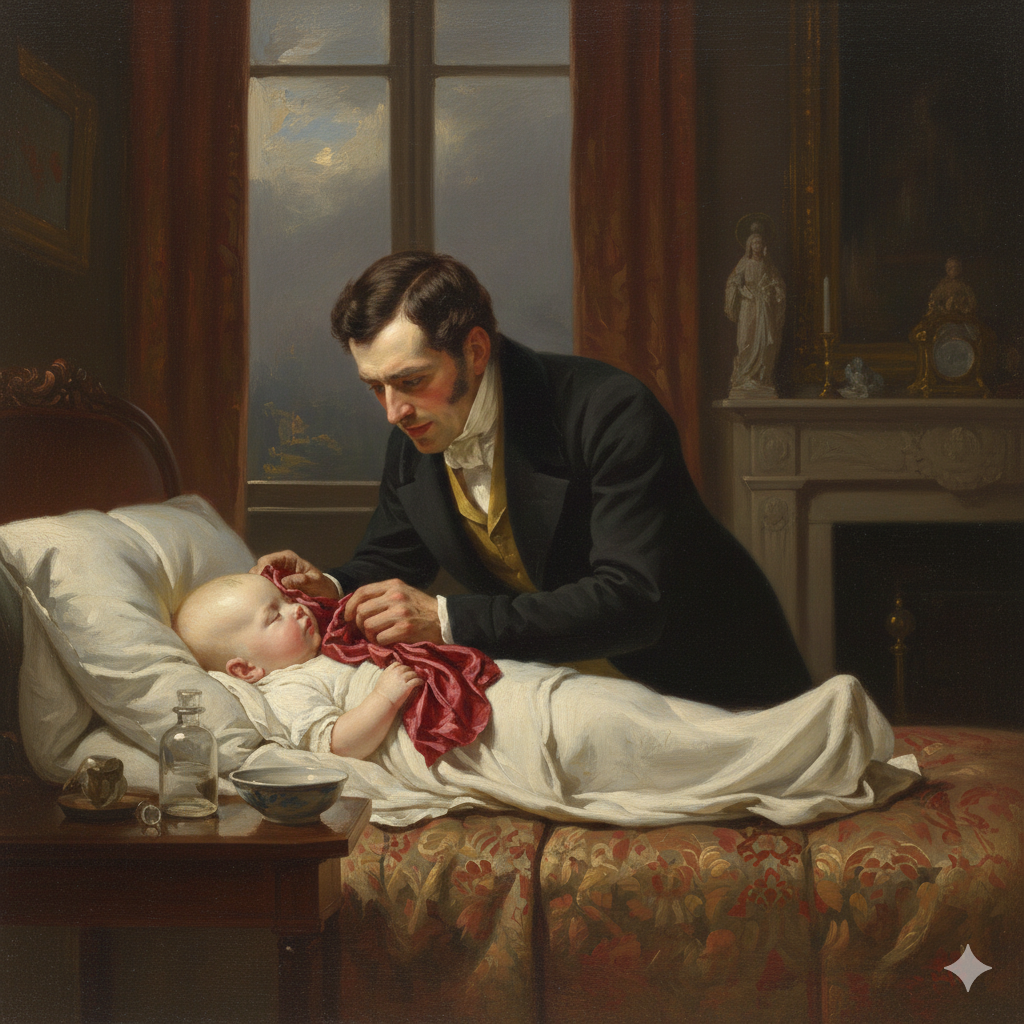
Another notable instance that really drives the point home, as it contains an element of contrast within it, comes from the life of Newel Knight, a close friend of Joseph Smith and one of the first branch presidents of the church, whose wife, Lydia, was sick and near to death in the early days of Nauvoo:
“One day [Lydia] called her husband to her bed and said: ‘Newel, go and ask the Prophet to send me a handkerchief with his blessing.’
“‘My dear wife, I do not like to trouble Joseph. You have no idea how worn down he is. He has asked the brethren to spare him as much as possible, for these constant never-ceasing calls upon him are depriving him of all his strength. I hope, my dear, you will soon be better.’
“The night came and passed and morning brought no relief to the weary sufferer. Again she called Newel to her and entreated him to go to the Prophet and get a handkerchief with his blessing.
“Newel went out, and in about half an hour returned, tied a handkerchief over her head saying: ‘There, Lydia, is a handkerchief.’
“The sufferer experienced no relief from it, however, and rapidly grew worse. A doctor was brought to her, and he tried his best to rally her, but all in vain. Thus one week passed.
“One day Newel, seeing she was all but gone and was trying to speak to him, bent over her to catch the faint whisper, ‘Newel, I am all but done with my suffering; good-by, dear one. You must do the best you can with the children. I cannot last much longer.’ This was very brokenly whispered to the distracted man above her, who, as soon as she ceased, hurried away. Coming back soon, he called her; she knew him but was unable to reply.
“‘Here, Lydia, here is a handkerchief from the Prophet Joseph. Oh my wife, the one I brought before was not from him, I so hated to trouble him. But see this is from Joseph, and he says your Heavenly Father shall heal you, and you shall be restored to life and health.’
“The handkerchief was bound around her brow, and as it touched her head, the blessing sent with it, descended upon her; and over her and all through her was poured the spirit of healing. Sleep, so long a stranger to the poor afflicted one, closed her eye-lids in a quiet, restful, blessed slumber. The hours came and fled, and in the quiet of midnight she awoke, and was like one who had been in a dark, loathsome dungeon, and was again free in the open air and sunshine.
“In the morning the physician came, and when he saw his patient, he exclaimed: ‘Why, I never saw such a change in my life! That last medicine has worked like a charm, I wish I’d stayed and seen it operate. Her pulse is all right, her tongue is all right, and in fact she is comparatively a well woman.’
“After the docter had praised up himself and his medicine to his heart’s content, Newel quietly reached the bottle down from the shelf, and said: ‘Sir, there is the medicine you speak of. My wife has not tasted one drop of it.’
“‘But what’s the meaning of all this change then?’
“‘She has been healed by faith through the Prophet Joseph Smith.’
“After studying some time over the matter the doctor said: ‘Well it’s a good thing to get well on any terms.'”17
Invoking the Faith of the Patriarchs Beyond the Veil
An order is an organizational structure with governing bodies and officers. Great men of the past, having magnified their calling through faith, were appointed to positions of authority over certain works; subsequent invocations of those works come through the authorization of those whom God made stewards.
The scriptures point out that there are varying degrees of governance within the Kingdom of Heaven, including but not limited to “thrones, or dominions, or principalities, or powers” (Col. 1:16; cf. D&C 132:19). These overlapping subdivisions are alluded to as reflections of earthly equivalents wherein servants and officers fill and lead them, respectively. In another place, the scriptures declare that Jesus “is Lord of lords, and King of kings: and they that are with him are called, and chosen, and faithful” (Rev. 17:14; cf. Deut. 10:17, Tim. 6:15). The correct understanding of such a title is had in recognizing not simply that Jesus is the best king or lord (though that is true) but in that He rules in a shared structure with other kings and lords—officers of overlapping subdivisions. As discussed in the recent blog post, Interstellar Relativity and the Heterarchal Kingdom of God, this shared structure is defined as a heterarchy, an ancient form of government where joint-rulers held sway together in a symbiotic federation of sorts (the expected structural outcome, perhaps, of the faithful becoming “joint-heirs” [Rom. 8:17] with Christ of “all that [the] Father hath” [D&C 84:38]).
In a similar formula to that of the use of “sacred relics” to transfer power or virtue between individuals, the ranks of the past faithful who have ascended to positions of power within the Holy Order allows subsequent mortal initiates of their same order to invoke the faith of their post-mortal superiors in carrying out certain works. This is sometimes referred to as connecting to “the priesthood on the other side of the veil” and informs us as to two inherent privileges that reside with initiates of the Holy Order accessible via their faith: power to seal and power to reveal.
Before we dive in to these two items, let us first see how this principle of a heterarcichal structure of ‘sealed’ or authorizing officers beyond the veil can be demonstrated in scripture. For example, in the Book of Revelation, these officers are referred to as “angels” but we might more accurately say “servants of the Holy Order given certain sealing powers”:
“And after these things I saw four angels standing on the four corners of the earth, holding the four winds of the earth, that the wind should not blow on the earth, nor on the sea, nor on any tree. And I saw another angel ascending from the east, having the seal of the living God: and he cried with a loud voice to the four angels, to whom it was given to hurt the earth and the sea, saying, Hurt not the earth, neither the sea, nor the trees, till we have sealed the servants of our God in their foreheads” (Rev. 7:1 – 3).
In a revelatory set of questions and answers, Joseph Smith learned more of the heterarchical roles and positions of these servants within the Holy Order:
“Q. What are we to understand by the four angels, spoken of in the 7th chapter and 1st verse of Revelation?
“A. We are to understand that they are four angels sent forth from God, to whom is given power over the four parts of the earth, to save life and to destroy; these are they who have the everlasting gospel to commit to every nation, kindred, tongue, and people; having power to shut up the heavens, to seal up unto life, or to cast down to the regions of darkness.
“Q. What are we to understand by the angel ascending from the east, Revelation 7th chapter and 2nd verse?
“A. We are to understand that the angel ascending from the east is he to whom is given the seal of the living God over the twelve tribes of Israel; wherefore, he crieth unto the four angels having the everlasting gospel, saying: Hurt not the earth, neither the sea, nor the trees, till we have sealed the servants of our God in their foreheads. And, if you will receive it, this is Elias which was to come to gather together the tribes of Israel and restore all things….
“Q. What are we to understand by sealing the one hundred and forty-four thousand, out of all the tribes of Israel—twelve thousand out of every tribe?
“A. We are to understand that those who are sealed are high priests, ordained unto the holy order of God, to administer the everlasting gospel; for they are they who are ordained out of every nation, kindred, tongue, and people, by the angels to whom is given power over the nations of the earth, to bring as many as will come to the church of the Firstborn” (D&C 77:8 – 9, 11).
In these verses we see that the four angels are ‘high priests, ordained unto the holy order,’ with a certain scope of administrative governance—namely, they are given geographically divided responsibility over: (1) the weather and (2) the selection of those who will be saved or damned; the angel ‘ascending out of the east’ (who is called an Elias), however, is described as a high priest given administrative governance over: (A) the gathering of the twelve tribes of Israel and (B) the selection of those who will be sealed out of the twelve tribes of Israel (brought to ‘the church of the Firstborn’ [Adam]). This angel speaks in the first-person plural (‘we’), referring to himself along with the four other servants, when describing the work of sealing the 144,000 high priests of the Holy Order despite the scope of their governance varying slightly.
This alignment of work despite governance distinctions shows that ‘Elias’ had to coordinate with and invoke the administrative authorization of his fellow servants to complete the work of his mission. Though not explicitly stated in the vision, these described servants themselves likely operate within the authorization of men in the Holy Order who are of an even greater faith and degree of power than they, and others higher than that (all of whom have ‘the seal of the living God’), even until one comes to God, who is the greatest and most faithful of all men. It is even possible that others stood in the heterarchy with Elias and the four higher servants, but Elias worked with those four specifically. Why? Because he needed them to delay causing massive physical destruction on the earth, according to their governance, until the 144,000 could all be found.
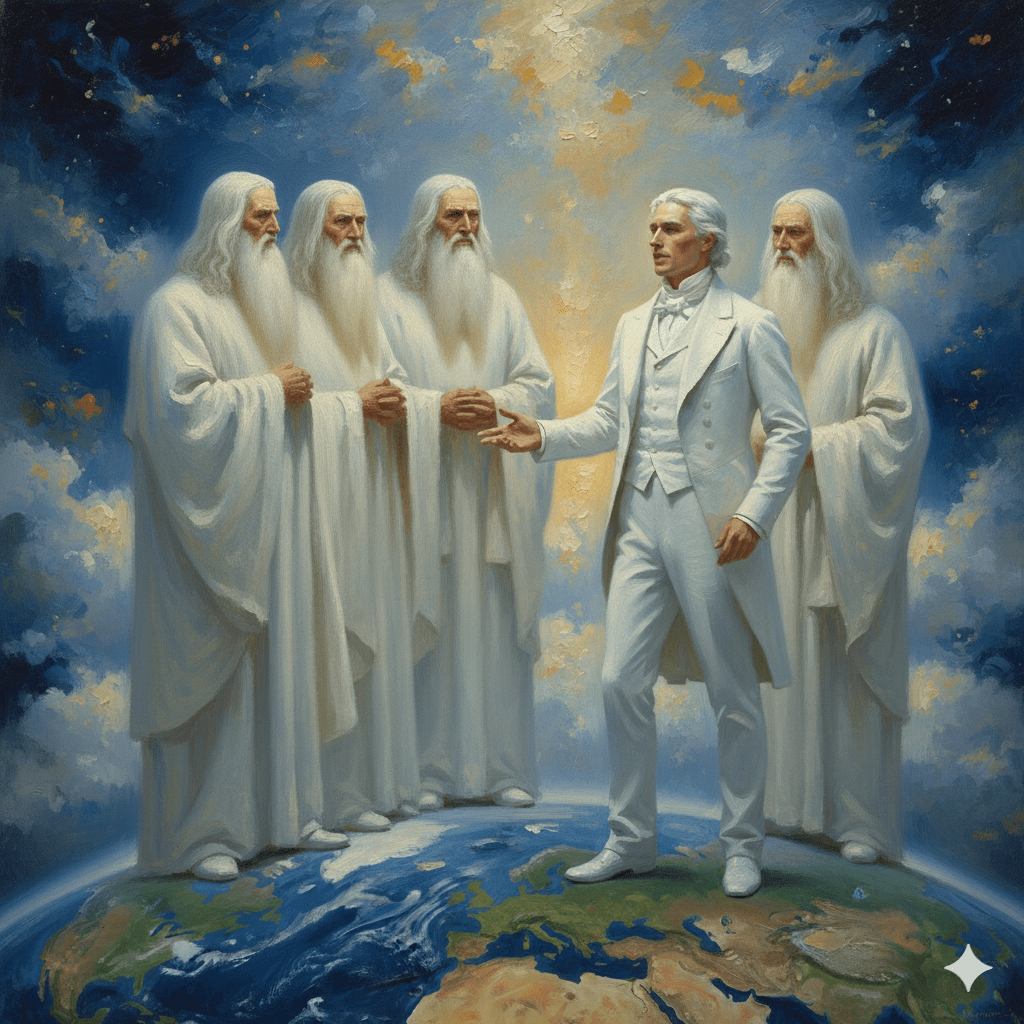
Joseph Smith once preached on the subject of heterarchies in heaven but appropriately subdued the language. (To explicitly detail all the heterarchical details could have led the early Mormons to adopt a Catholic form of praying to saints directly if left unchecked!) He emphasized that all we need to concern ourselves with is God at the head, our prayers offered to Him in the name of Jesus, and that His revelations would appear to come directly back from Him, through the divine investiture of authority via his ministering angels (or what we detect as the power of the Holy Ghost as discussed in the Aaronic Order section, above, about angels and the medium of the the Lord’s spirit):
“And again, God purposed in Himself that there should not be an eternal fullness until every dispensation should be fulfilled and gathered together in one, and that all things whatsoever, that should be gathered together in one in those dispensations unto the same fullness and eternal glory, should be in Christ Jesus; therefore He set the ordinances to be the same forever and ever, and set Adam to watch over them, to reveal them from heaven to man, or to send angels to reveal them. ‘Are they not all ministering spirits, sent forth to minister for them who shall be heirs of salvation?’ (Hebrews 1:14.) These angels are under the direction of Michael or Adam, who acts under the direction of the Lord.18a From the above quotation we learn that Paul perfectly understood the purposes of God in relation to His connection with man, and that glorious and perfect order which He established in Himself, whereby he sent forth power, revelations, and glory…. This, then, is the nature of the Priesthood; every man holding the Presidency of his dispensation, and one man holding the Presidency of them all, even Adam; and Adam receiving his Presidency and authority from the Lord,18b but cannot receive a fullness until Christ shall present the Kingdom to the Father, which shall be at the end of the last dispensation” (TPJS, 168 – 169).
From the foregoing we can see that angels, or at least patriarchs of the Holy Order who are beyond mortality, are under the direction of others within that same ‘glorious and perfect order.’ This shows that power in the priesthood comes from being connected to the governing system that is, simply, the other accepted priests of the order. This connection provides a two-way line for those connected in the heterarchy: being both (i) directed by higher authorities and (ii) dependent upon the powers or rights of the same.
Power to Seal & Power to Reveal
Taking another example from the scriptures, Nephi, the son of Helaman, after having proved himself true and faithful in all things, obtains an immense scope of power within the Holy Order:
“Behold, thou art Nephi, and I am God. Behold, I declare it unto thee in the presence of mine angels, that ye shall have power over this people, and shall smite the earth with famine, and with pestilence, and destruction, according to the wickedness of this people. Behold, I give unto you power, that whatsoever ye shall seal on earth shall be sealed in heaven; and whatsoever ye shall loose on earth shall be loosed in heaven; and thus shall ye have power among this people. And thus, if ye shall say unto this temple it shall be rent in twain, it shall be done. And if ye shall say unto this mountain, Be thou cast down and become smooth, it shall be done” (Hel. 10:6 – 9).
We read later that Nephi uses this power to cause a famine (see Hel. 11:4). Note how similar the language is that God uses to describe the powers he grants to Nephi with the language He used in D&C 77 to describe the four “angels” or servants with authority over certain aspects of nature (what we might call natural disasters). Indeed, Nephi calls upon God to cause the natural disaster of a famine and then it is carried out. Doubtless, the means by which it was carried out was God’s dispatching the fellow servant in the Holy Order on the other side of the veil who had been given dominion or power over the rains of the promised land. Note how that God declares Nephi’s authority ‘in the presence of [His] angels.’ Given the context just discussed, it appears that the presence of the patriarchal angels is so that they would recognize Nephi’s requests for their authority.
In a word, Nephi was brought into the heterarchy of the Holy Order, his right to ordination confirmed by God directly. As such, he was made a fellow servant, a king among kings and a lord among lords, able to call upon the faith and powers of the patriarchal angels in the Holy Order to make him “mighty in word and in deed, in faith and in works” (Hel. 10:5). So when Nephi asked God to stop the rains, on the other side of the veil God dispatched the servant to whom He had entrusted the control of the rain for that part of the world and he honored Nephi’s request.
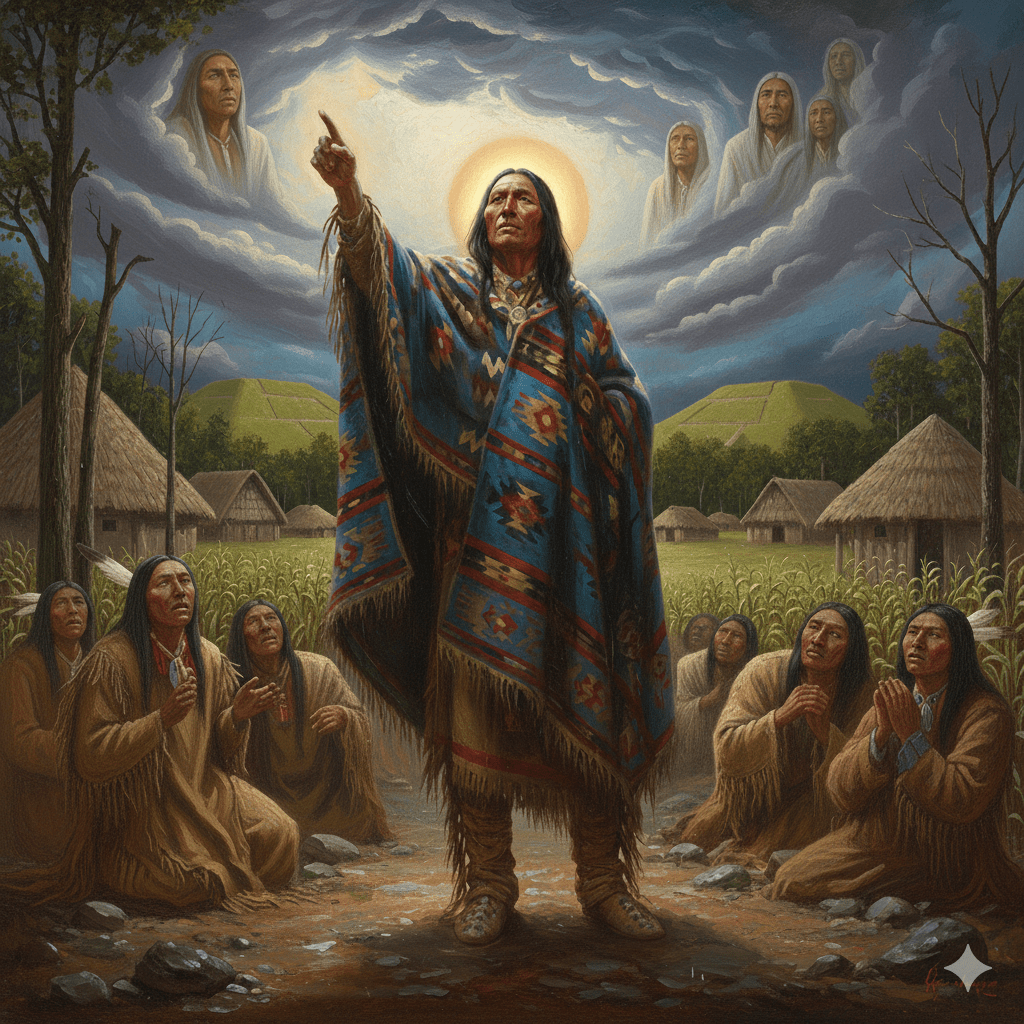
Operationally, a mortal priest petitions God; under divine investiture, the authorized stewards beyond the veil execute according to their governance. Requests are honored when the petitioner stands in the Holy Order (sealed and faithful) and asks within the bounds of his granted stewardship or office—thus mortal sealing and judgment align with the angels’ stewardships, becoming effective ‘on earth’ and ‘in heaven.’
This then is the substance of the “sealing power” that belongs to the Holy Order. No agreement or expectation of any kind in this life (see D&C 132:7) will be valid in the next without the ratification of the Holy Order—the whole body of it, both on this side of the veil and especially on the other. As discussed in my blog post, Confusing the One Man Doctrine & The Law of Adoption: a New Approach to D&C 132:7, this is commensurate with the Holy Spirit of Promise and is connected to the law of adoption, or the creation of “sealed” covenant relationships. Sealed covenant relationships constitute the only enduring connection to the Holy Order and must be guided by revelation. Thus ordinances, if they are to have validity beyond this world must also be “sealed,” and for that they must be attended to by a legal administrator, someone already in a sealed covenant in the Holy Order. Or as Joseph Smith said, “No man can attain to the joint heirship with Jesus Christ without being administered to by one having the same power and authority of Melchizedek”19 The prophet further noted the reason for this is because God ‘or angels’ will only recognize works performed by such legal administrators:
“Whenever men can find out the will of God and find an administrator legally authorized from God, there is the kingdom of God; but where these are not, the kingdom of God is not. All the ordinances, systems, and administrations on the earth are of no use to the children of men, unless they are ordained and authorized of God; for nothing will save a man but a legal administrator; for none others will be acknowledged either by God or angels” (TPJS, 274).
Being sealed into the Holy Order not only enables agreements and expectations to be valid in the next life, it also enables priests so sealed to communicate with one another through the veil (including Christ, the great high priest). In other words, being connected to the Holy Order beyond the veil enables increased revelation. As Joseph Smith taught:
“We cannot be perfect without the fathers…. We must have revelation from them, and we can see that the doctrine of revelation far transcends the doctrine of no revelation; for one truth revealed from heaven is worth all the sectarian notions in existence. This spirit of Elijah was manifest in the days of the Apostles, in delivering certain ones to the buffetings of Satan, that they might be saved in the day of the Lord Jesus. They were sealed by the spirit of Elijah unto the damnation of hell until the day of the Lord, or revelation of Jesus Christ” (TPJS, 338).
“Now the great and grand secret of the whole matter, and the summum bonum of the whole subject that is lying before us, consists in obtaining the powers of the Holy Priesthood. For him to whom these keys are given there is no difficulty in obtaining a knowledge of facts in relation to the salvation of the children of men, both as well for the dead as for the living” (D&C 128:11).
John Taylor echoes this message and pointed out how that modern receivers of ‘a knowledge of God and his law’ are merely following in the revelatory footsteps of those priests who went before:
“While we are engaged in building Temples and administering therein both for the living and the dead, the everlasting Priesthood in the heavens are engaged in operating in the same way in the interests of all humanity, not only of those who now live but those who have lived. We need, it is true, the assistance and guidance of the Almighty, and the Holy Priesthood behind the veil also requires our assistance and our help. Paul, who understood these things, said, ‘that they without us should not be made perfect’ [Heb. 11:40], and we without them cannot be made perfect [see D&C 128:15, 18]. They in their day had obtained a knowledge of God and his law, and we are permitted to obtain the same. God has been pleased to restore the same principles and to place us in communion with him and them. Hence, while they are operating in the heavens we are operating here upon the earth. We build Temples and administer in them. They are attending to those who have died without a knowledge of the Gospel, and who will communicate from time to time with us to show us our duty. It is written that ‘saviors shall come upon Mount Zion’ [Obad. 1:21]. How can a man be a savior if he saves nobody? And how can they save unless God shows them how? How can they build Temples unless they have a knowledge of the work in which they are engaged? And how can they administer in these Temples, unless God instructs them? They cannot do it; we cannot do it; nobody can do it; and therefore it is necessary that we should all the time be under the guidance and direction of the Almighty, for without Him we can do nothing” (John Taylor, JOD 22:292 – 293).
Father Priesthood; Mother Church
The Lord throughout scripture compares Himself to a husband and his people, or his churches, as his brides. As discussed in the blog post Horite Priest-Kings, the New and Everlasting Covenant, and the Succession Crisis of 1844, even in the parable of the ten virgins, which is an allegory of the churches or kingdom before the Lord comes (see Matt. 25:1, JST), the Lord is comparing himself to their betrothed husband. Another notable example includes:
“Behold, the days come, saith the LORD, that I will make a new covenant with the house of Israel, and with the house of Judah: not according to the covenant that I made with their fathers in the day that I took them by the hand to bring them out of the land of Egypt; which my covenant they brake, although I was an husband unto them, saith the LORD: but this shall be the covenant that I will make with the house of Israel; After those days, saith the LORD, I will put my law in their inward parts, and write it in their hearts; and will be their God, and they shall be my people” (Jer. 31:31 – 33; cf. Ezek. 23:1 – 4).
Referring to this exact marital imagery, Paul explains that Jesus, as the high priest of the Holy Order, accomplishes the establishment of a new covenant with his people via the Holy Order:
“Now of the things which we have spoken this is the sum: We have such an high priest, who is set on the right hand of the throne of the Majesty in the heavens…For every high priest is ordained to offer gifts and sacrifices: wherefore it is of necessity that this man have somewhat also to offer…. But now hath he obtained a more excellent ministry, by how much also he is the mediator of a better covenant, which was established upon better promises. For if that first covenant had been faultless, then should no place have been sought for the second. For finding fault with them, he saith, Behold, the days come, saith the Lord, when I will make a new covenant with the house of Israel and with the house of Judah” (Heb. 8: 1, 3, 6 – 8).
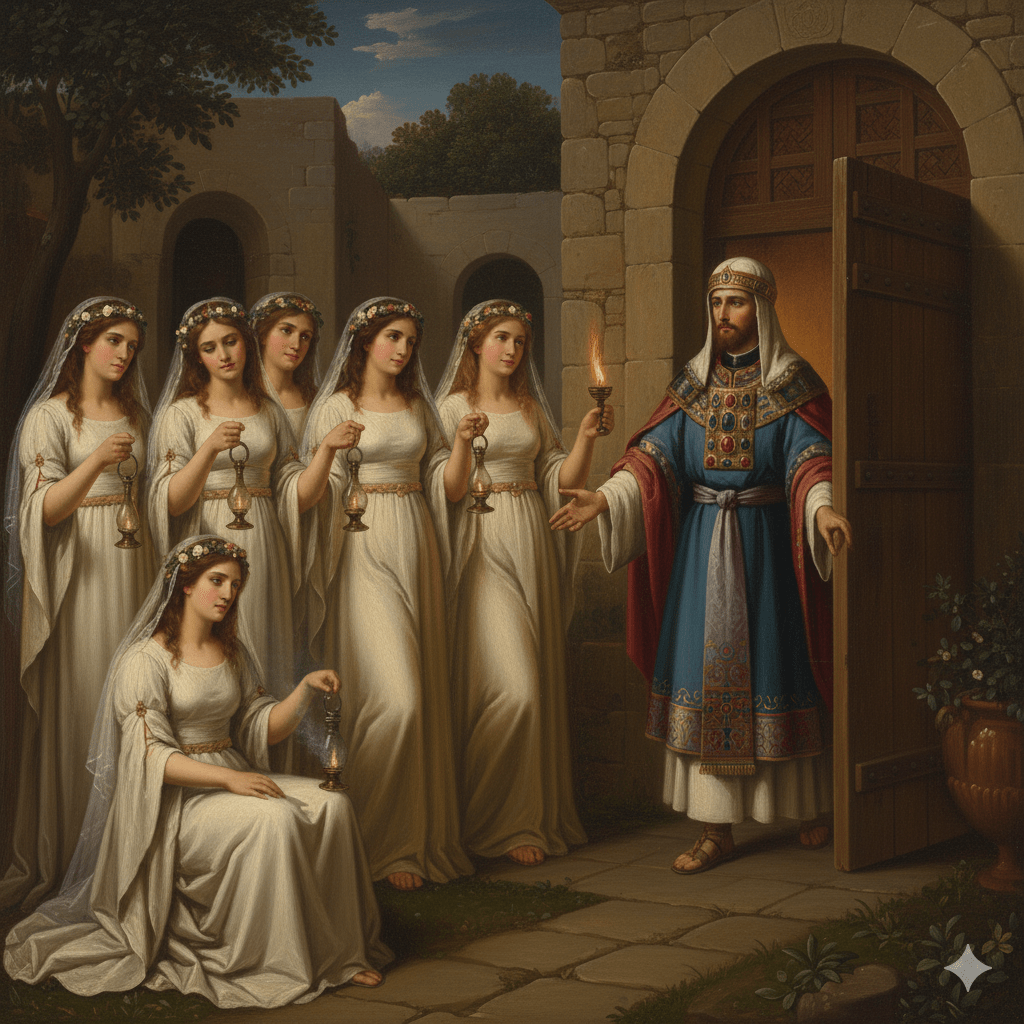
Note that Christ performs his great intercessory role for the church, the greatest sacerdotal role ever known, as a high priest. To people versed only in the offices that pertain to the church body, this designation may seem beneath the Lord. Yet it’s true, and it can be understood by a simple fact: the Aaronic Order only creates priests (hence priest-hood) and the Melchizedek Order only creates high priests (hence high priest-hood). The Lord himself acknowledges that all other offices (such as Elder, deacon, etc.) are just appendages:
“And again, the offices of elder and bishop are necessary appendages belonging unto the high priesthood. And again, the offices of teacher and deacon are necessary appendages belonging to the lesser priesthood, which priesthood was confirmed upon Aaron and his sons” (D&C 84:29 – 30).
Paul explains further that these appendages are temporary structures meant to help the saints work toward perfection (“till we all…” become high priests like Jesus):
“He gave some, apostles; and some, prophets; and some, evangelists; and some, pastors and teachers; for the perfecting of the saints, for the work of the ministry, for the edifying of the body of Christ: till we all come in the unity of the faith, and of the knowledge of the Son of God, unto a perfect man, unto the measure of the stature of the fulness of Christ” (Eph. 4:11 – 13).
John Taylor, commenting on the various offices seen in the church related to the high priesthood, explained that all of them are ultimately only high priests though with different callings:
“I will now speak a little upon the High Priesthood. This High Priesthood, we are told, has held the right of Presidency in all ages of the world. But there is a difference between the general powers of the Priesthood, and the particular office and calling to which men are set apart…. For instance the Presidency of the Priesthood, or the Presidency of the Church, are High Priests. The Twelve are High Priests. The Presidents of Stakes and their Counselors, the High Council of a Stake, and of all the Stakes, are High Priests. The Bishops are ordained and set apart through the High Priesthood, and stand in the same capacity; and thus Bishops and their Counselor are High Priests. Now, these things you all know. There is nothing mysterious about them” (John Taylor, JOD 22:196).
The implication of these facts is that the initiatic Holy Order is designed to bring initiates up by degrees until they become high priests and high priestesses. At that stage, once all the earthly ordinances have been pronounced on their heads, they become kings and queens sealed and tied into the heterarchy of God’s kingdom.
Given the priesthood’s primary nature to the church (as in, beyond the above analysis, historically Joseph Smith had to first obtain the priesthood before he could organize the church), the extended implication is that “climbing the ladder” of church callings has no bearing on the eternal career of a man. Critics of the church have ignorantly compared the church to a membership club where the best benefits are reserved for the elite tier members. This could be a tempting criticism to take seriously if one believed that only apostles qualify for kingship:
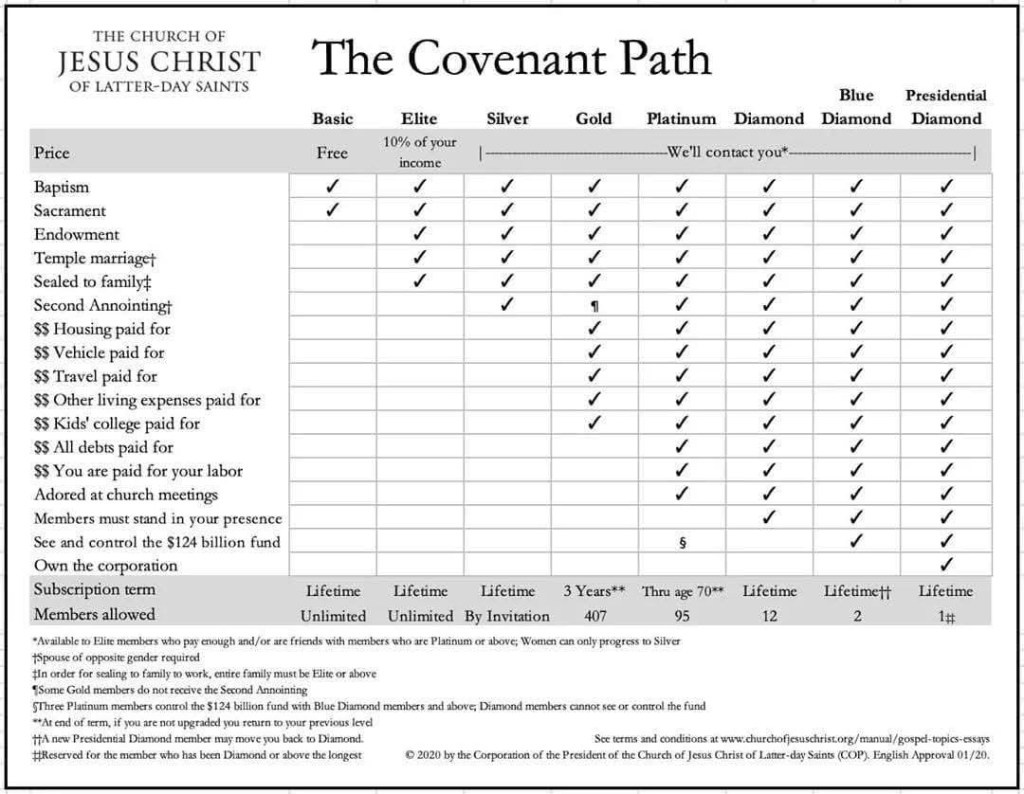
The true hetararchical structure of the Holy Order was illustrated in simple terms by Orson Hyde in 1847. In it, each connecting point is a king and priest to God, ruling over his own sphere and giving the allegiance of his sphere to God’s greater sphere:
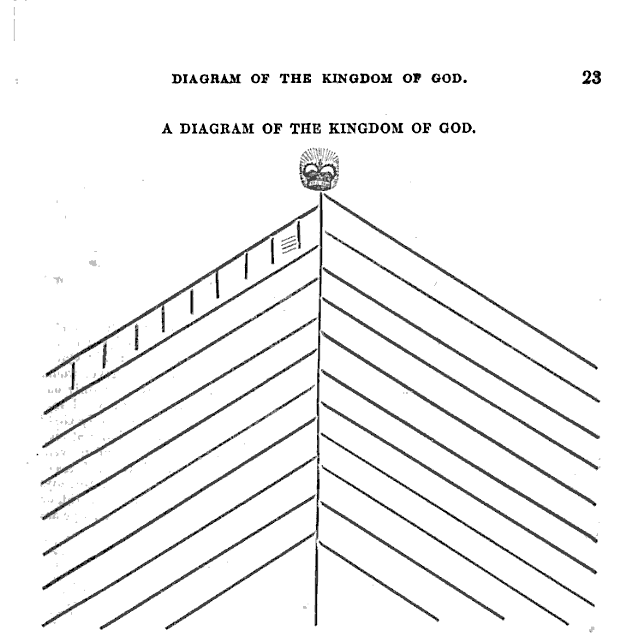
Of course the church is necessary to be organized to regulate the body of believers, all of whom are given different gifts by God (though eventually and ultimately You Need to be Your Own Prophet). But the path trod by most of the prophets and holy men of the past were not within what we would recognize as church boundaries; they were raised by degrees in the Holy Order directly. We too—even within the church—must be raised by degrees within the Holy Order to obtain the blessings they obtained. The only ladder to climb toward God is not one of church office, but one of mastering initiatic degrees.
To Change Ordinances Is to Change Priesthood
This brings us to the final and most powerful point of this discourse. As we have seen, an order is defined by its ordinances (including ordination), which are its degrees of instructive patterns. The world is filled with orders of various kinds, all of which have at least their conceptual origin in the original Holy Order of which Adam and Eve were a part. According to one account, Joseph Smith even went so far as to identify that “Freemasonry, as at present, was the apostate endowments, as sectarian religion was the apostate religion.”21 If many such orders trace back to a true original order, why are they now incapable of producing ‘legal administrators’? Joseph Smith gives us the answer:
“Ordinances instituted in the heavens before the foundation of the world, in the priesthood, for the salvation of men, are not to be altered or changed. All must be saved on the same principles” (TPJS, 308).
In modern times, the reason for advocating changes in ordinances has often been attributed to Joseph Smith, saying that he had advanced the principle that the “the government of heaven is conducted” on the principle of “revelation adapted to the circumstances in which the children of the kingdom are placed.” This is a true quote, but its context is needful, for he was not talking about ordinances but instead about commandments:
“We cannot keep all the commandments without first knowing them, and we cannot expect to know all, or more than we now know unless we comply with or keep those we have already received. That which is wrong under one circumstance, may be, and often is, right under another. God said, ‘Thou shalt not kill;’ at another time He said, ‘Thou shalt utterly destroy.’ This is the principle on which the government of heaven is conducted—by revelation adapted to the circumstances in which the children of the kingdom are placed. Whatever God requires is right, no matter what it is, although we may not see the reason thereof till long after the events transpire” (TPJS, 256).
That is the only quote the author could find from Joseph Smith on the topic of ‘adaption’ or change in the context of the administration of the kingdom; whereas the numbers of quotes where he specifically warns of changing ordinances are numerous and include but are not limited to:
“If there is no change of ordinances, there is no change of Priesthood. Wherever the ordinances of the Gospel are administered, there is the Priesthood” (TPJS, 158).
“The power, glory and blessings of the Priesthood could not continue with those who received ordination [except] their righteousness [also] continued; for Cain also being authorized to offer sacrifice, but not offering it in righteousness, was cursed. It signifies, then, that the ordinances must be kept in the very way God has appointed; otherwise their Priesthood will prove a cursing instead of a blessing” (TPJS, 168).
“If a man gets a fullness of the priesthood of God he has to get it in the same way that Jesus Christ obtained it, and that was by keeping all the commandments and obeying all the ordinances of the house of the Lord” (TPJS, 308).
This last quote brings us back to the full name of the priesthood: the Holy Priesthood, after the Order of the Son of God. To join this Holy Order, an initiate must pass through the same ordinances as the Son of God (and all those who already constituted that order). These original initiates will only recognize as duly ordained members those who have received and accorded to the same instructional patterns that they have; if it were not so, it would be a disorder! To be clear, entering into altered versions of those original ordinances does also put an initiate into the ranks of a body of adherents, it’s just a completely different set of people—not the church of the Firstborn.
That the Patriarchal Order of marriage, or polygyny, belongs to the Holy Order as a condition of full kingship (see Horite Priest-Kings, the New and Everlasting Covenant, and the Succession Crisis of 1844) shows that the Lord engaged Joseph Smith up to his dying day in restoring all the degrees of the order needed to fulfill the everlasting covenant, or promises, made to the fathers. Their descendants in the last days were to have these promises planted in their hearts (see D&C 2:2), along with a blood right to ordination, that they might turn to their fathers beyond the veil—the patriarchal angels or fellow servants—and establish Zion according to the pattern of instructions contained in the unchanging ordinances of the Holy Order:
“And this is mine everlasting covenant: that when thy posterity shall embrace the truth and look upward, then shall Zion look downward, and all the heavens shall shake with gladness, and the earth shall tremble with joy; and the general assembly of the church of the firstborn shall come down out of heaven, and possess the earth, and shall have place until the end come. And this is mine everlasting covenant, which I made with thy father Enoch” (Gen. 9:22 – 23, JST).
Many worldly commentators have been lauding changes in the church, from the time it abandoned plural marriage as a practice required for exaltation down to the most recent simplifications of the endowment ordinance with fewer laws, etc. But if “friendship of the world is enmity with God” (Jas. 4:4), the terrible question begs: are such changes the will of God? Or was His will prophetically decreed long ago when He warned:
“Behold, vengeance cometh speedily upon the inhabitants of the earth…. And upon my house shall it begin, and from my house shall it go forth, saith the Lord; first among those among you, saith the Lord, who have professed to know my name and have not known me, and have blasphemed against me in the midst of my house, saith the Lord” (D&C 112:24 – 26).
The prison of language must indeed be burst by those desiring to fulfill the promises made to the fathers. Mercifully, the fetters are made of lead, and the smallest effort can free our minds to see the priesthood more clearly. Pray always: concern yourself with your place in the Holy Order, learn to connect with the patriarchal angels, ascend the degrees by undertaking and applying the unchanged instructional patterns of its rites, and prepare to be tested and tried according to that knowledge that you might enter the rest of the Lord and someday perhaps obtain the highest degree, the Melchizedek Priesthood, by the Father directly.
Footnotes:
- JS, Letter, Kirtland Township, OH, to William W. Phelps, [Independence, Jackson Co., MO], 27 Nov. 1832. Retained copy, [ca. 27 Nov. 1832] in JS Letterbook 1, pp. 1–4; handwriting of JS and Frederick G. Williams; includes JS copy of signature of JS; CHL.↩︎
- “Hold.” Merriam-Webster.com Dictionary, Merriam-Webster, Last updated 5 Oct. 2025, HOLD Definition & Meaning – Merriam-Webster. Accessed 9 Oct. 2025.↩︎
- Very specifically, the ‘Order of the Son of God’ is an “initiatic order,” which is defined as: “A structured fraternity or brotherhood in which membership and advancement are granted through formal initiation rites that symbolically transform the individual and confer deeper levels of knowledge, responsibility, or spiritual authority.”3a↩︎3b↩︎
- This definition is derived from multiple sources that treat on the subject, including:
- “A regular organization possessing an unbroken chain of transmission, by which the initiatic influence is handed on through the rites of initiation and the participation in the symbols that express its doctrine.”
— Guénon, René. Perspectives on Initiation. (Sophia Perennis, 2001 English edition), ch. 2, “Initiatic Transmission.” - “Initiation always implies a passage from one mode of being to another… and is generally organized within a brotherhood or secret society that perpetuates traditional knowledge.”
— Eliade, Mircea. Rites and Symbols of Initiation. (Harper & Row, 1958), p. xvii. - “Associations structured by grades of initiation, where esoteric knowledge is transmitted progressively through ritual and symbol.”
— Faivre, Antoine. Access to Western Esotericism. (SUNY Press, 1994), p. 39.
- “A regular organization possessing an unbroken chain of transmission, by which the initiatic influence is handed on through the rites of initiation and the participation in the symbols that express its doctrine.”
- This definition is derived from multiple sources that treat on the subject, including:
- “Bro Joseph turned to me and said Bro Brigham this is not arranged right but we have done the best we could under the circumstances in which we are placed, and I wish you to take this matter in hand and organize and systematize all these ceremonies with the signs, tokens penalties and Key words. I did so, and each time I got something more so that when we went through the Temple at Nauvoo I understood and Knew how to place them there, we had our ceremonies pretty correct” (L. John Nuttall diary, Feb. 7, 1877, as recalled by Brigham Young).↩︎
- Hubbard MacKay, Michael (2021) “Event or Process? How ‘the Chamber of Old Father Whitmer’ Helps Us Understand Priesthood Restoration,” BYU Studies Quarterly: Vol. 60 : Iss. 1 , Article 4. Available at: https://scholarsarchive.byu.edu/byusq/vol60/iss1/4↩︎
- Pratt, Parley P. Quoted in “Minutes, circa 3–4 June 1831,” The Joseph Smith Papers, edited by the Church Historian’s Press. Accessed 25 Nov. 2025.↩︎
- Richards, Franklin D. Scriptural Items. “27 Aug 1843”. 1841–1844. Manuscript, Church History Library, MS 4409; spelling and grammar modernized.↩︎
- Ibid.↩︎
- Joseph Smith Papers, “Discourse, 27 August 1843, as Reported by James Burgess.” ID #1151; featured version copied in James Burgess, Journal and Notebook, Oct. 1841–Dec. 1848, verso, pp. [14]–[18]; handwriting of James Burgess. JSP, D13:78–79; grammar and punctuation modernized.↩︎
- Ibid.↩︎
- This account is powerful to read and was written by Vibia Perpetua herself before her death in the year 203AD. The fuller portion of the quote above says: “In…a few days we were baptised, and the Spirit declared to me, I must pray for nothing else after that water save only endurance of the flesh…. Then said my brother to me: Lady my sister, you are now in high honor, even such that you might ask for a vision; and it should be shown you whether this be a passion or else a deliverance. And I, as knowing that I conversed with the Lord, for Whose sake I had suffered such things, did promise him nothing doubting; and I said: Tomorrow I will tell you. And I asked, and [a vision] was shown me.”
Kirby, Peter. “Acts of Perpetua and Felicitas.” Early Christian Writings. 2025. 29 Oct. 2025 <http://www.earlychristianwritings.com/text/perpetua.html>.↩︎ - Orson F. Whitney, Life of Heber C. Kimball, Bookcraft, 1975, p. 241; italics added. Also see the blog post, Classic Truth: The Light of Christ.↩︎
- Ibid., p. 93.↩︎
- Thomas Bullock in the Manuscript History of the Church vol. 3, 1326; vol. 4, addenda segment, 26-27, 38-43; spelling and grammar modernized.↩︎
- See my blog post, Classic Truth: Administering the Form Without the Power.↩︎
- “History of Wilford Woodruff,” Millennial Star, vol. 27, no. 1 (May 27, 1865), 326.↩︎
- Homespun. “Lydia Knight’s History.” The First Book of the Noble Women’s Lives Series. Salt Lake City: Juvenile Instructor Office, 1883.↩︎
- By this, the meaning is likely Adam’s father, his Lord in the Holy Order. See Plain & Precious Keys for Decoding the Adam-God Doctrine.18a↩︎18b↩︎
- Richards, Franklin D. Scriptural Items (See footnote 7).↩︎
- Orson Hyde, “A Diagram of the Kingdom of God,” Millennial Star 9 (15 January 1847), 23.↩︎
- Benjamin F. Johnson, My Life’s Review, p. 93 (1947).↩︎
 Home | The Science of Theology