
Few verses of modern scripture have been more fiercely debated throughout Mormon history as Doctrine and Covenants section 132 verse 7 (hereafter referred to as “D&C 132:7”). For mainstream Latter-day Saints, it is their claim to the church president’s authority in all the world; for fundamentalist sects, it has often been theirs too. Many, many groups use it to point to their “one man” who sits at the top and say that this verse justifies his place in authorizing all eternal marriages in the world (not coincidentally, within the homes of LDS and FLDS members alike, portraits of their top leading men are often found prominently displayed on their walls or on their mantles).
For a refresher, the verse will be reproduced with some additional contextualizing verses around it. The verse belongs to the introductory portion of a revelation on plural marriage that Joseph Smith dictated in 1843 (though he likely knew of it as early as 1831 and personally acted upon it after the visit by Elijah in 1836). Here’s the whole “Current Text” in question (hereafter referred to as “CT”):
Current Text (“CT”)
- Verily, thus saith the Lord unto you my servant Joseph, that inasmuch as you have inquired of my hand to know and understand wherein I, the Lord, justified my servants Abraham, Isaac, and Jacob, as also Moses, David and Solomon, my servants, as touching the principle and doctrine of their having many wives and concubines….
- Prepare thy heart to receive and obey the instructions which I am about to give unto you; for all those who have this law revealed unto them must obey the same.
- For behold, I reveal unto you a new and an everlasting covenant; and if ye abide not that covenant, then are ye damned; for no one can reject this covenant and be permitted to enter into my glory….
- As pertaining to the new and everlasting covenant, it was instituted for the fulness of my glory; and he that receiveth a fulness thereof must and shall abide the law, or he shall be damned, saith the Lord God.
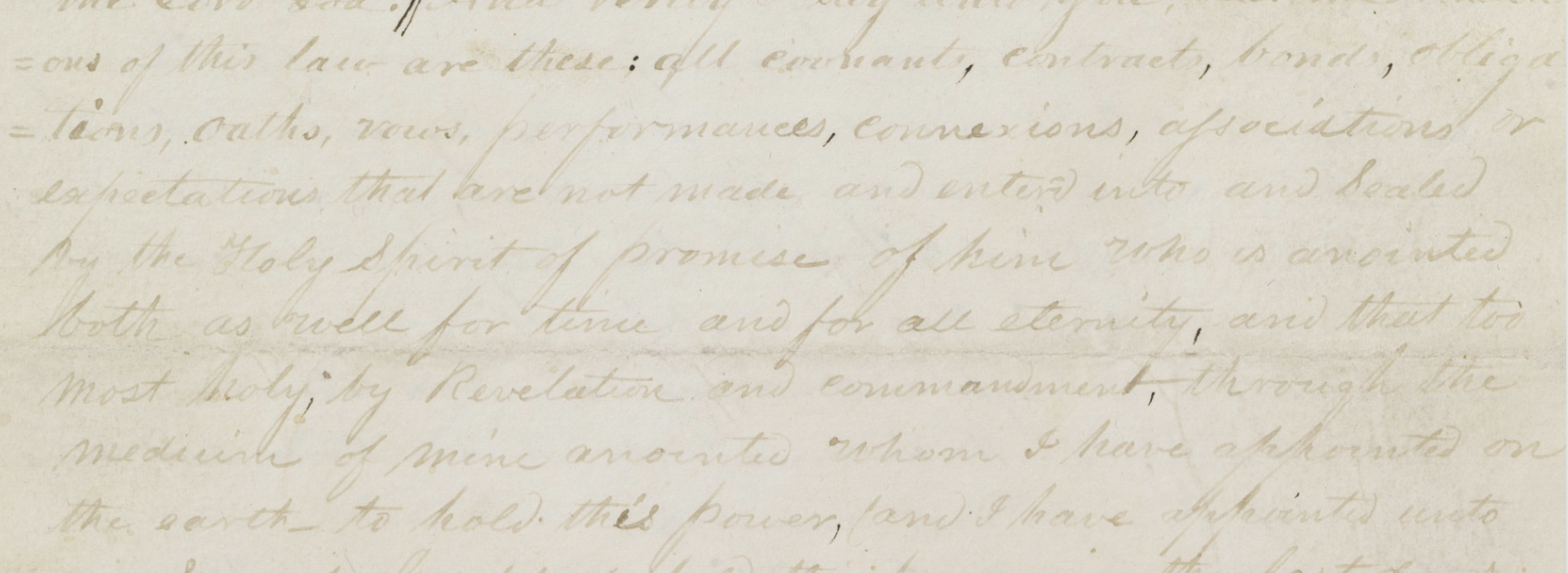
- And verily I say unto you, that the conditions of this law are these: All covenants, contracts, bonds, obligations, oaths, vows, performances, connections, associations, or expectations, that are not made and entered into and sealed by the Holy Spirit of promise, of him who is anointed, both as well for time and for all eternity, and that too most holy, by revelation and commandment, through the medium of mine anointed, whom I have appointed on the earth to hold this power (and I have appointed unto my servant Joseph to hold this power in the last days, and there is never but one on the earth at a time on whom this power and the keys of this priesthood are conferred), are of no efficacy, virtue, or force in and after the resurrection from the dead; for all contracts that are not made unto this end have an end when men are dead.
- Behold, mine house is a house of order, saith the Lord God, and not a house of confusion.
The text is rather cumbersome and a bit unwieldy to a modern reader. This is further exacerbated by the fact that the original document transcript did not have any punctuation, so what we have today is a best guess to help cleanup the long-winded law. Here is an image of one of the earliest surviving manuscripts penned in the Nauvoo era:
Thus if we cannot rely on the punctuation to help appropriately clarify the text, a grammatical analysis of the words used alone must be entered into. So here it is, broken down into an easier-to-comprehend format, a sentence “Diagramed Text” version (hereafter referred to as the “DT”):
Diagramed Text (“DT”)

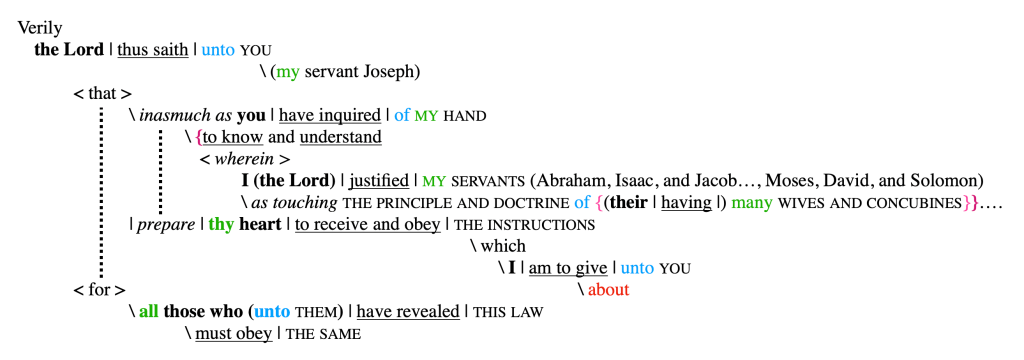
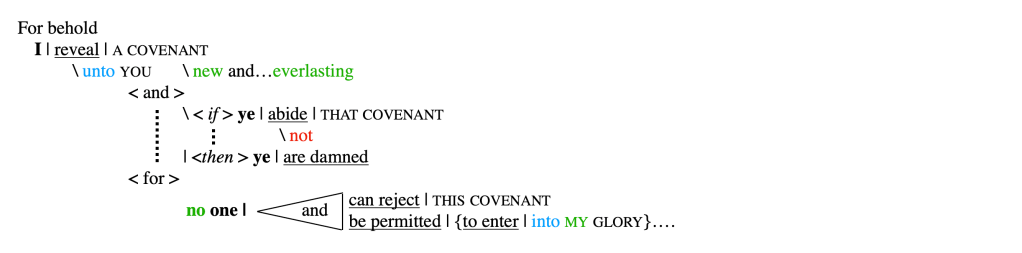

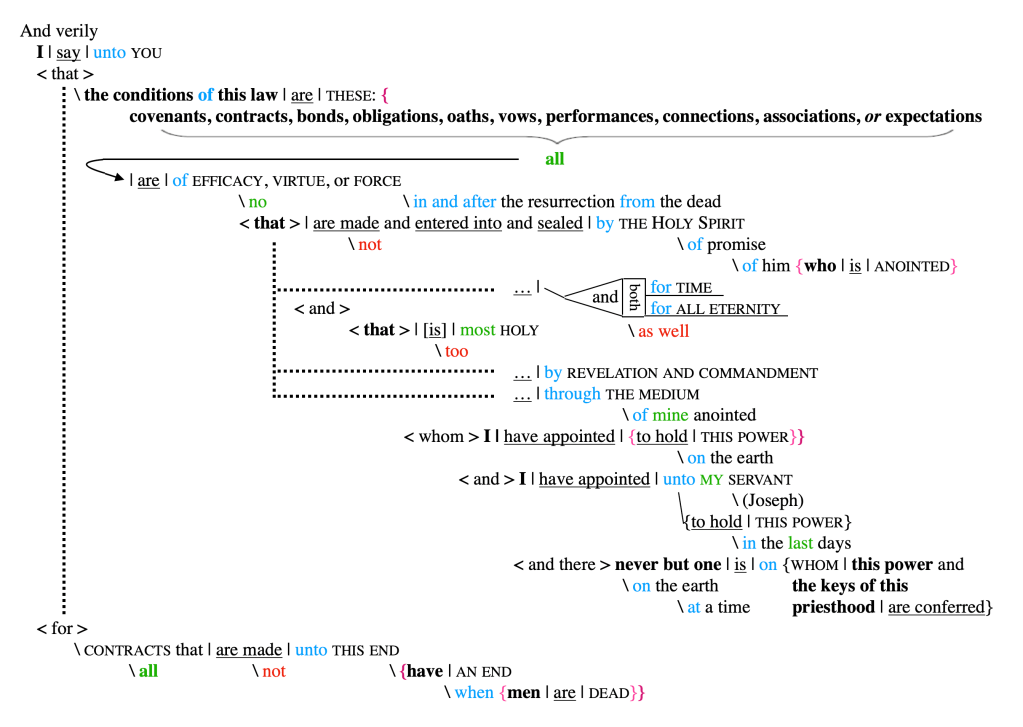

This sentence diagraming exercise enables us to derive a more plain rewrite of the content, a “Simplified Text” as follows (hereafter referred to as “ST”):
Simplified Text (“ST”)
Truly, my servant Joseph, since you have asked me how in principle and doctrine I justified my servants in times past who had multiple wives and concubines (like Abraham, Isaac, Jacob, Moses, David, or Solomon), the Lord says to you: prepare your heart for the instructions I am about to give, because, whenever I give the answer to this question, I require those who receive the answer to also live it.
Because look, [beyond being just instructions,] I am revealing a new and everlasting covenant to you! And if you are not true to it, your progress will be halted because only those who have received this covenant can join me where I live.
Now, regarding this covenant, it exists to bring people all the way to the highest place where I live, and so anyone who wants to join me there is required to successfully handle the law of this covenant or be halted in their progress as I have proclaimed.
Now here it is—the following are the details of the law of this covenant:
All promises made between people of any kind in this life will not apply in the resurrection—meaning that, outside of the terms of this law, any and all agreements will end at death—that is, unless the following conditions are all met regarding the making of promises between people. They must be:
- Sealed by the Holy Spirit of promise by the means of an anointed one;
- Made not just for time but also in holiness for all eternity;
- Entered into by revelation and commandment; and
- Be through the anointed one whom I have appointed to hold a special place and power in the last days. (What I mean is, there’s only ever one man at a time on the earth to whom I confer this special priesthood power, and, for this last dispensation, I have selected Joseph Smith Jr. to be that man.)
See, it must be this way because I live in a place that is perfectly ordered and there is no confusion here.
The above resources enable us to more clearly see the following points:
- The revelation is about plural marriage
- (I know this seems obvious, but there are detractors out there; eternal monogamy inferred in the text must be a misconstruction of the fact that plural marriage is in its most basic parts a parallel series of husband-wife unions, hence the text talks of “a man” and “his wife” meaning only one of his wives within the broader context of a plurality of such unions wherein the common husband cleaves “unto his wife” and they twain become “one flesh”);
- Plural marriage is part and parcel of the New and Everlasting Covenant
- (Hence early Mormon references to plural marriage simply called it the ‘New and Everlasting Covenant’);
- This covenant is governed by a law; and
- That law has certain conditions or provisos (specifically four, as enumerated in the ST).
Regarding the provisos, an analysis of the words used shows that the function of the repetitious prepositions (‘by,’ ‘of,’ ‘for,’ ‘through’) appears to indicate the delineation of each intended condition, each associated prepositional phrase linking back to the main predicate (which is that covenants ‘are made and entered into and sealed’).
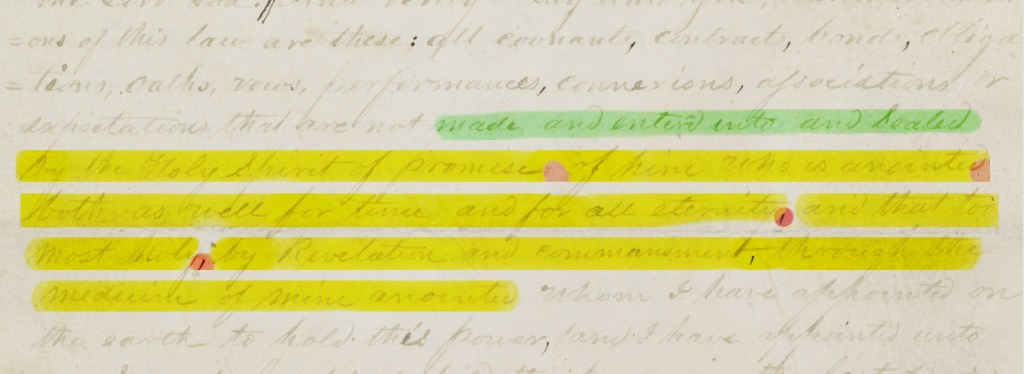


The analysis of the original manuscript’s usage of prepositional phrasing, as illustrated above, allows us to perceive an interesting detail that has apparently escaped notice for almost two centuries: the ‘anointed’ one referred to performs two separate functions and may in fact be two different men. Let’s take a closer look:
Proviso 1 states that:
- An eternal covenant, such as marriage, must be ‘sealed by the Holy Spirit of promise, of him who is anointed‘ (CT)
While Proviso 4 simultaneously requires that:
- An eternal covenant, such as marriage, must be ‘through the medium of mine anointed’ (CT).
According to the generally received interpretation that only one man on earth, being duly anointed, can authorize and perform eternal marriages, why would the Lord repeat that proviso, with different wording and separated by a couple other Provisos?
The answer to that question may lie in a previously unrecognized aspect of the law the Lord gave Joseph Smith as pertains to entering the Kingdom of God, one which is nonethelss vital and perhaps even paramount to the concept of eternal marriage itself: the Law of Adoption. Therefore to understand the differences between Proviso 1 and Proviso 4, we must first build a firm foundation of understanding this crucial doctrine and principle.
The Law of Adoption
The prophet Brigham Young is famously quoted for a dream he had of Joseph Smith shortly after the martyrdom in February of 1847 wherein he interacts with Joseph in the spirit world. It is usually quoted in a truncated form. For example, Elder David A. Bednar did exactly this in his October 2010 General Conference address, “Receive the Holy Ghost”:
“Several years after the Prophet Joseph Smith was martyred, he appeared to President Brigham Young and shared this timeless counsel: ‘Tell the people to be humble and faithful and [be] sure to keep the Spirit of the Lord and it will lead them right. Be careful and not turn away the small still voice; it will teach [you what] to do and where to go; it will yield the fruits of the kingdom. Tell the brethren to keep their hearts open to conviction so that when the Holy Ghost comes to them, their hearts will be ready to receive it. They can tell the Spirit of the Lord from all other spirits. It will whisper peace and joy to their souls, and it will take malice, hatred, envying, strife, and all evil from their hearts; and their whole desire will be to do good, bring forth righteousness, and build up the kingdom of God. Tell the brethren if they will follow the Spirit of the Lord they will go right.'”1
What most people don’t know is the question and context Brigham had in obtaining this counsel from the departed spirit of the prophet Joseph Smith and what more Joseph had to say about it. Here is Brigham’s journal entry in full for the surprising answer:

In my dream I went to see Joseph. He sat [by] a large window in a southwest direction, leaned back in his chair, with his feet on the lower round. I took him by the right hand and kissed him many times. He looked perfectly natural. I asked him why it was that we could not be together as we used to live; [that] he had been from us a long time and we wanted his society; and [that] I [did] not like to be separated from him.
He rose up from his chair [and] looked at me with an earnest and pleasant countenance, [and] spoke in his usual way, “It is all right.”
I then said to him, “I do not like to be away from you.”
“It is right,” he replied. “We cannot be together yet. We shall, by and by, but you will have to do without me a while. And then we shall be together again.”
I then discovered there was a handrail between us. He stayed by the window, and I was in twilight; to the north of me, it was very dark; to the southwest of him, it was very light.
I then said to Brother Joseph, “The brethren you know well better then I do; you raised them up, and brought the priesthood to us. The brethren have great anxiety to understand the law of adoption or sealing principles.” And I Said, “If you have a word of counsel for me I shall be glad to receive it.”
Joseph stepped towards me looked very earnest yet pleasant and commenced his instruction: “Tell the people to be humble and faithful and sure to keep the spirit of the Lord and it will lead them right. Be careful and not turn away the small, still voice; it will teach how to do and where to go; it will yield the fruits of the kingdom. Tell the brethren [to] keep their hearts open to conviction so that when the Holy Ghost comes to them their hearts will be ready to receive it. They can tell the spirit of the Lord from all other spirits; it will whisper peace and joy to their souls, and it will take malice, hatred, envying, strife, and all evil from their hearts; and their whole desire will be to do good, bring forth richness, and build up the Kingdom of God.
“Tell the brethren if they will follow the spirit of the Lord, and, if they will, they will find themselves just as they where organized by our Father in Heaven before they came into the world. Our Father in Heaven organized the human family, but they are all disorganized and in great confusion.“
Then he showed me the pattern—how they they were in the beginning. This I cannot describe, but saw it and where the priesthood had been taken from the earth, and how it must be joined together so there would be a perfect chain from father Adam to his latest posterity.
He said, “Tell the people to be sure to keep the spirit of the [Lord] and follow it and it would lead them just right.”2
So we see that Joseph’s famous posthumous instructions were not about just having the spirit of the Lord for the sake of having the spirit; Joseph was telling Brigham that to understand both the Law of Adoption and how to organize the human family the brethren of the priesthood would need to listen carefully to the instruction, or revelation, they could obtain by the spirit of the Lord. This would enable the chain back to ‘father Adam’ to be correctly constructed.
This surprising context sheds interesting light on the thoughts and concerns of Brigham Young in the midst of administering the ordinances of the recently completed Nauvoo Temple to the saints who were to leave for the west in a few short months. The most pressing question was not where to go or how to get there, but rather how to organize the kingdom under the Law of Adoption.
Unfortunately, the Law of Adoption is little understood today, and the practice of it is completely abandoned in the church. Despite this, the proofs for its importance are numerous, both within and without the scriptures.
Let Him Enter
The first principle to comprehend in understanding its importance is that no person can let himself or herself into the presence of the Father, to dwell where he dwells. Besides needing to be resurrected into the right type of body to not melt in his presence (his world conducting such energy that bodies insufficiently capacitated to handle it would be immediately disorganized), it is furthermore required that someone who is already on the inside admit someone who is on the outside wanting in. As Joseph Smith said on different occasions, placing himself in the position of admitting the saints to heaven through himself:
- “If you will follow the revelations and instructions which God gives you through me, I will take you into heaven as my back load.”3
- “I will walk through the gate of heaven and claim what I seal, and those that follow me and my counsel.”4
- “God has wrought out a salvation for all men, unless they have committed a certain sin; and every man who has a friend in the eternal world can save him, unless he has committed the unpardonable sin. And so you can see how far you can be a savior.”5
Though a bit cryptic and veiled, Jesus’s allusion to this concept within his intercessory prayer for his disciples in his day establishes the concept that the friends one saves in the eternal world glorifies the one who becomes that medium of salvation, or being ‘a savior’ for his friends. Note how that Christ brings glory to the Father (as the Father admits the Son into heaven) while Christ’s disciples bring glory to Jesus (as Jesus admits his disciples):
“And this is the way to have eternal life—to know you, the only true God, and Jesus Christ, the one you sent to earth. I brought glory to you here on earth by completing the work you gave me to do. Now, Father, bring me into the glory we shared before the world began….
“My prayer is not for the world, but for those you have given me, because they belong to you. All who are mine belong to you, and you have given them to me, so they bring me glory. Now I am departing from the world; they are staying in this world, but I am coming to you. Holy Father, you have given me your name; now protect them by the power of your name so that they will be united just as we are” (John 17:3 – 5, 9 – 11, NLT).
That “no man cometh unto the Father, but by me [the son]” (John 14:6), is a phrase that is also an allusion to this doctrine inasmuch as the only son of Adam who lived worthy to be sealed directly to the Father and admitted by Him into the fulness of His glory was Jesus Christ (hence “only begotten” as a covenant relationship). This is visually told by the earliest depiction of the ascension of Jesus Christ, which was wrought in ivory in the 4th century AD:
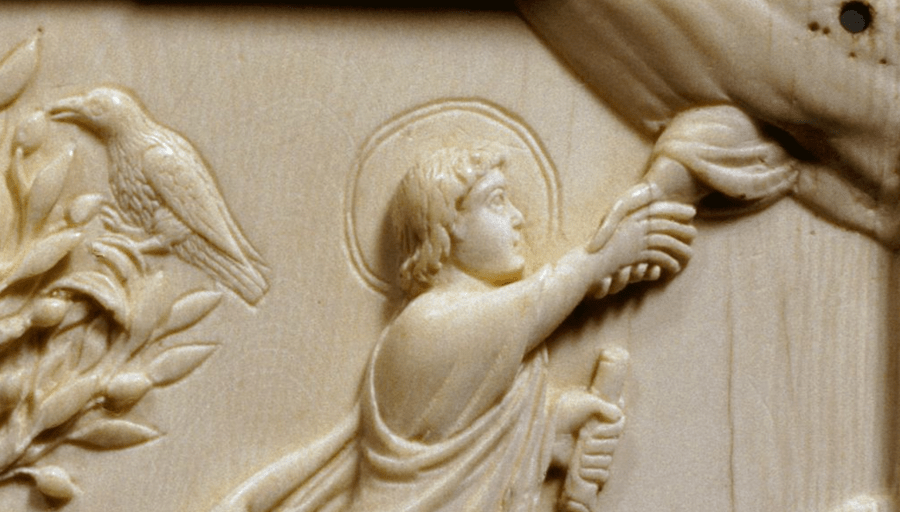
Though we admit the literal parentage of God the Father to Jesus Christ, the summum bonum of the Law of Adoption is the arranging of father-to-son covenant relationships that enable the kingdom of God to be a house of order, all who enter needing to pass by their fathers in covenant until they ultimately pass by Christ before being admitted to the Father. For this reason, all people who enter the presence of the Father will need to pass by the Son. It is also the same reason why all people of this last dispensation who will enter the presence of the Son will have to pass by Joseph Smith on their way:
“No man or woman in this dispensation will ever enter into the celestial kingdom of God without the consent of Joseph Smith. From the day that the Priesthood was taken from the earth to the winding-up scene of all things, every man and woman must have the certificate of Joseph Smith, junior, as a passport to their entrance into the mansion where God and Christ are—I with you and you with me. I cannot go there without his consent. He holds the keys of that kingdom for the last dispensation—the keys to rule in the spirit world; and he rules there triumphantly, for he gained full power and a glorious victory over the power of Satan while he was yet in the flesh, and was a martyr to his religion and to the name of Christ, which gives him a most perfect victory in the spirit world. He reigns there as supreme a being in his sphere, capacity, and calling, as God does in heaven. Many will exclaim—’Oh, that is very disagreeable! It is preposterous! We cannot bear the thought!’ But it is true.”6
Why must all people of this dispensation who desire exaltation pass by Joseph Smith? It is simply because all must be adopted to him as sons (grandsons, great grandsons, etc.) to be connected back to the Father inasmuch as no righteous unbroken line existed from the days of Christ down to the restoration of the Gospel. As Brigham said Joseph had shown him in a dream, the human family had been ‘organized’ once by ‘our Father in Heaven’ but now ‘they are all disorganized and in great confusion.’ Brigham drove the point home in a private discourse the the day before he had the dream:
“I have gathered a number of families around me by the Law of Adoption and seal of the covenant according to the order of the priesthood, and others have done likewise, it being the means of salvation left to bring us back to God. But had the keys of the priesthood been retained and handed down from father to son throughout all generations up to the present time then there would have been no necessity of the Law of Adoption for we would have all been included in the covenant [naturally] and would have been legal heirs instead of being heirs according to promise.”7
Six months later, and with stronger language, he reinforced the point:
“All the ordinances of the gospel administered by the world since the apostasy of the [original] church were illegal, in like manner was the marriage ceremony illegal, and all the world who had been begotten through illegal marriage were bastards and not sons; and hence they had to enter into the Law of Adoption and be adopted into the priesthood in order to become sons and legal heirs of salvation.”8
The New Family Kingdom
Fathers & Sons
Brigham’s choice of words is rough to modern ears, but the point is consistent: the human family will be reorganized according to covenant relationships wherever natural ones are insufficient to enable someone to be administered an entrance into heaven—and no natural connection exists to connect us back to Christ except through Joseph Smith, through those sealed to him as sons.
This new family kingdom (a.k.a, “the priesthood”) could be illustrated visually like a branching genealogical “descendant chart” (reverse pedigrees would be lineal inasmuch as the system is strictly patriarchal, each son having exactly one father). The top most and earliest traced ancestor in the covenant chain would be our Father in Heaven, connected to him would be one son, Jesus Christ, and branching from Jesus would be his disciples, and so on with those sealed to them as sons (including worthy natural born sons). This is, in fact, exactly the famous diagram published by Orson Hyde a month before Brigham’s dream:
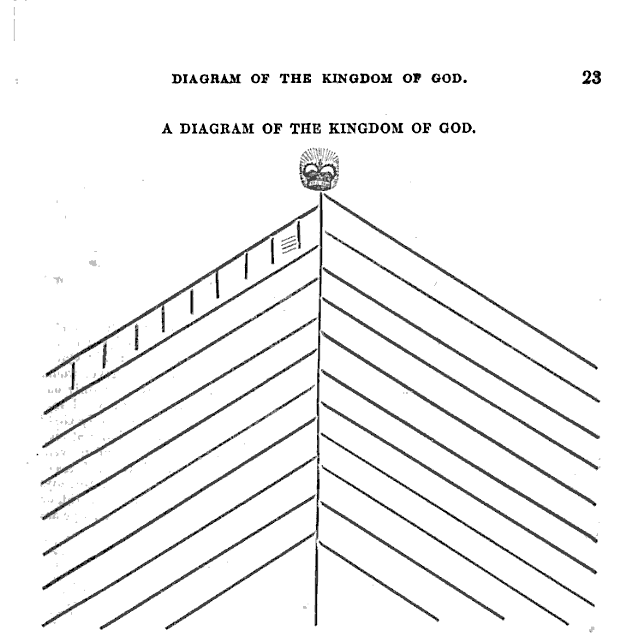
“The above diagram shows the order and unity of the kingdom of God. The eternal Father sits at the head, crowned King of kings and Lord of lords. Wherever the other lines meet, there sits a king and a priest unto God, bearing rule, authority, and dominion under the Father. He is one with he Father, because his kingdom is joined to his Father’s and becomes part of it.…”9
The pattern of this kingdom structure then is not only the delineation of sub-kingdoms and principalities within the God’s kingdom, but the ascending lineal pedigree would also serve as a schematic of the series of “sentinels and angels” that one will trace as he presents “the signs and tokens pertaining to the Holy Priesthood” on his way up to the presence of the Father of all.10 As Heber C. Kimball more fully fleshed out:
“Joseph always told us that we would have to pass by sentinels that are placed between us and our Father and God. Then, of course, we are conducted along…from one dispensation to another, by those who conducted those dispensations.”11
It may be wondered then how a man could presently ascend through his sealings until he comes to the place of the Father if he is not now sealed into a perfectly righteous, unbroken chain back to Him. Any of us modernly who are sealed only to our blood ancestors runs up against the paucity of historical records to even make such a chain if (and that’s an important ‘if’) those in the chain are even worthy of that connection (or attempt to become worthy of it in the spirit world). This very question in large part was the impetus in the early days of the church for men to seek to be sealed to the apostles of the church so they could tie more reliably into that family kingdom. In fact, the practice of getting sealed as a son to a prophet or apostle in order connect back to Joseph Smith was the norm until 1894 under the presidency of Wilford Woodruff. He then famously said:
“I want every man who presides over a Temple to see performed from this day henceforth and forever, unless the Lord Almighty commands otherwise, is, let every man be adopted to his father. When a man receives the endowments, adopt him to his father; not to Wilford Woodruff, nor to any other man outside the lineage of his fathers. That is the will of God to this people.” 12
Though these comments would seem to shut off the Law of Adoption forever as a principle of the kingdom, the full comments by Wilford Woodruff, which are seldom if ever reproduced, show that no such change in doctrine was anticipated by him:
“We want the Latter day Saints from this time to trace their genealogies as far as they can, and to be sealed to their fathers and mothers. Have children sealed to their parents, and run this chain through as far as you can get it. When you get to the end, let the last man be adopted to Joseph Smith, who stands at the head of the dispensation. This is the will of the Lord to this people, and I think when you come to reflect upon it you will find it to be true…. When you get to the last man in the lineage, as I said before, we will adopt that man to the Prophet Joseph, and then the Prophet Joseph will take care of himself with regard to where he goes. A man may say, ‘I am an Apostle, or I am a High Priest, or I am an Elder in Israel, and if I am adopted to my father, will it take any honor from me?’ I would say not. If Joseph Smith was sealed to his father, with whom many of you were acquainted, what effect will that have upon his exaltation and glory? None at all. Joseph Smith will hold the keys of this dispensation to the endless ages of eternity…. Those of you who stand here—I do not care whether you are Apostles or what you are—by honoring your fathers you will not take any honor from your heads; you will hold the keys of the salvation of your father’s house, as Joseph Smith does.”13
Thus the central importance of the Law of Adoption in building the kingdom of God was not lost on Wilford Woodruff, but sometime institutionally thereafter was lost, his words in their full context being apparently not understood. For his part, Woodruff understood that the only way to connect the chain back to the Father was through Joseph Smith by the Law of Adoption.
Wives and Daughters
Returning to the context of marriage unions, we can see foundational aspects of the Law of Adoption sprinkled into the revelation of the law of the New and Everlasting Covenant (D&C 132). This context reinforces the fact that no man can be made a king in a chain of kings without having the ratification of a queenship:
“And again, verily I say unto you, if a man marry a wife by my word, which is my law, and by the new and everlasting covenant…they shall pass by the angels, and the gods, which are set there, to their exaltation and glory in all things, as hath been sealed upon their heads, which glory shall be a fulness and a continuation of the seeds forever and ever” (D&C 132:19).
The formative presence of woman in the patriarchal order of the priesthood kingdom is at least two fold:
- They nurture and bear the physical bodies of men who can join the patriarchal order as kings in the first place, and
- They are the source of glorification to the kings who make them their queens.
These two points should stand alone by reason, but should scriptural support be needed it is readily available as well:
- “[Queens] are given unto [a King] to multiply and replenish the earth, according to my commandment, and to fulfil the promise which was given by my Father before the foundation of the world, and for their exaltation in the eternal worlds, that they may bear the souls of men; for herein is the work of my Father continued, that he may be glorified” (D&C 132:63).
- “[Man] is the image and glory of God: but the woman is the glory of the man” (1 Cor. 11:7).
It is the union of man and wife that brings to pass the crucial step known as “mortality” for man, and since man is that he might become immortal and have eternal life, which is God’s work and glory, it is through the marriage of his sons and daughters that God obtains his glory (see 2 Ne. 2:25 and Moses 1:39). The Law of Adoption connects these dots by showing how the human family will be arranged by covenant in order to fulfill these promises of glory to God and man. It could be stated, in short, that the Law of Adoption is as crucial to exaltation in a fallen world as the New and Everlasting Covenant itself. Consider the following simple rules:
- A king in heaven may admit and receive glory from his queens and children (sons and daughters, natural or adopted)
- Any sons who themselves married may turn around and admit and receive glory from their queens and children (sons and daughters, natural or adopted),
- So on to as many as will be chosen
- Any sons who themselves married may turn around and admit and receive glory from their queens and children (sons and daughters, natural or adopted),
Now we may apply these rules to history and see Joseph Smith’s crucial place in the fulfillment of the “restoration of all things”:
- God admits Jesus into the highest degree of the Celestial Kingdom and is glorified therein;
- Jesus turns around and admits his wives and children (natural born children and/or covenant disciples who conform to the requirements), to the same, increasing his glory and the glory of the Father;
- (Children who remain single and never marry have no one sealed to them to admit to heaven, and their line ends there;)
- Sons, natural or adopted, who are sealed to wives and covenant sons turn around and admit their wives, natural born children, and covenant sons, obtaining and passing upwards even more glory;
- At some point during the Great Apostasy, the line of worthy males ends and the patriarchal kingdom dissolves;
- The sealing keys are restored to Joseph Smith and the covenant kingdom re-established through his being sealed in the line to Jesus, allowing the glory of all who are exalted in the final dispensation to rise up to the Father through the Son;
- Joseph is now able to turn around and admit his wives and worthy natural born children and covenant sons; and
- Those who search out their ancestors and seal themselves back to Joseph Smith—or someone sealed back to Joseph Smith—will be admitted to heaven in order, being glorified themselves and bringing their glory to God.
- At some point during the Great Apostasy, the line of worthy males ends and the patriarchal kingdom dissolves;
- Jesus turns around and admits his wives and children (natural born children and/or covenant disciples who conform to the requirements), to the same, increasing his glory and the glory of the Father;
The above rules and history could be illustrated with a diagram like the following. It follows the diagram presented by Orson Hyde but is expanded to show the place of women, who are represented by the red/ochre color. The yellow arrows indicate the flow of glory up to God who is King of Kings (Jesus taking his place at the prophesied handing over of the world to him as Daniel foresaw).
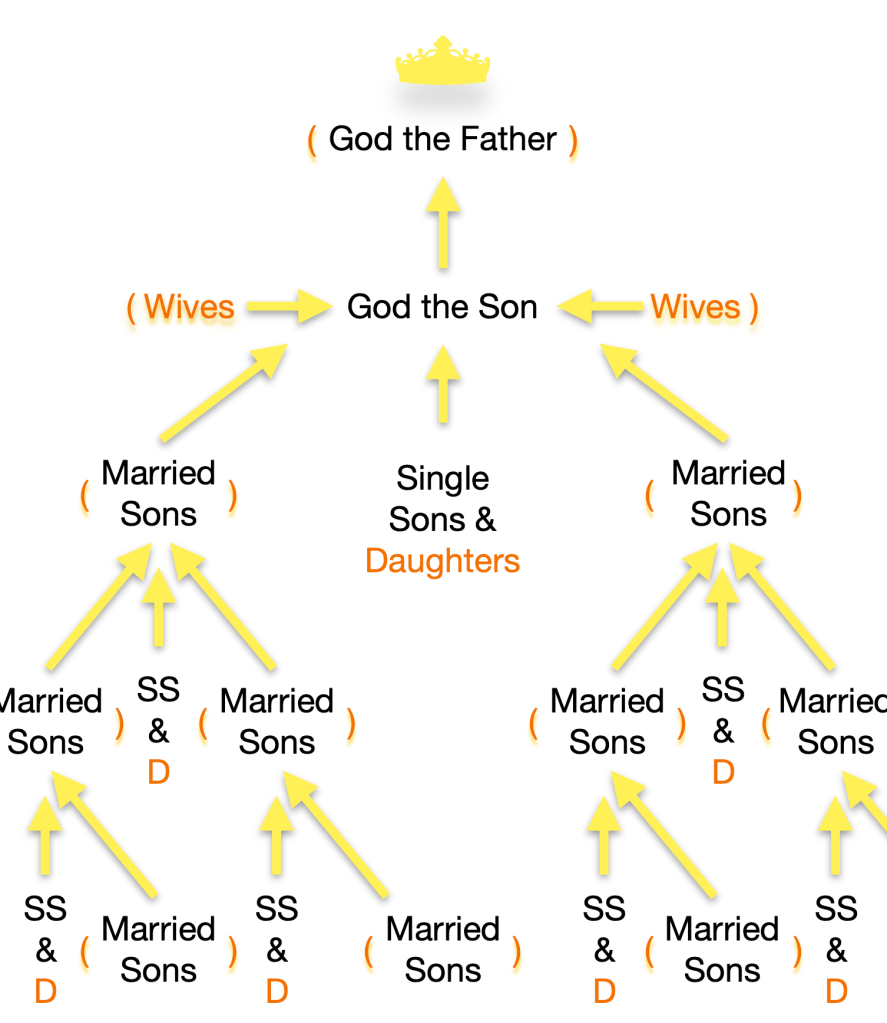
With the foregoing details of the integral Law of Adoption now laid out, we can return to the controversy of D&C 132:7 to answer the question of why the Lord repeated the need for an ‘anointed one’ in the provisos to his law.
Putting It Together
So, why are there two ‘anointed one’ references in D&C 132:7? Let’s review the provisos to remember what we mean here. For covenant relationships to be eternal, they must be:
- Sealed by the Holy Spirit of promise by the means of an anointed one;
- Made not just for time but also in holiness for all eternity;
- Entered into by revelation and commandment; and
- Be through the anointed one whom I have appointed to hold a special place and power in the last days. (What I mean is, there’s only ever one man at a time on the earth to whom I confer this special priesthood power, and, for this last dispensation, I have selected Joseph Smith Jr. to be that man.)
It has long been assumed, and is the accepted interpretation by both the LDS and the FLDS (among others), that the two references to an ‘anointed one’ are in fact references to one in the same person. This interpretation has resulted in the concentration of all sealing power only being available on ‘one man at a time,’ namely the President of the organization; when others are allowed to perform sealing ceremonies, it is considered to only be under the delegation of the ‘one man’ and not by virtue of a bestowal of any actual authority.
But is this correct?
Textually speaking, there seems to be more going on in D&C 132:7 than the Lord simply repeating himself haphazardly. What if, instead, the two seemingly repetitious provisos are referring to different people? Consider the following:
- Proviso 1 refers to any man or set of men to whom the power to seal marriages and adoptions has been conferred;
- (‘Sealed by the Holy Spirit of promise by [someone anointed to the sealing authority]….’ [ST])
- Proviso 4 refers to Joseph Smith’s place at the head of the new family organization established via the Law of Adoption, all valid connections having therefore to go ‘through the medium’ of his sentinel position to the presence of the Son.
- (‘Be through [the head of adoption in this dispensation] whom I have appointed to hold a special place and power in the last days….’ [ST])
Note the particular use of the preposition ‘through’, as in ‘through the medium of mine anointed’ (CT) who is clarified to be Joseph Smith.14 Beyond that particular wording, it is also compelling to note how that the Lord clarifies that this ‘anointed’ one always follows a predictable pattern: there is only one at a time (a) physically and (b) temporally. Physically, the scope is earth; and temporally it is the ‘last days.’ Thus this would seem to clearly preclude anyone after Joseph Smith, in the last days, from being able to claim this position! From the perspective of Proviso 4—Joseph standing at the head of the Law of Adoption to this dispensation—such exclusivity makes perfect sense; from the perspective of Proviso 1, it doesn’t make sense because it contradicts church history granting the sealing power to subsequent leaders.
Furthermore, the Lord says that this anointing is only ‘conferred’ to one man alone; yet, in the spring of 1844, Joseph Smith specifically ‘conferred’ the sealing power (Proviso 1) to multiple men:
“[Joseph Smith] called the Twelve together the last time he spoke to us, and his face shone like amber. And upon our shoulders he rolled the burden of the Kingdom, and he gave us all the keys and powers and gifts to carry on this great and mighty work. He told us that he had received every key, every power and every gift for the salvation of the living and the dead, and he said: ‘Upon the Twelve I seal these gifts and powers and keys from henceforth and forever. No matter what may come to me. And I lay this work upon your shoulders. Take it and bear it off, and if you don’t, you’ll be damned.'”15
This seems contradictory only if one considers the ‘anointed one’ of Proviso 1 to be the same as that of Proviso 4 (wherein the Lord specifies that conferral is on ‘never but one’ at a time); however, when the ‘one man’ concept is clarified to only apply to Proviso 4 as being the head of the Law of Adoption in this dispensation, then the right to confer the sealing power on multiple men on earth at a time, as he said he had done with the Twelve Apostles, falls in line with the terms of Proviso 1.
This is actually implied in other sections of the Doctrine and Covenants:
“It may seem to some to be a very bold doctrine that we talk of—a power which records or binds on earth and binds in heaven. Nevertheless, in all ages of the world, whenever the Lord has given a dispensation of the priesthood to any man by actual revelation, or any set of men, this power has always been given. Hence, whatsoever those men did in authority, in the name of the Lord, and did it truly and faithfully, and kept a proper and faithful record of the same, it became a law on earth and in heaven, and could not be annulled, according to the decrees of the great Jehovah. This is a faithful saying. Who can hear it?” (D&C 128:9)
Doctrine and Covenants section 132 itself even seems to contradict the idea that the sealing power can only be held by one person at a time:
“David’s wives and concubines were given unto him of me, by the hand of Nathan, my servant, and others of the prophets who had the keys of this power; and in none of these things did he sin against me save in the case of Uriah and his wife; and, therefore he hath fallen from his exaltation, and received his portion; and he shall not inherit them out of the world, for I gave them unto another, saith the Lord” (D&C 132:39).

This is an important point supporting Proviso 1, the power to seal, being applicable to more than one ‘anointed’ man at a time. The scriptures bear out that at least three prominent servants of God overlapped through David’s life when they say, “The acts of David the king, first and last, behold, they are written in the book of Samuel the seer, and in the book of Nathan the prophet, and in the book of Gad the seer” (1 Chr. 29:29).
Other specific instances within the scriptures supporting the overlap of these multiple men include:
- Three chapters before Samuel the seer died, a different man, Gad the seer, simultaneously begins working with David: “The prophet Gad said unto David, Abide not in the hold; depart, and get thee into the land of Judah. Then David departed, and came into the forest of Hareth” (1 Sam. 22:5).
- Nathan the prophet also shows up and begins to work with David, including his rebuke against David’s murder of Uriah in 2 Samuel 12:7-10, despite the fact that Gad the seer is mentioned yet again in working with David in 2 Samuel 24:11 – 14.
These verses support verse 39 of Doctrine and Covenants section 132 in claiming that multiple men during David’s life ‘had the keys of this power’ who overlapped with one another; which supports section 128 claiming a ‘set of men’ may have sealing power; which supports Joseph’s own actions, having conferred those same powers to the Twelve Apostles in his day. Thus the conditions of the law of the New and Everlasting Covenant may be seen to truly have a scriptural and historic case for including a proviso for multiple men to simultaneously have the power to seal as also a proviso for ‘one man’ (Joseph Smith) to perform a special function for all those sealed, admitting all others to Jesus via his own sealing.
Conclusion: Faithful Brigham & the Late Nauvoo Chaos
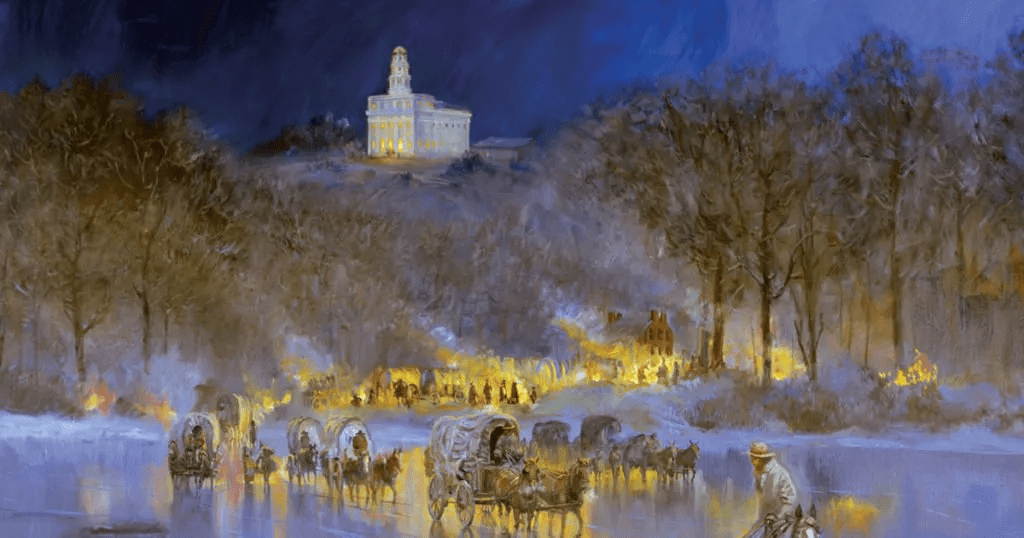
After Joseph died, the secret sayings and meetings related to the establishment of the New and Everlasting Covenant began to come forth as increasingly public knowledge. Unfortunately, due to the secretive nature of it all, with the exception of the text of Doctrine and Covenants section 132, we are at the mercy of the recollection of the early apostles, who succeeded Joseph, in maintaining an accurate doctrinal picture of all these things. Though doubtless they performed this function as admirably and faithfully as any set of men could be expected to do, is it possible that some recollections were faulty?
It will be remembered that when Joseph appeared to Brigham in a dream that it was expressly Brigham’s lack of a full grasp of Joseph’s teachings on the Law of Adoption that preoccupied his worries. The saints who knew of plural marriage as a true principle promulgated by the prophet were quickly embroiled into a firestorm of inner turmoil and clandestine defensiveness in the months following Joseph’s death. Under these terrible conditions, Brigham Young and the rest of the Apostles sought carefully to retain the easily abused rights of the sealing power to only those who needed to know. There had been and continued to be in Nauvoo no lack of unruly men (strikers and false teachers) who sought to take advantage of unsuspecting, believing women.
It was during this time that many communications regarding the sealing power were entered into, slowly reinforcing the concept that the only person who could seal a marriage or an adoption was the ‘one man’ at the head of the church. Anecdotes were recollected but possible context forgotten. As an example, Brigham wrote to censure William Smith, the prophet’s brother, for sealing women to himself during patriarchal blessings. In that letter he said:
“You refer to ‘Joseph’s teachings upstairs in the brick store, that the Twelve have power to build up the kingdom of God, etc.,’ which the Twelve well recollect and they also recollect that Joseph said that the sealing power is always vested in one man, and that there never was nor never would be but one man on the earth at a time to hold the keys of the sealing power in the church, that all sealings must be performed by the man holding the keys or by his dictation, and that man is the president of the Church.
“Hyrum held the patriarchal office legitimately. So do you. Hyrum was counselor. So are you. But the sealing was not in Hyrum legitimately neither did he act on the sealing principle only as he was dictated by Joseph. This was proven for Hyrum did undertake to seal without counsel and Joseph told him if he did not stop it he would go to hell and all those he sealed with him.”16
Why would Joseph have told Hyrum that those sealed persons that he personally did not approve of would ‘go to hell’? To Brigham’s understanding, it was that Hyrum had no power without Joseph’s authorization as the ‘one man’ who controlled all sealing power (still the current LDS and FLDS view); however, it may just as easily have been the case that despite having the power to seal, Hyrum still needed Joseph’s approval inasmuch as those sealed would have to pass by Joseph to enter heaven—a responsibility that made Joseph, as the highest living head of the adopted family kingdom, entitled to personally approve all who would be exalted by being sealed to him.
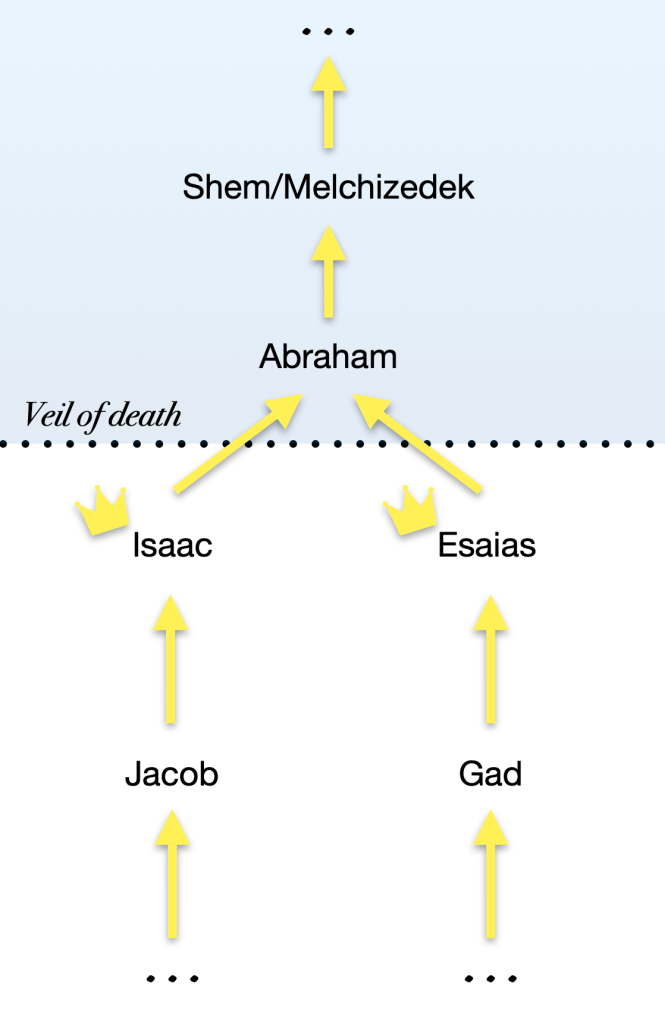
In some traditional, patriarchal families from the old country (including my own a few generations ago), it was the custom for the oldest living male progenitor to personally approve of all marriages being entered into by his posterity. Was this tradition an artifact of ancient, true practices passed down by the righteous patriarchs of old? Consider for a moment the great pains Abraham took to ensure that his son, Isaac, would marry the right person, seeking revelation and prophecy through his servant to find Rebecca. Why did Abraham care so much? Because it was his right as the oldest patriarch living in his day. Once Abraham stepped behind the veil in death, Isaac then became the living gatekeeper of that line, and after Isaac died then Jacob. In Joseph Smith’s day, he was the living gatekeeper. Could this explain Joseph’s strict command to Hyrum if it was recollected correctly?
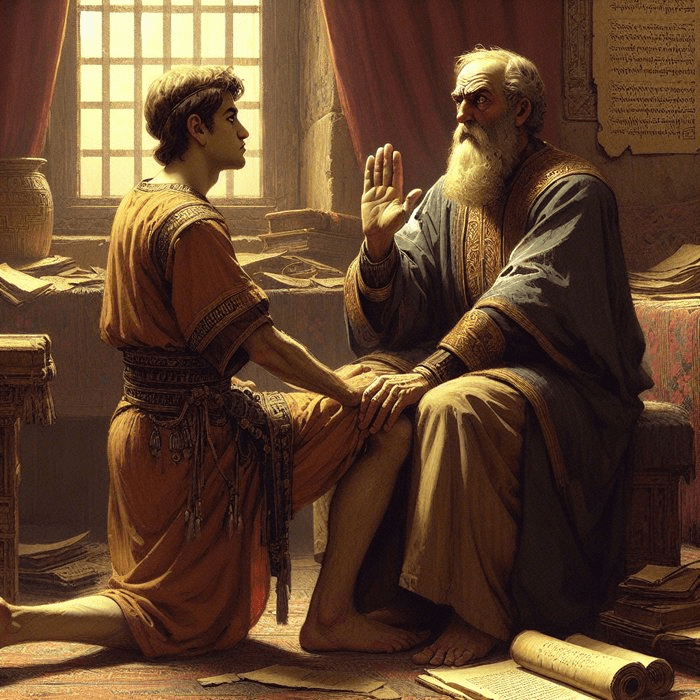
After Joseph was martyred, who then became the next gatekeeper or eldest patriarch of the adopted family line entitled to approve all new connections to the family kingdom? Answer: Brigham Young, for those sealed to Brigham. Accordingly it would always be the oldest living person in a line of sealings who stands as the gatekeeper for that line. Hence if Joseph had multiple covenant sons sealed to him who themselves obtained the sealing power, then, after Joseph’s death, each one of those men would stand as the gatekeeper to those who are adopted (or born) into their respective lines.
Consider upon the case of Isaac and Esaias. Isaac was the natural son of Abraham and became the gatekeeper of his line after Abraham passed away; however, modern revelation has informed us that Moses did not receive his Melchizedek priesthood through Jacob through Isaac, etc., but rather through Jethro’s line, which line went back through someone named Esaias who, the scriptures say, “received it under the hand of God…[who] also lived in the days of Abraham, and was blessed of him” (D&C 84:12 – 13). Apparently Esaias’ line did not invalidate Isaac’s, but both existed at the same time, each man standing as gatekeepers to their own natural and covenant sons.
A complimentary reason for the need that Joseph, or the highest living covenant Father, be involved in the personal approval of the sealed lineages is in the overriding requirement that all ‘covenants,… connections, associations, or expectations’ be governed and entered into by guidance of the Holy Spirit. Joseph was clear that no one should enter into a sealing ordinance, even who were dead, who did not first find the approval of the spirit:
“Every man that has been baptized and belongs to the kingdom has a right to be baptized for those who have gone before; and as soon as the law of the Gospel is obeyed here by their friends who act as proxy for them, the Lord has administrators there to set them free. A man may act as proxy for his own relatives; the ordinances of the Gospel which were laid out before the foundations of the world have thus been fulfilled by them, and we may be baptized for those whom we have much friendship for; but it must first be revealed to the man of God, lest we should run too far.” 17
Why the caution regarding the dead? For the same reason Joseph cautioned Hyrum regarding those he might seal without the united approval of all involved to whom the spirit should bear witness: persons sealed who reject the ordinance offered them after they accept it are thence no longer neutral subjects relative to the law of God; they are sealed up to hell, as Brigham Young made clear on a few occasions like the following:
“Do you query why we give endowments to A., B., and C.? It is to make devils of those who will deny the faith, for that is also necessary, as a host of devils will be needed.”18
“Many get their endowments who are not worthy but this is the way devils are made. There will be some needed in the next world.”19
In this light, the requirement that all covenants being entered into by any parties in view of eternity must be ‘made and entered into and sealed by the Holy Spirit of promise,’ as D&C 132:7 states, stands as a careful litmus test the saints must use in discerning whom God does or does not desire to expose to the level of truth capable of making them into either gods or devils. Only under the auspices of such revelation should work for the living or the dead take place, as Heber C. Kimball cautioned:
“Perhaps my father may not receive the Gospel. If he don’t, my baptism will not do him any good. He is in the spirit-world; he has to believe and embrace the Gospel in his heart and affections, and then I receive knowledge from him through a proper authority, and I am administered to for him. You might as well go and be baptized for a devil as for a man who will not receive the Gospel in the spirit-world.”20
The overall proposition of this essay faces a significant hurdle in needing to claim that every leader of the church since Joseph died has inherited a slightly mistaken interpretation of the “one man doctrine.” Though there is good scriptural and post-martyrdom contextual support for this hypothesis, it nevertheless forces us to place post-martyrdom teachings in the rare and tepid light of thoughtful scrutiny. Venturing into such mental spaces has caused some to conclude that Brigham was the author of anything they didn’t like (such as the entirety of the revelation on plural marriage itself!). In fact, this territory would not even be treaded upon on this blog if it were not for the fact that Brigham stated himself that he had questions on the subject for Joseph that had been left unanswered. The conclusion of this blog post is to say that perhaps the answers were laying in wait all along, hiding under our noses in the revelation on the New and Everlasting Covenant.
In the end, we, like Brigham, are led to lament that we don’t have more of the teachings of Joseph Smith, who peered into heaven and knew what there was. But we do have some of his words and revelations, and with them precious directions to ponder and pray over them with the spirit of the Lord that we might be enlightened, such as with the words he spoke three months before he died:
“If you have power to seal on earth and in heaven, then we should be wise. The first thing you do, go and seal on earth your sons and daughters unto yourself, and yourself unto your fathers in eternal glory, and go ahead, and not go back, but use a little wisdom, and seal all you can, and when you get to heaven tell your Father that what you seal on earth should be sealed in heaven, according to his promise.”21
Postscript
“So what does this information change about the church?” One may ask. Answer: nothing, except that the kingdom may be larger than we assume, many more men may having had the power to seal on earth and in heaven than was previously considered (i.e., more than just the presidents of the church); and that the Law of Adoption—forming a connection to Joseph Smith—will have to be reckoned with by each person seeking to ‘live in the highest place’ where the Father lives.
Footnotes
1. David Bednar, “Receive The Holy Ghost,” Conference Report, October 2010, p. 94.↩︎
2. Brigham Young office files, 1832-1878 (bulk 1844-1877); President’s Office Files, 1843-1877; General Office Files, 1844- 1877; Revelations and Dreams, 1845 -1861; Brigham Young, vision, 1847 February 17; Church History Library, https://catalog.churchofjesuschrist.org/assets/455d14f4-6788-46c2-a167-4d69f0f3bb6d/0/4?lang=eng, punctuation, spelling, and grammar modernized.↩︎
3. Scriptural Teachings of the Prophet Joseph Smith [STPJS], 193.↩︎
4. Ibid., 340.↩︎
5. Ibid., 357.↩︎
6. Brigham Young, Journal of Discourses [JOD] 7:289.↩︎
7. “Journal (January 1, 1847 – December 31, 1853),” February 16, 1847, The Wilford Woodruff Papers, accessed November 4, 2024, https://wilfordwoodruffpapers.org/p/n5lY, punctuation, spelling, and grammar modernized.↩︎
8. “Journal (January 1, 1847 – December 31, 1853),” August 15, 1847, The Wilford Woodruff Papers, accessed November 4, 2024, https://wilfordwoodruffpapers.org/p/kRW6, punctuation, spelling, and grammar modernized.↩︎
9. Orson Hyde, “A Diagram of the Kingdom of God,” Millennial Star 9 (15 January 1847), 23-24. Emphasis added.↩︎
10. Brigham Young, JOD 2:31.↩︎
11. Heber C. Kimball, JOD 6:63.↩︎
12. “Discourse 1894-04-08,” p. 3, The Wilford Woodruff Papers, accessed November 4, 2024, https://wilfordwoodruffpapers.org/p/kwYr↩︎
13. Ibid.↩︎
14. There are other instances in Doctrine and Covenants section 132 using the prepositions ‘through’ and ‘by,’ which could easily be interpreted as meaning the “one man” condition of Proviso 4 as opposed to the inferred multiple man arrangement of Proviso 1. In light of the proposition of this essay, it is considered that these verses use these common prepositions not in the context of Proviso 4 but in the context of Proviso 1:
18 And again, verily I say unto you, if a man marry a wife, and make a covenant with her for time and for all eternity, if that covenant is not by me or by my word, which is my law, and is not sealed by the Holy Spirit of promise, through him whom I have anointed and appointed unto this power, then it is not valid neither of force when they are out of the world, because they are not joined by me, saith the Lord, neither by my word; when they are out of the world it cannot be received there, because the angels and the gods are appointed there, by whom they cannot pass; they cannot, therefore, inherit my glory; for my house is a house of order, saith the Lord God.
19 And again, verily I say unto you, if a man marry a wife by my word, which is my law, and by the new and everlasting covenant, and it is sealed unto them by the Holy Spirit of promise, by him who is anointed, unto whom I have appointed this power and the keys of this priesthood; and it shall be said unto them—Ye shall come forth in the first resurrection….↩︎
15. “Discourse 1894-06-24,” p. 2, The Wilford Woodruff Papers, accessed November 5, 2024, https://wilfordwoodruffpapers.org/p/gxMZ↩︎
16. Brigham Young office files, 1832-1878 (bulk 1844-1877); General Correspondence, Outgoing, 1843-1876; 1845 June-August; Church History Library, https://catalog.churchofjesuschrist.org/assets/a0a1a911-3045-4807-abfe-23d34f16ce3c/0/38↩︎
17. STPJS, 367.↩︎
18. JOD 8:178.↩︎
19. Brigham Young, in Wilford Woodruff diary, 14 Jun., 1857.↩︎
20. JOD 5:90.↩︎
21. STPJS, 340.↩︎
 Home | The Science of Theology