
“A man never has half so much fuss to unlock a door, if he has a key, as though he had not and had to cut it open with his jack-knife.”
Joseph Smith, STPJS 308
In the fall of 1883, John Taylor spoke to a group of saints settled in the area of Bear Lake, Utah, and told them a surprising principle:
“Joseph Smith said to the Twelve in my hearing prior to their departure for Great Britain, ‘If you come across a people who have even the first principles of the Gospel of Christ correctly you need not baptize them, for the possession of those principles will be a sign that they have some portion of the Holy Priesthood.‘ And to this the Apostle John bears testimony when he says, ‘Whosoever transgresseth, and abideth not in the doctrine of Christ, hath not God. He that abideth in the doctrine of Christ, he hath both the Father and the Son‘ [2 John 1:9]. But I never found anybody—and I have traveled many thousands of miles—who had even the first principles of the Gospel correctly, nor did of my brethren—the Twelve, Seventies, Elders, High Priests, etc., ever meet with such a people. We knew nothing about these things ourselves until they were revealed from the heavens unto Joseph Smith. No people outside of the Latter-day Saints know how to build temples. The world would not know what to do with them today if they had them. Neither religionists, scientists, politicians, statesmen, philanthropists, nor any others would know how to administer in those temples if they had them. They would know no more how to administer therein, than this table that stands before me; and then we should be just as ignorant on this subject as they, only for the intelligence imparted unto us by the Almighty. But He has given us revelation in relation to this matter; He has told us what to do and how to do it, and what will be the result of our action in the performance of these ordinances” (JOD 24:228 – 229).
In case you missed it, the surprising principle was this: if a people practice ordinances correctly, it is a sign of their having a correct priesthood. This is a slight expansion on the concept found in the recorded Teachings of the Prophet Joseph Smith where he said: “If there is no change of ordinances, there is no change of Priesthood. Wherever the ordinances of the Gospel are administered, there is the Priesthood” (STPJS, 158).
These pronouncements, sweeping as they are, seem at first to contradict the concept of priesthood keys being needed to perform valid ordinances; for, if a person merely knows the form an ordinance should take, what would stop that person from just going through those motions despite not having been given the appropriate priesthood keys? After all, Joseph Smith also stated that, “Without the authority [being] given, the ordinances could not be administered in righteousness” (Ibid., 172).
This brings up at least two questions:
- Are the motions enough to constitute priesthood authority or are keys needed before the motions are valid? and
- How could these keys possibly operate outside the organized church?
The scriptural approach to answering the first question lies in correctly understanding what priesthood keys really are.
Why the Symbol of a Key
The term “keys” used in the Old and New Testaments are, as with the modern word, a reference to a door’s physical security system. Anciently, as today, keys were used to admit unique individuals, namely key holders, through an otherwise locked entrance on the basis of their possessing an item with the correct physical shape that would open a corresponding lock.
There is no mistake that scripturally where the concept of keys are concerned the subject alluded to is authority. But why is authority compared to a key of all physical symbols? Why not a crown, a mace, a seal, or a staff like the Roman fasces? The answer: it is because a key represents most fully the subliminal truth that authority is derived from a correct pattern.
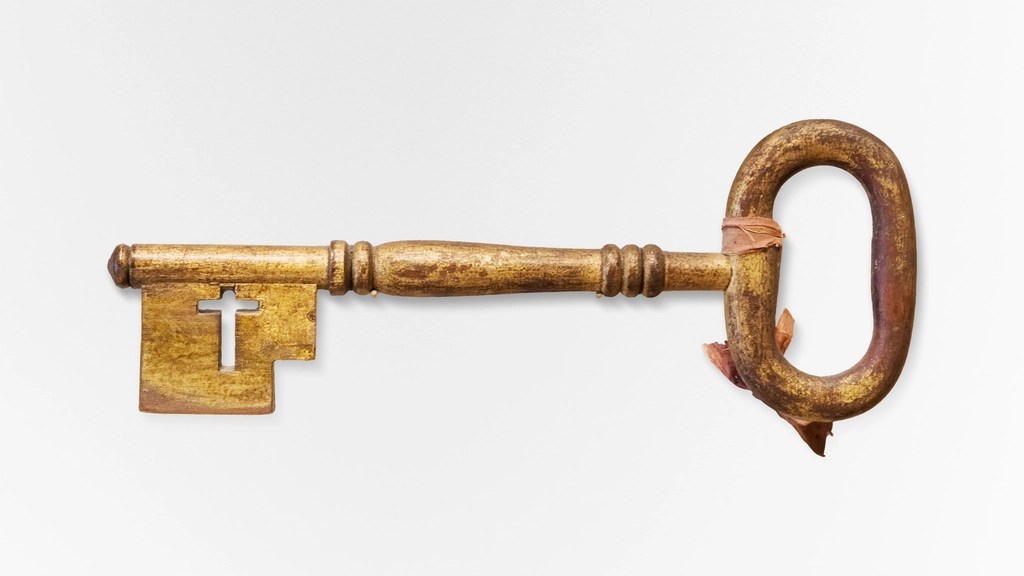

This symbolism can be further extended by showing that enacting correct patterns is analogous to turning a key, thus unlocking blessings or even passage into the Kingdom of Heaven. Hence all keys of the Gospel taken together provide a pattern of living that is referred to as the Gospel of Jesus Christ—when you are living the Gospel, you are living after a certain pattern. Living the “first principles” of the Gospel means abiding the pattern that leads to salvation; living the “fulness” of the Gospel means abiding the pattern that leads to exaltation.
The first reference to a key as a symbol of authority appears in Isaiah, wherein a Messianic prophecy states: “And the key of the house of David will I lay upon his shoulder; so he shall open, and none shall shut; and he shall shut, and none shall open” (Isa. 22:22). This reference sets the stage for every other reference by the Lord to “keys” in a symbolic sense as it invoked every symbolic aspect of the function and purpose of keys anciently:
- ‘Upon his shoulder‘:
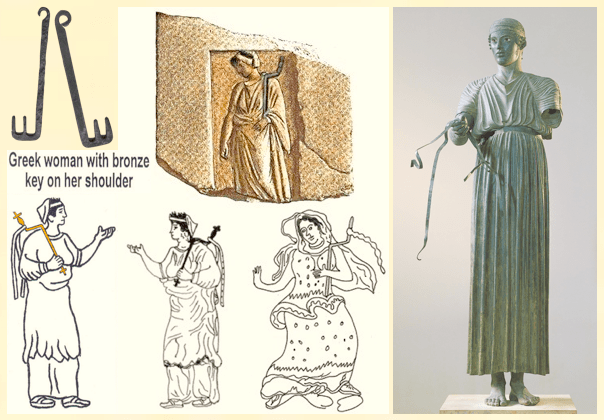
- Anciently, keys were large devices that were carried upon the shoulder as a visible token of trust by the house owner.
- ‘He shall open…he shall shut‘:
- Besides being large, keys used to double as door knobs so that only the key holder could even attempt to open a closed door. Furthermore, unlike modern locks that can be toggled from either side of a door, ancient locks had to be accessed only from the inside. This meant that either the door was opened from the inside, as someone on the inside would be assumed to be authoritative, or the key holder would have to reach his key and arm into the inside of the door through a small hole made for this purpose.
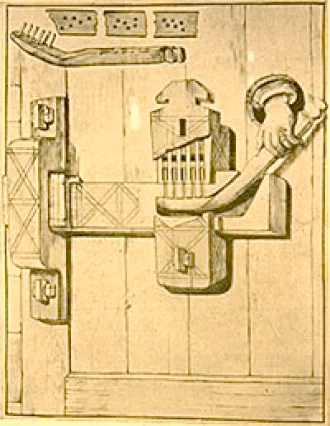
As it is said in the Song of Solomon, referencing this type of opening near the lock:
“My lover thrust his hand through the latch-opening; my heart began to pound for him. I arose to open for my beloved, and my hands dripped with myrrh, my fingers with flowing myrrh, on the handles of the bolt. I opened for my beloved, but my beloved had left” (Song 5:4 – 6).
Keys anciently, as well as modernly, relied on protruding bits (literally called “bits”) that enabled them to fit into the corresponding slots and grooves within a lock so that all the necessary pins in the locking mechanism could be toggled. These bits taken as a whole formed a correct pattern, meaning that a key with the wrong pattern of bits could not open the lock.
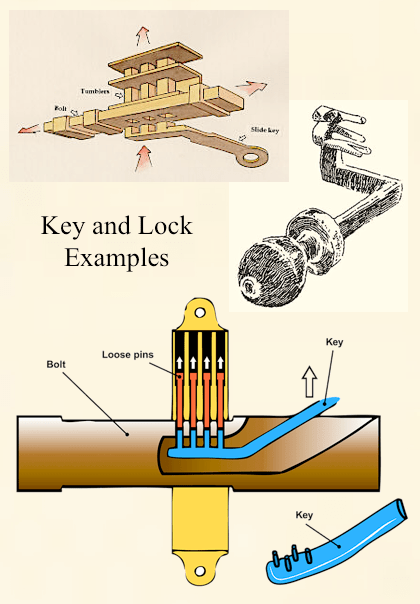
In the Gospel of Jesus Christ, there are many keys, or patterns of action, that unlock many different blessings; as the Lord told Joseph Smith, “I, the Lord, am bound when ye do what I say” (D&C 82:10). Some keys operate independent of any need for a legal administrator. These are actions, such as faith in Christ, that may be undertaken without the authorization of some other person ordained to that function; other keys, however, require a legal administrator to function, such as baptism. These are what we would term “priesthood keys.”
In the case of priesthood keys, the bits symbolize key actions and conditions that must be met or else the Celestial Kingdom cannot be entered. For example, Jesus spoke on the requirement of baptism as being one of these conditions: “Jesus answered, Verily, verily, I say unto thee, Except a man be born of water and of the Spirit, he cannot enter into the kingdom of God” (John 3:5, emphasis added). This stringent pattern of action becomes then one of the ‘bits’ in the key to seeing ‘the Kingdom of God.’
Owing to this, most Christians practice some form of baptismal ordinance, but the nature of that ordinance among differing sects varies wildly and often excludes any sort of baptism of spirit ordinance wherein the gift of the Holy Ghost is conferred. Jesus, however, had reference to a specific form of baptismal ordinance with water and with spirit, and anything straying from that form or pattern would be ‘the wrong pattern of bits,’ or the wrong key, and would not allow admittance to heaven. As Joseph Smith said:
“You might as well baptize a bag of sand as a man, if not done in view of the remission of sins and getting of the Holy Ghost. Baptism by water is but half a baptism, and is good for nothing without the other half—that is, the baptism of the Holy Ghost” (STPJS, 314).
Jesus furthermore attested to another bit in the priesthood key to heaven when he insisted on being baptized by John the Baptist instead of anyone else. Why? Because the person doing the baptizing must first have been ordained as a legal administrator of that ordinance:
“The Savior said unto John, I must be baptized by you. Why so? To fulfil [sic] all righteousness. John refuses at first, but afterwards obeyed by administering the ordinance of baptism unto him, Jesus having no other legal administrator to apply to. There is no salvation between the two lids of the Bible without a legal administrator. Jesus was then the legal administrator, and ordained His Apostles” (STPJS, 319).
Though the first principles and ordinances of the Gospel start with “Faith in the Lord Jesus Christ” (Articles of Faith 1:4), the first bit of the priesthood key of the Gospel has to be a proper bestowal of authority:
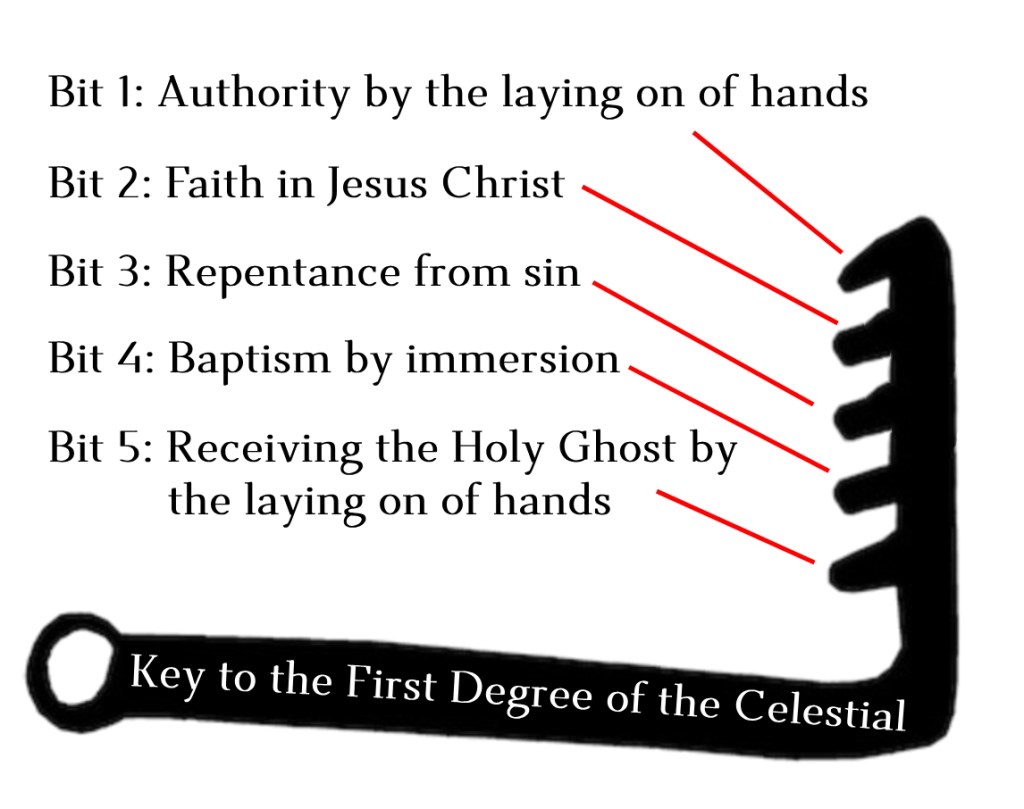
This explains why Joseph Smith told John Taylor that anyone having ‘even the first principles of the Gospel of Christ correctly…[is] a sign that they have some portion of the Holy Priesthood.’ It is because the first principles must necessarily have included a proper chain of ordination through the generations of time. This answers the first question posed above: the motions alone are enough to constitute priesthood authority if the first motion is ordination to the priesthood by the laying on of hands.
This pattern of authorization to act in behalf of the King of Heaven as a legal administrator by the laying on of hands is referred to as coming in ‘at the gate’ as the Lord referred to Joseph Smith as having done in his day:
“O hearken, ye elders of my church, and give ear to the words which I shall speak unto you. For behold, verily, verily, I say unto you, that ye have received a commandment for a law unto my church, through him whom I have appointed unto you to receive commandments and revelations from my hand.
“And this ye shall know assuredly—that there is none other appointed unto you to receive commandments and revelations until he be taken, if he abide in me. But verily, verily, I say unto you, that none else shall be appointed unto this gift except it be through him; for if it be taken from him he shall not have power except to appoint another in his stead.
“And this shall be a law unto you, that ye receive not the teachings of any that shall come before you as revelations or commandments; and this I give unto you that you may not be deceived, that you may know they are not of me. For verily I say unto you, that he that is ordained of me shall come in at the gate and be ordained as I have told you before, to teach those revelations which you have received and shall receive through him whom I have appointed” (D&C 43:1 – 7).1
Nothing in this pronouncement from the Lord would invalidate the possibility that other peoples, descended through righteous priesthood lines in history, could concurrently have ‘the first principles of the Gospel of Christ correctly’ and who then did not require preaching to or baptism. In fact, scripturally there have been times when multiple concurrent lines of priesthood authority existed that separately held the requisite keys to be recognized by God.
Abraham and Esaias
In the days of Moses, Israel had lived in bondage to Egyptians for a number of generations but they came into the land bearing the priesthood. There is no mention in the Biblical narrative of the Israelites losing their priesthood or even proper reverence for God. Rather, the Israelites are portrayed as God fearing even at the time of Moses’ birth, as the account of the midwives who strategically lied for God shows:
“The king of Egypt said to the Hebrew midwives, whose names were Shiphrah and Puah, ‘When you are helping the Hebrew women during childbirth on the delivery stool, if you see that the baby is a boy, kill him; but if it is a girl, let her live.’ The midwives, however, feared God and did not do what the king of Egypt had told them to do; they let the boys live. Then the king of Egypt summoned the midwives and asked them, ‘Why have you done this? Why have you let the boys live?’
“The midwives answered Pharaoh, ‘Hebrew women are not like Egyptian women; they are vigorous and give birth before the midwives arrive.’
“So God was kind to the midwives and the people increased and became even more numerous. And because the midwives feared God, he gave them families of their own” (Exo 1:15 – 21, NIV).
Moreover, when God tells Moses to go back to Israel, it is not to reprove them for their backsliding from him during their bondage to Egypt, but instead the opposite (the ‘backsliding’ came later):
“The children of Israel sighed by reason of the bondage, and they cried, and their cry came up unto God by reason of the bondage. And God heard their groaning, and God remembered his covenant with Abraham, with Isaac, and with Jacob. And God looked upon the children of Israel, and God had respect unto them” (Exo. 2:23 – 25).
Despite this, Moses did not receive the priesthood from Israel. Modern revelation shows that he was ordained under the hands of his father-in-law, a Midianite:
“The Holy Priesthood…[Moses] received under the hand of his father-in-law, Jethro; and Jethro received it under the hand of Caleb; and Caleb received it under the hand of Elihu; and Elihu under the hand of Jeremy; and Jeremy under the hand of Gad; and Gad under the hand of Esaias; and Esaias received it under the hand of God.
“Esaias also lived in the days of Abraham, and was blessed of him—which Abraham received the priesthood from Melchizedek, who received it through the lineage of his fathers, even till Noah; and from Noah till Enoch, through the lineage of their fathers; and from Enoch to Abel, who was slain by the conspiracy of his brother, who received the priesthood by the commandments of God, by the hand of his father Adam, who was the first man—which priesthood continueth in the church of God in all generations, and is without beginning of days or end of years” (D&C 84:6 – 17).
These verses are notable for they show that Moses’ ordination is traced up to a contemporary of Abraham—not Abraham himself—which contemporary was visited directly by God and was not ordained by Melchizedek nor beholden to Abraham for direction (though Abraham clearly endorsed this man). This bifurcation of two separate peoples—the Esaiasites on one hand, and the Abrahamites on the other—accomplished a marvelous thing in the days of Moses wherein God did not need to send angels to ordain Moses since the fulness of the priesthood had been preserved by a separate people several generations earlier.2 Apparently, at the time of Israel’s departure into Egypt at which time Jacob blessed the brothers Ephraim and Manasseh, there were individuals such as Jeremy, Elihu, and Gad who lived in a completely different place separate from any of Jacob’s descendants whom God recognized as having the keys of the Gospel, including ordination to perform ordinances.
An Unchangeable [Pattern]
Tying this example back to the principle laid out by John Taylor at the start of this essay, had Moses been sent to preach to the people of Midian he would have found no need to do so, their possessing the first principles and ordinances correctly—including conferral of authority—being a sign of their possession of some portion of the priesthood. In other words, Moses would have found that the Midianites had the correct pattern in place, or to use the symbol, they possessed a priesthood key.
Taking the converse as a hypothetical, had the Midianites altered the pattern in any place it would have constituted the sign that they did not anymore possess the same priesthood, the original key having been malformed by the people—or, seen from a different perspective, taken away by God—leaving the people unable to fully unlock the heavens. This was the case with the people of Zarahemla when the Nephites discovered them after the passage of several centuries; they had forgotten the true patterns, or keys, of the Gospel:
“Behold, it came to pass that Mosiah discovered that the people of Zarahemla came out from Jerusalem at the time that Zedekiah, king of Judah, was carried away captive into Babylon…. And their language had become corrupted; and they had brought no records with them; and they denied the being of their Creator” (Omni 1:15, 17).
The people of Zarahemla lost the keys of the priesthood probably not all at once, as they were ostensibly forewarned to leave Jerusalem like Lehi, but instead over time as they forgot the principles and ordinances they had once possessed. Despite being able to trace their genealogy back to Jerusalem, they had modified their keys literally one “bit” at a time until the very idea of a key was foreign to them; the Nephites, on the other hand, successfully maintained their keys despite also having split from the Jerusalem church at the same time.
According to the Prophet Joseph Smith, the altering of even one bit in the keys constitutes the altering of the associated priesthood:
“If a man gets a fullness of the priesthood of God he has to get it in the same way that Jesus Christ obtained it, and that was by keeping all the commandments and obeying all the ordinances of the house of the Lord. Where there is no change of priesthood, there is no change of ordinances, says Paul” (STPJS, 308).

The passage from Hebrews to which the prophet Joseph is referring reinforces the point: “[Jesus] hath an unchangeable priesthood” (Heb. 7:24, emphasis added). That Christ’s ‘unchangeable priesthood’ is directly equivalent to an unchangeable pattern of actions and living—which constitutes the fulness of his Gospel—can be demonstrated by the fact that priesthoods are described, in the scriptures, as themselves holding keys! If we imagine up keys to be some literal thing that is given to a person abstract of any actions taken in life, the following scriptural language would be very mysterious indeed:
“Upon you my fellow servants, in the name of Messiah I confer the Priesthood of Aaron, which holds the keys of the ministering of angels, and of the gospel of repentance, and of baptism by immersion for the remission of sins; and this shall never be taken again from the earth, until the sons of Levi do offer again an offering unto the Lord in righteousness” (D&C 13:1).
“This greater [Melchizedek] priesthood administereth the gospel and holdeth the key of the mysteries of the kingdom, even the key of the knowledge of God. Therefore, in the ordinances thereof, the power of godliness is manifest. And without the ordinances thereof, and the authority of the priesthood, the power of godliness is not manifest unto men in the flesh; for without this no man can see the face of God, even the Father, and live….
“And the lesser [Aaronic] priesthood…holdeth the key of the ministering of angels and the preparatory gospel; which gospel is the gospel of repentance and of baptism, and the remission of sins, and the law of carnal commandments” (D&C 84:19 – 22, 26 – 27).
In fact, these verses read very plainly if the word “pattern(s)” is substituted for the word “key(s)”:
“Upon you my fellow servants, in the name of Messiah I confer the Priesthood of Aaron, which holds the [patterns] of the ministering of angels, and of the gospel of repentance, and of baptism by immersion for the remission of sins; and this shall never be taken again from the earth, until the sons of Levi do offer again an offering unto the Lord in righteousness” (D&C 13:1).
“This greater [Melchizedek] priesthood administereth the gospel and holdeth the [pattern] of the mysteries of the kingdom, even the [pattern] of the knowledge of God. Therefore, in the ordinances thereof, the power of godliness is manifest. And without the ordinances thereof, and the authority of the priesthood, the power of godliness is not manifest unto men in the flesh; for without this no man can see the face of God, even the Father, and live….
“And the lesser [Aaronic] priesthood…holdeth the [pattern] of the ministering of angels and the preparatory gospel; which gospel is the gospel of repentance and of baptism, and the remission of sins, and the law of carnal commandments” (D&C 84:19 – 22, 26 – 27).
How else could an abstraction like the priesthood (meaning that it is not a physical or spiritual substance) ‘hold’ another thing unless that other thing was also an abstraction? This clearly shows that priesthood keys are not themselves things to be handed out and handled, even in the context of spirit matter, but rather they are a concept, specifically the concept of certain patterns of actions beginning with proper ordination.
Since ordinances are some of those patterned actions, the above verses specifically confirm this hypothesis when they say, ‘in the ordinances thereof, the power of godliness is manifest’! This is because the priesthood holds the pattern that leads to ‘the knowledge of God.’ Of course, as has been stated, the first bit in any priesthood key is the laying on of hands to denote the authorized person, and hence the verse conversely notes, ‘without the ordinances thereof, and the authority of the priesthood, the power of godliness is not manifest unto men in the flesh.’
For verses such as these, simply doing as demonstrated above and substituting the word ‘pattern(s)’ in place of ‘key(s)’ makes the point clear; in other places, however, the Lord also talks of individuals being “given” or “holding” keys, which would seem to imply that a person can in fact possess some real spiritual thing called a key. But the above simple test of substituting the word ‘keys’ with ‘patterns’ can be adapted to all such instances in scripture by using the phrase “knowledge of patterns” instead to show that what the Lord really bestows on someone when he bestows keys on a person is knowledge of a pattern, which pattern unlocks certain blessings of heaven (see Appendix A: Every Verse).
In fact, the Prophet Joseph in his discourses often spoke of giving the saints “keys” as he taught them about certain actions that would lead to predicated outcomes. Examples include:
“I will inform you that it is contrary to the economy of God for any member of the Church, or any one, to receive instructions for those in authority, higher than themselves; therefore you will see the impropriety of giving heed to them; but if any person have a vision or a visitation from a heavenly messenger, it must be for his own benefit and instruction; for the fundamental principles, government, and doctrine of the Church are vested in the keys of the kingdom [pattern of actions pertaining to the kingdom—hierarchy of revelation, in this case]” (STPJS 21).
“Repentance is a thing that cannot be trifled with every day. Daily transgression and daily repentance is not that which is pleasing in the sight of God. Baptism is a holy ordinance preparatory to the reception of the Holy Ghost; it is the channel and key [pattern of action] by which the Holy Ghost will be administered. The Gift of the Holy Ghost by the laying on of hands, cannot be received through the medium of any other principle than the principle of righteousness, for if the proposals [pattern of action] are not complied with, it is of no use, but withdraws” (Ibid., 148).
“I will give you one of the Keys of the mysteries of the Kingdom. It is an eternal principle [consisting of the following actions], that has existed with God from all eternity: That man who rises up to condemn others, finding fault with the Church, saying that they are out of the way, while he himself is righteous, then know assuredly, that that man is in the high road to apostasy; and if he does not repent, will apostatize, as God lives” (Ibid., 156 – 157).
Keys & the Church
Now that we have unlocked the concept of what a priesthood key really is, it will be easier to answer the second question posed at the top of this essay regarding how keys could possibly operate outside the organized church. We might be tempted to think it would be as easy as seeing whether or not someone was a member of the church in good standing, but this is specifically not what Joseph Smith had in mind when he gave instruction to John Taylor as a departing missionary. To understand how this could be, we must first comprehend the primacy of priesthood in relation to the formation of the church.
If we trace the history of the founding of the Church of Jesus Christ of Latter-day Saints back to its inception, we will find that the Lord caused first the priesthood to be restored by heavenly messengers (as the keys of the priesthood were no longer on the earth) and then, being duly authorized, the priesthood holders organized the church:
- May 15th, 1829: John the Baptist bestows the Aaronic priesthood to Joseph Smith and Oliver Cowdery
- Circa May 31st, 1829: Peter, James, and John bestow the Melchizedek Priesthood to Joseph Smith and Oliver Cowdery
- April 6th, 1830: Joseph Smith and Oliver Cowdery, the “first” and “second” “ordained” elders of this dispensation, organize the church (see D&C 20:1 – 3).
There are verses that even show that the keys of the kingdom were given for the purpose of establishing the church:
“We obtained of him [Jesus Christ] the following, by the spirit of prophecy and revelation; which not only gave us much information, but also pointed out to us the precise day upon which, according to his will and commandment, we should proceed to organize his Church once more here upon the earth:
“The rise of the Church of Christ in these last days, being one thousand eight hundred and thirty years since the coming of our Lord and Savior Jesus Christ in the flesh, it being regularly organized and established agreeable to the laws of our country, by the will and commandments of God, in the fourth month, and on the sixth day of the month which is called April—which commandments were given to Joseph Smith, Jun., who was called of God, and ordained an apostle of Jesus Christ, to be the first elder of this church” (D&C 20 introduction and verses 1 – 2).
Seeing then that the priesthood organized the church, and that it was not the church that organized the priesthood, it’s easier to comprehend how that John Taylor was told to watch for those who might not be in the church and yet ‘have some portion of the Holy Priesthood.’
Let us now take John Taylor’s example and apply it to a modern setting, as if we were Moses stumbling upon Jethro, the priest of Midian, in a modern sense: if we knew the pattern or keys for ourselves, we could test his validity in being the Melchizedek Priesthood by seeing whether he truly possessed all the keys necessary to enable one to “see the face of God, even the Father, and live” (D&C 84:22). Or taking John Taylor’s example more directly, if someone was called to serve a mission somewhere and they came across a people who were not in the church but who yet had the first principles of the Gospel correctly—namely, a man claiming to have been ordained in a chain of authority back to a recognized legal administrator of the kingdom, who was baptizing by immersion and confirming people who had faith in Christ and repented of their sins—would they have to be re-baptized and re-taught the Gospel? According to Joseph Smith, the answer is no—for their actions would constitute a sign that they indeed possessed the keys of some part of the priesthood!
In conclusion, we can now fully comprehend the truth of John Taylor’s statements. How do you know if someone possesses the keys of some part or another of the priesthood or not? If it’s not by their membership in the church, what is it? It’s simply by their possessing the correct pattern—for that is all that keys are.
Footnotes
- Of course per Alma 12:9 – 10, the above revelation does not preclude any man from being given ‘commandments and revelations’ from God personally, but in Joseph Smith’s day he was the only one appointed to do so in behalf of the whole church. (See also Classic Truth: Darkened in their Minds.)↩︎
- “The angel told good old Cornelius that he must send for Peter to learn how to be saved: Peter could baptize, and angels could not, so long as there were legal officers in the flesh holding the keys of the kingdom, or the authority of the priesthood. There is one evidence still further on this point, and that is that Jesus himself when he appeared to Paul on his way to Damascus, did not inform him how he could be saved. He had set in the church first Apostles, and secondly prophets, for the work of the ministry, perfecting of the saints, etc.; and as the grand rule of heaven was that nothing should ever be done on earth without revealing the secret to his servants the prophets, agreeably to Amos 3:7, so Paul could not learn so much from the Lord relative to his duty in the common salvation of man, as he could from one of Christ’s ambassadors called with the same heavenly calling of the Lord, and endowed with the same power from on high—so that what they loosed on earth, should be loosed in heaven; and what they bound on earth should be bound in heaven” (STPJS, 265).↩︎
Appendix A: Every Verse
The word “key” shows up 76 times in scriptures: twice in the Old Testament, six times in the New Testament, once in the Book of Mormon, once in the Pearl of Great Price (if you include the facsimile footnotes), and a whopping 65 times in the Doctrine and Covenants.
Of those 76 times, two instances literally referenced a physical key and 74 referenced keys as a symbol of something else. What that ‘something else’ is can only be ascertained by individual scrutiny in the written revelations from God. What follows is a breakdown of each of those 76 instances:
| Scripture Ref. | Verse Content | Key as Pattern |
|---|---|---|
| Judg. 3:25 | And they tarried till they were ashamed: and, behold, he opened not the doors of the parlour; therefore they took a key [literally a key], and opened them: and, behold, their lord was fallen down dead on the earth. | This is one of two literal references to a key |
| Isa. 22:22 | And the key of the house of David will I lay upon his shoulder; so he shall open, and none shall shut; and he shall shut, and none shall open. | Pattern of actions performed by the priest-kings of Israel |
| New Testament | ||
| Matt. 16:19 | And I will give unto thee the keys of the kingdom of heaven: and whatsoever thou shalt bind on earth shall be bound in heaven: and whatsoever thou shalt loose on earth shall be loosed in heaven. | Patterns of actions legally recognized in heaven |
| Luke 11:52 | Woe unto you, lawyers! for ye have taken away the key of knowledge: ye entered not in yourselves, and them that were entering in ye hindered. | Pattern whereby the heavens are opened. (Note that the layman had them and were ‘entering in’ for themselves.) |
| Rev. 1:18 | I am he that liveth, and was dead; and, behold, I am alive for evermore, Amen; and have the keys of hell and of death. | Pattern of actions that grant Jesus ultimate power over souls |
| Rev. 3:7 | And to the angel of the church in Philadelphia write; These things saith he that is holy, he that is true, he that hath the key of David, he that openeth, and no man shutteth; and shutteth, and no man openeth; | Pattern of actions performed by the priest-kings of Israel |
| Rev. 9:1 | And the fifth angel sounded, and I saw a star fall from heaven unto the earth: and to him was given the key of the bottomless pit. | Pattern of actions (possibly just ordination) to initiate certain calamities |
| Rev. 20:1 | And I saw an angel come down from heaven, having the key of the bottomless pit and a great chain in his hand. | Same as above |
| Book of Mormon | ||
| 1 Ne. 4:20 | And after I had done this, I went forth unto the treasury of Laban. And as I went forth towards the treasury of Laban, behold, I saw the servant of Laban who had the keys of the treasury. And I commanded him in the voice of Laban, that he should go with me into the treasury. | This is one of two literal references to a key |
| Doctrine and Covenants | ||
| D&C 6:25, 28 | And, behold, I grant unto you a gift, if you desire of me, to translate, even as my servant Joseph…. And now, behold, I give unto you, and also unto my servant Joseph, the keys of this gift, which shall bring to light this ministry; and in the mouth of two or three witnesses shall every word be established. | Knowledge of the pattern of actions necessary to translate (see D&C 9) |
| D&C 7:7 | And I will make thee to minister for him and for thy brother James; and unto you three I will give this power and the keys of this ministry until I come. | Knowledge of the pattern of actions legally pertaining to ministering the fulness of the Gospel in the latter days |
| D&C 13:1 | Upon you my fellow servants, in the name of Messiah I confer the Priesthood of Aaron, which holds the keys of the ministering of angels, and of the gospel of repentance, and of baptism by immersion for the remission of sins; and this shall never be taken again from the earth, until the sons of Levi do offer again an offering unto the Lord in righteousness. | Pattern of actions necessary to receive the ministering of angels and salvation |
| D&C 27:5 | Behold, this is wisdom in me; wherefore, marvel not, for the hour cometh that I will drink of the fruit of the vine with you on the earth, and with Moroni, whom I have sent unto you to reveal the Book of Mormon, containing the fulness of my everlasting gospel, to whom I have committed the keys of the record of the stick of Ephraim; | Knowledge of the pattern of actions to be taken with the coming forth of the Book of Mormon |
| D&C 27:6 | And also with Elias, to whom I have committed the keys of bringing to pass the restoration of all things spoken by the mouth of all the holy prophets since the world began, concerning the last days; | Knowledge of the pattern of actions to be taken in restoring all things in the latter days |
| D&C 27:9 | And also Elijah, unto whom I have committed the keys of the power of turning the hearts of the fathers to the children, and the hearts of the children to the fathers, that the whole earth may not be smitten with a curse; | Knowledge of the pattern of actions to be taken to restore the new and everlasting covenant as it was in the beginning |
| D&C 27:12 – 13 | And also with Peter, and James, and John, whom I have sent unto you, by whom I have ordained you and confirmed you to be apostles, and especial witnesses of my name, and bear the keys of your ministry and of the same things which I revealed unto them; Unto whom I have committed the keys of my kingdom, and a dispensation of the gospel for the last times; and for the fulness of times, in the which I will gather together in one all things, both which are in heaven, and which are on earth…. | Same as D&C 7:7 |
| D&C 28:7 | For I have given him the keys of the mysteries, and the revelations which are sealed, until I shall appoint unto them another in his stead. | Knowledge of the pattern of actions, including hierarchy in the church, to receive revelation binding for the whole church (individuals may obtain mysteries for themselves) |
| D&C 35:18 | And I have given unto him the keys of the mystery of those things which have been sealed, even things which were from the foundation of the world, and the things which shall come from this time until the time of my coming, if he abide in me, and if not, another will I plant in his stead. | Same as above |
| D&C 35:25 | And Israel shall be saved in mine own due time; and by the keys which I have given shall they be led, and no more be confounded at all. | Pattern of actions pertaining to the manner in which Israel will be gathered |
| D&C 42:69 | Lift up your hearts and rejoice, for unto you the kingdom, or in other words, the keys of the church have been given. Even so. Amen. | Pattern of actions to be undertaken by the church to produce the kingdom of God |
| D&C 64:5 | And the keys of the mysteries of the kingdom shall not be taken from my servant Joseph Smith, Jun., through the means I have appointed, while he liveth, inasmuch as he obeyeth mine ordinances. | Same as D&C 28:7 |
| D&C 65:2 | The keys of the kingdom of God are committed unto man on the earth, and from thence shall the gospel roll forth unto the ends of the earth, as the stone which is cut out of the mountain without hands shall roll forth, until it has filled the whole earth. | Same as D&C 42:69 |
| D&C 68:17 – 18 | For the firstborn holds the right of the presidency over this priesthood, and the keys or authority of the same. No man has a legal right to this office, to hold the keys of this priesthood, except he be a literal descendant and the firstborn of Aaron. | Pattern of actions beginning with ordination belongs first to the eldest literal descendant of Aaron, pertaining to the presidency of the Aaronic Priesthood |
| D&C 78:16 | Who hath appointed Michael your prince, and established his feet, and set him upon high, and given unto him the keys of salvation under the counsel and direction of the Holy One, who is without beginning of days or end of life. | Pattern of actions pertaining to salvation belong to Michael who operates according to the archetypal Church of the Firstborn |
| D&C 81:2 | Unto whom I have given the keys of the kingdom, which belong always unto the Presidency of the High Priesthood: | Same as D&C 42:69 |
| D&C 84:19 | And this greater priesthood administereth the gospel and holdeth the key of the mysteries of the kingdom, even the key of the knowledge of God. | Pattern of actions to be undertaken to open the heavens and receive revelation |
| D&C 84:26 | And the lesser priesthood continued, which priesthood holdeth the key of the ministering of angels and the preparatory gospel; | Same as D&C 13:1 |
| D&C 90:2 | Therefore, thou art blessed from henceforth that bear the keys of the kingdom given unto you; which kingdom is coming forth for the last time. | Same as D&C 42:69 |
| D&C 90:3 | Verily I say unto you, the keys of this kingdom shall never be taken from you, while thou art in the world, neither in the world to come; | Same as above |
| D&C 90:6 | And again, verily I say unto thy brethren, Sidney Rigdon and Frederick G. Williams, their sins are forgiven them also, and they are accounted as equal with thee in holding the keys of this last kingdom; | Same as above |
| D&C 90:7 | As also through your administration the keys of the school of the prophets, which I have commanded to be organized; | Knowledge of the pattern of actions pertaining to the school of the prophets |
| D&C 97:14 | That they may be perfected in the understanding of their ministry, in theory, in principle, and in doctrine, in all things pertaining to the kingdom of God on the earth, the keys of which kingdom have been conferred upon you. | Same as D&C 42:69 |
| D&C 107:15 | The bishopric is the presidency of this priesthood, and holds the keys or authority of the same. | Same as D&C 68:17 – 18 |
| D&C 107:16 | No man has a legal right to this office, to hold the keys of this priesthood, except he be a literal descendant of Aaron. | Same as above |
| D&C 107:18 | The power and authority of the higher, or Melchizedek Priesthood, is to hold the keys of all the spiritual blessings of the church— | Pattern of actions pertaining to spiritual blessings |
| D&C 107:20 | The power and authority of the lesser, or Aaronic Priesthood, is to hold the keys of the ministering of angels, and to administer in outward ordinances, the letter of the gospel, the baptism of repentance for the remission of sins, agreeable to the covenants and commandments. | Same as D&C 13:1 |
| D&C 107:35 | The Twelve being sent out, holding the keys, to open the door by the proclamation of the gospel of Jesus Christ, and first unto the Gentiles and then unto the Jews. | Same as D&C 42:69 |
| D&C 107:70 – 71 | For unless he is a literal descendant of Aaron he cannot hold the keys of that priesthood. Nevertheless, a high priest, that is, after the order of Melchizedek, may be set apart unto the ministering of temporal things, having a knowledge of them by the Spirit of truth. | Same as D&C 68:17 – 18 (Note: this knowledge can also come to a high priest by revelation) |
| D&C 107:76 | But a literal descendant of Aaron has a legal right to the presidency of this priesthood, to the keys of this ministry, to act in the office of bishop independently, without counselors, except in a case where a President of the High Priesthood, after the order of Melchizedek, is tried, to sit as a judge in Israel. | Same as above |
| D&C 110:11 | After this vision closed, the heavens were again opened unto us; and Moses appeared before us, and committed unto us the keys of the gathering of Israel from the four parts of the earth, and the leading of the ten tribes from the land of the north. | Same as D&C 35:25 |
| D&C 110:16 | Therefore, the keys of this dispensation are committed into your hands; and by this ye may know that the great and dreadful day of the Lord is near, even at the doors. | Same as D&C 42:69 |
| D&C 112:15 | Exalt not yourselves; rebel not against my servant Joseph; for verily I say unto you, I am with him, and my hand shall be over him; and the keys which I have given unto him, and also to youward, shall not be taken from him till I come. | Same as D&C 42:69 |
| D&C 112:16 | Verily I say unto you, my servant Thomas, thou art the man whom I have chosen to hold the keys of my kingdom, as pertaining to the Twelve, abroad among all nations— | Same as above |
| D&C 112:32 | For verily I say unto you, the keys of the dispensation, which ye have received, have come down from the fathers, and last of all, being sent down from heaven unto you. | Same as D&C 110:16 |
| D&C 113:6 | Behold, thus saith the Lord, it is a descendant of Jesse, as well as of Joseph, unto whom rightly belongs the priesthood, and the keys of the kingdom, for an ensign, and for the gathering of my people in the last days. | Same as D&C 42:69 |
| D&C 115:19 | For behold, I will be with him, and I will sanctify him before the people; for unto him have I given the keys of this kingdom and ministry. Even so. Amen. | Same as D&C 42:69 |
| D&C 124:28 – 34 | For there is not a place [a temple] found on earth that [the Most High] may come to and restore again that which was lost unto you, or which he hath taken away, even the fulness of the priesthood…. For therein are the keys of the holy priesthood ordained, that you may receive honor and glory. | Pattern of actions pertaining to the temple |
| D&C 124:91 – 92 | …My servant Hyrum may take the office of Priesthood and Patriarch, which was appointed unto him by his father, by blessing and also by right. That from henceforth he shall hold the keys of the patriarchal blessings upon the heads of all my people…. | Knowledge of the pattern of actions pertaining to obtaining revelation for patriarchal blessings |
| D&C 124:94 – 95 | And from this time forth I appoint unto [Hyrum] that he may be a prophet, and a seer, and a revelator unto my church, as well as my servant Joseph; that he may act in concert also with my servant Joseph; and that he shall receive counsel from my servant Joseph, who shall show unto him the keys whereby he may ask and receive, and be crowned with the same blessing, and glory, and honor, and priesthood, and gifts of the priesthood, that once were put upon him that was my servant Oliver Cowdery. | Knowledge of the pattern of actions pertaining to receiving special blessings Note: Joseph is described as being able to ‘show’ the keys inasmuch as they are a demonstrable pattern of actions. |
| D&C 124:97 | Let my servant William Law also receive the keys by which he may ask and receive blessings; let him be humble before me, and be without guile, and he shall receive of my Spirit, even the Comforter, which shall manifest unto him the truth of all things, and shall give him, in the very hour, what he shall say. | Same as above |
| D&C 124:123 | Verily I say unto you, I now give unto you the officers belonging to my Priesthood, that ye may hold the keys thereof, even the Priesthood which is after the order of Melchizedek, which is after the order of mine Only Begotten Son. | Knowledge of the pattern of actions pertaining to the Melchizedek Priesthood |
| D&C 124:128 | Which Twelve hold the keys to open up the authority of my kingdom upon the four corners of the earth, and after that to send my word to every creature. | Same as D&C 110:11 |
| D&C 124:143 | The above offices I have given unto you, and the keys thereof, for helps and for governments, for the work of the ministry and the perfecting of my saints. | Same as D&C 124:123 |
| D&C 128:10 | And again, for the precedent, Matthew 16:18, 19: And I say also unto thee, That thou art Peter, and upon this rock I will build my church; and the gates of hell shall not prevail against it. And I will give unto thee the keys of the kingdom of heaven: and whatsoever thou shalt bind on earth shall be bound in heaven; and whatsoever thou shalt loose on earth shall be loosed in heaven. | Same as Matt. 16:19 (above) |
| D&C 128:11 | Now the great and grand secret of the whole matter, and the summum bonum of the whole subject that is lying before us, consists in obtaining the powers of the Holy Priesthood. For him to whom these keys are given there is no difficulty in obtaining a knowledge of facts in relation to the salvation of the children of men, both as well for the dead as for the living. | Same as D&C 124:95 |
| D&C 128:14 | This, therefore, is the sealing and binding power, and, in one sense of the word, the keys of the kingdom, which consist in the key of knowledge. | Same as Matt. 16:19 |
| D&C 128:18 | For it is necessary in the ushering in of the dispensation of the fulness of times, which dispensation is now beginning to usher in, that a whole and complete and perfect union, and welding together of dispensations, and keys, and powers, and glories should take place, and be revealed from the days of Adam even to the present time. And not only this, but those things which never have been revealed from the foundation of the world, but have been kept hid from the wise and prudent, shall be revealed unto babes and … | Same as above |
| D&C 128:20 | The voice of Peter, James, and John in the wilderness between Harmony, Susquehanna county, and Colesville, Broome county, on the Susquehanna river, declaring themselves as possessing the keys of the kingdom, and of the dispensation of the fulness of … | Same as D&C 42:69 |
| D&C 128:21 | The voice of Gabriel, and of Raphael, and of divers angels, from Michael or Adam down to the present time, all declaring their dispensation, their rights, their keys, their honors, their majesty and glory, and the power of their priesthood; giving line upon line, precept upon precept; here a little, and there a little; giving us consolation by holding forth that which is to come, confirming our … | Knowledge of a pattern of actions for which a given individual has the responsibility for communicating to men on earth when being restored |
| D&C 129:9 | These are three grand keys whereby you may know whether any administration is from God. | Patterns of actions pertaining to detecting true heavenly messengers from false |
| D&C 130:11 | And a white stone is given to each of those who come into the celestial kingdom, whereon is a new name written, which no man knoweth save he that receiveth it. The new name is the key word. | One element of a greater pattern of actions pertaining to obtaining knowledge of higher kingdoms |
| D&C 132:7 | Too most holy, by revelation and commandment through the medium of mine anointed, whom I have appointed on the earth to hold this power (and I have appointed unto my servant Joseph to hold this power in the last days, and there is never but one on the earth at a time on whom this power and the keys of this priesthood are conferred), are of no efficacy, virtue, or force in and after the resurrection from the dead; for all contracts that are not made unto this end have an end when men are … | Knowledge of the pattern of actions pertaining to eternal marriage bestowed from heaven as part of the restoration |
| D&C 132:19 | If a man marry a wife by my word, which is my law, and by the new and everlasting covenant, and it is sealed unto them by the Holy Spirit of promise, by him who is anointed, unto whom I have appointed this power and the keys of this priesthood; and it shall be said unto them—Ye shall come forth in the first resurrection; and if it be after the first resurrection, in the next resurrection; and shall inherit thrones, kingdoms, principalities, and powers, dominions, all heights and depths…. | Knowledge of the pattern of actions pertaining to eternal marriage |
| D&C 132:39 | David’s wives and concubines were given unto him of me, by the hand of Nathan, my servant, and others of the prophets who had the keys of this power; and in none of these things did he sin against me save in the case of Uriah and his wife; and, therefore he hath fallen from his exaltation, and received his portion; and he shall not inherit them out of the world, for I gave them unto another, saith the Lord. | Same as above |
| D&C 132:45 | For I have conferred upon you the keys and power of the priesthood, wherein I restore all things, and make known unto you all things in due time. | Same as above |
| D&C 132:59 | Verily, if a man be called of my Father, as was Aaron, by mine own voice, and by the voice of him that sent me, and I have endowed him with the keys of the power of this priesthood, if he do anything in my name, and according to my law and by my word, he will not commit sin, and I will justify him. | Same as above |
| D&C 132:64 | And again, verily, verily, I say unto you, if any man have a wife, who holds the keys of this power, and he teaches unto her the law of my priesthood, as pertaining to these things, then shall she believe and administer unto him, or she shall be destroyed, saith the Lord your God; for I will destroy her; for I will magnify my name upon all those who receive and abide in my law. | Same as above |
 Home | The Science of Theology